$900 Billion Ad Market to Be Remade by AI Agents, Blockchain Micropayments
Summary
- Panelists said AI agents are emerging as a new class of consumers, reshaping advertising and marketing and shifting the center of that transformation toward blockchain infrastructure.
- Yat Siu said traditional advertising is losing effectiveness, while a micropayment model based on agent-to-agent transactions and small-value settlement on blockchain networks is set to spread.
- The panel said AI agents are likely to serve as gatekeepers in repeat purchases and B2B procurement, accelerating market growth as more consumer decisions become automated.
Forecast Trend Report by Period


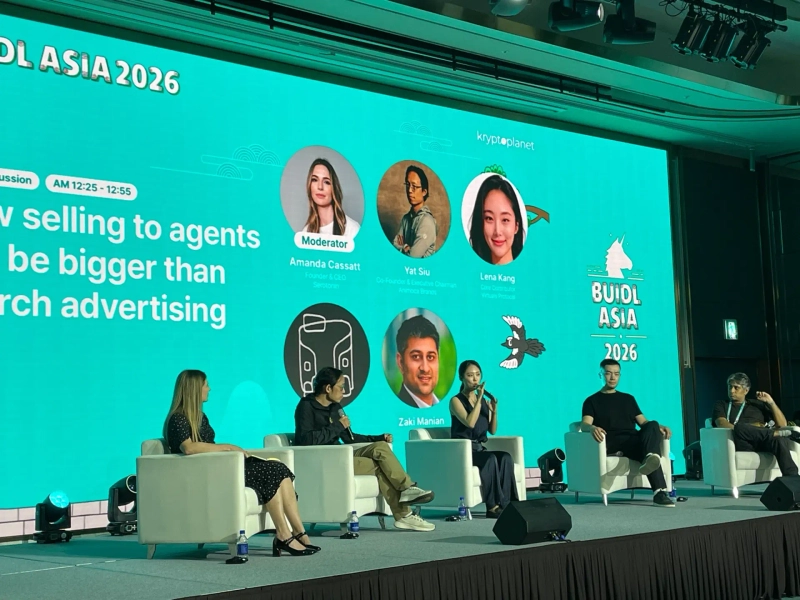
Web3 industry executives said AI agents are emerging as a new class of consumers, setting up a fundamental overhaul of advertising and marketing with blockchain infrastructure at the center of that shift.
That theme dominated a panel discussion at BUIDL Asia 2026, held June 16 at Sofitel Ambassador Seoul. Participants included Animoca Brands co-founder Yat Siu, Virtuals Protocol lead Rena Kang and IREN co-founder Zaki Manian.
Panelists said the main base of buyers is expanding from humans to AI agents. If website design and copy once mattered most, API stability and the quality of structured data are becoming more important, Kang said. She added that a shift from search engine optimization, or SEO, to agent optimization, or AO, is unavoidable.
The speakers also outlined changes in marketing strategy. Instead of click-through rates, they said, a concept akin to "AI validation" is becoming more important, measuring how much an AI trusts and selects a product. Data architecture and API design that agents can access are emerging as key competitive strengths, rather than website interfaces.
They also forecast a deeper shift in advertising. Traditional advertising was designed to capture human attention, but the market is moving toward an environment where agents execute transactions directly, the panel said. Conventional advertising will gradually lose its utility and give way to a micropayment model based on agent-to-agent transactions, Siu said. Websites will connect directly with agents through APIs, while transactions will be settled in small increments on blockchain networks.
The panel said branding strategies will also have to change. "A brand ultimately means trust," Siu said. AI agents, too, will choose counterparties they view as trustworthy. Because agents can carry out far more transactions than humans, competition to build trust in purchase decisions will intensify, he added.
Kang proposed a "dual branding" strategy that accounts for both humans and agents. Storytelling and emotional appeal for human users still matter. At the same time, companies need policies, data structures and API designs that agents can interpret, she said.
The discussion also turned to e-commerce. Panelists said AI agents are likely to spread quickly in repeat purchases and B2B procurement, where they could take on a gatekeeper role in major transaction flows. As agents increasingly search for and select products on behalf of users, a large share of consumption decisions could become automated.
Manian said the biggest constraint at present is not the technology itself, but a lack of understanding about how agents can be used. Once more people recognize that agents are not simple chatbots but autonomous actors that can execute tasks on their own, market growth will accelerate, he said.

Minseung Kang
minriver@bloomingbit.ioBlockchain journalist | Writer of Trade Now & Altcoin Now, must-read content for investors.