PiCK
Bitcoin Ceasefire Rally Fades as Iran Talk Uncertainty Puts $78,000 in Focus
Summary
- Bitcoin has entered a key battleground, with its short-term direction hinging on whether it can hold the $78,000 level.
- Institutional money continues to post net inflows through spot Bitcoin ETFs, but upside remains limited by short-term holders’ profit-taking and geopolitical risks.
- Technically, a cup-and-handle pattern points to potential upside beyond the $80,000 level, but the market is at a pivotal point where a break of key support could trigger broader downside volatility.
Forecast Trend Report by Period



Bitcoin’s rebound on hopes for an end to hostilities between the US and Iran lost steam as uncertainty over negotiations resurfaced, leaving the token searching for direction. Whether Bitcoin can hold support around $78,000 may determine its near-term path.
As of 8:45 a.m. on April 24, Bitcoin traded at $78,245 on Binance’s USDT market, down about 0.05% from a day earlier. On Upbit, it changed hands at 116.42 million won. The kimchi premium, a gauge of the price gap between domestic and offshore exchanges, stood at 0.27%.
Trump Keeps Pressure on Iran as Talks Remain Unclear; Stocks Extend Gains
Global financial markets were mixed as geopolitical tensions in the Middle East persisted and uncertainty around negotiations lingered. US stocks extended gains on ceasefire hopes, with the Nasdaq closing at a record high, though some investors have cautioned that the recent rally has been driven more by optimism than fundamentals.
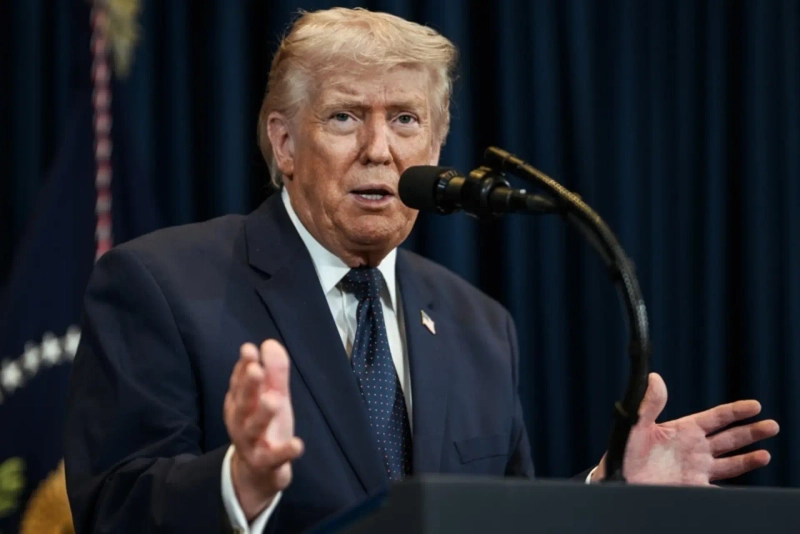
Fox News reported on April 23 that President Donald Trump was maintaining maritime pressure on Iran despite the ceasefire extension as he pushed for leverage in negotiations. Iran has responded by escalating shows of force, including ship seizures in the Strait of Hormuz. Both sides have signaled a willingness to negotiate, but differences over lifting the maritime blockade have left the chances of a diplomatic breakthrough murky.
Trump has also indicated there will be no separate deadline for negotiations, signaling a prolonged standoff. Tensions in the Strait of Hormuz have intensified as attacks on ships and seizures continue amid a struggle over control. Iran is also moving to tighten its hold over the waterway, including by advancing legislation to collect transit fees. Geopolitical risks, in other words, have not materially eased.
At the same time, reports of possible short-term progress in negotiations have kept hopes alive. The New York Post said a positive outcome could come as early as April 24. There are also signs of easing tensions between Israel and Lebanon. Trump wrote on Truth Social that the ceasefire between Israel and Lebanon would be extended by three weeks. Tensions across the Middle East remain elevated, but the extension has reduced the immediate risk of a broader clash.
On monetary policy, investors remain in wait-and-see mode as differences over the policy path come into sharper focus. Kevin Warsh, a candidate to lead the Federal Reserve, stressed central bank independence during a recent hearing. Trump, by contrast, has repeatedly called for lower interest rates, adding pressure for an easier stance. Those conflicting signals are adding to uncertainty over the Fed’s path.
CME FedWatch showed markets pricing a 99.5% probability that the Federal Open Market Committee will leave rates unchanged in April. The odds of a hold in June and July were 95.8% and 91.7%, respectively, suggesting the pause could continue in the near term. The probability of no rate cut by year-end stood at 74.8%.
Bitcoin Inflows Improve, but Short-Term Selling Caps Upside
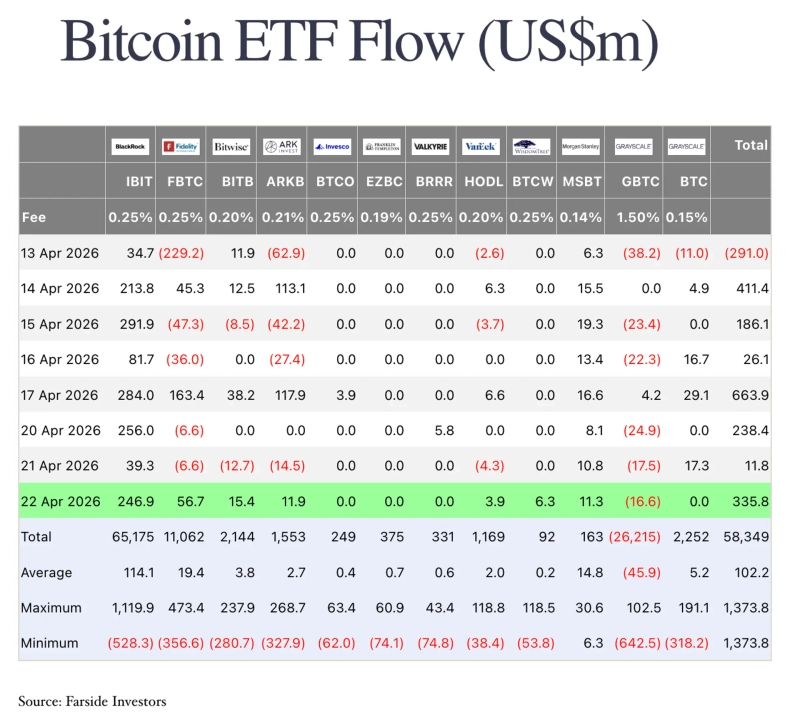
Bitcoin has seen some improvement in fund flows as ceasefire hopes prompted renewed inflows, but profit-taking near the top of the range is limiting upside. Spot Bitcoin exchange-traded funds recorded $996.5 million of net inflows last week, signaling renewed institutional demand. Flows have remained positive since then, raising expectations for further improvement in supply-demand conditions.
Medium-term positioning remains relatively firm, Bitfinex said in a weekly report published on April 22. Structural demand is still absorbing supply as exchange balances fall and whale investors continue accumulating, the exchange said. ETF flows have also turned net positive for the year, pointing to a gradual recovery in institutional demand. In the short term, however, geopolitical risks and derivatives-market positioning could amplify downside volatility. Over the medium term, accumulation by long-term holders may help support the market’s floor.
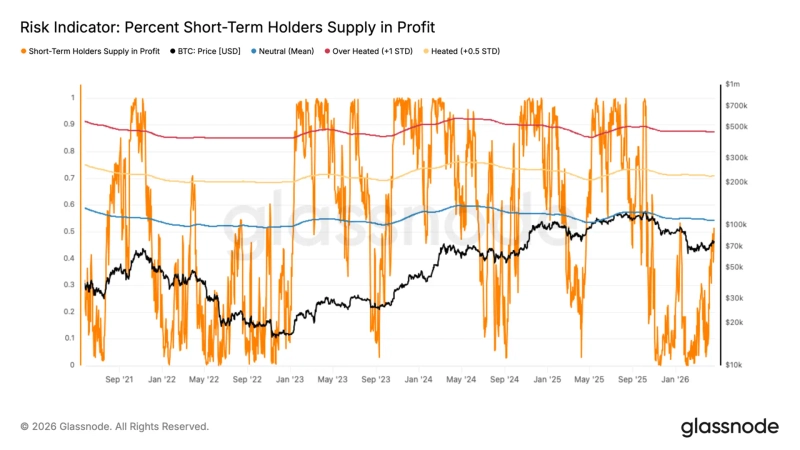
In the near term, selling pressure is building as Bitcoin runs into resistance. Glassnode said Bitcoin is attempting a structural rebound, but strong selling may emerge near the average cost basis of short-term holders at $80,100. As prices approach breakeven levels, the incentive to lock in profits is increasing. Realized gains among short-term holders have risen, and patterns associated with local tops are reappearing. Spot demand has recovered somewhat, but not enough to absorb the supply. The decline in volatility also reflects a broader wait-and-see mood and weak conviction across the market.
The recent rebound looks more like a short-term relief rally than a structural trend reversal, according to QCP Capital. The Singapore-based crypto trading firm said Bitcoin’s recovery appears closer to an easing in risk aversion than a conviction-driven advance. Open interest has started to rise again while funding rates remain negative, indicating the market is still tilted toward short positions. As long as oil prices stay high and monetary policy uncertainty persists, upside for risk assets may remain limited. Markets are likely to keep pricing uncertainty rather than a clear directional view.
Bitcoin Faces Key Test at $78,000
Bitcoin has entered a critical battleground around $78,000 during its rebound. Holding that level could open the door to further gains, while a break below it could intensify correction pressure.
Alex Kuptsikevich, chief analyst at FxPro, said Bitcoin pulled back into the $78,000 range after briefly breaking above $79,000. The $75,000 to $86,000 range faces relatively light resistance, but stronger correlation with traditional financial markets is capping short-term momentum. While Bitcoin is moving sideways, altcoins are broadly under pressure, highlighting increasing divergence within the market.
In the short term, bulls are still trying to extend the advance. Aayush Jindal, a researcher at NewsBTC, said Bitcoin is maintaining an uptrend above $77,500. A break above resistance at $78,500 could clear the way for a move to $79,200 to $79,500, and potentially to $80,000. If the breakout fails, support in the $77,000 range could give way and trigger a pullback toward $75,000.
If Bitcoin holds the $78,000 line, the bullish case could remain intact. But if that key support fails, downside volatility could accelerate, making the current range a decisive inflection point. Rakesh Upadhyay, an analyst at Cointelegraph, said a move above $78,333 would suggest buyers are regaining the upper hand. If that level holds, Bitcoin could have room to rise to $84,000. A break below the 20-day moving average, around $78,457, would invalidate the bullish scenario and increase downside pressure.
Some technical signs of a rebound are emerging, but uncertainty across broader markets is keeping bullish expectations in check. Katie Stockton, founder of Fairlead Strategies, said a cup-and-handle pattern is forming in Bitcoin, a structure that points to further upside. She added that the pattern still needs to be completed and confirmed by a breakout. For now, the market remains in a contested range, and it is too early to call a confirmed uptrend.
Kang Min-seung, Bloomingbit reporter minriver@bloomingbit.io

Minseung Kang
minriver@bloomingbit.ioBlockchain journalist | Writer of Trade Now & Altcoin Now, must-read content for investors.