South Korea Stock Market Value Tops 6,000 Trillion Won for First Time as Kospi Breaks 6,600
Summary
- South Korea’s stock market capitalization topped 6,000 trillion won for the first time, while the Kospi broke above 6,600, swelling to 2.76 times its level from a little more than a year earlier.
- The rally was led by semiconductor shares, with Samsung Electronics and SK Hynix surging and accounting for a substantial share of the domestic market’s value.
- The market is balancing expectations for improved chip-industry conditions driven by expanding AI demand against caution over index pressure, as the recent surge and the rise in the VKOSPI volatility index point to growing strain.
Forecast Trend Report by Period


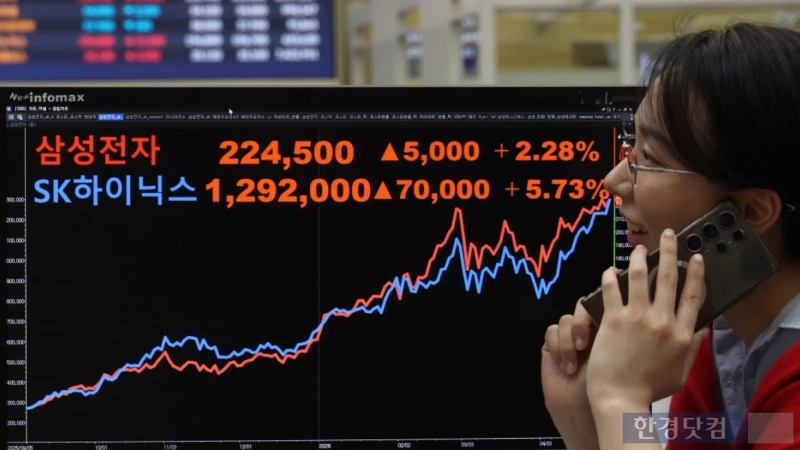
South Korea’s stock market extended its record-setting rally on April 27, with total market capitalization topping 6,000 trillion won ($4.49 trillion) for the first time. The Kospi closed above 6,600 for the first time, while the Kosdaq also advanced, lifting the combined value of the two markets to 2.76 times its level from a little more than a year earlier.
The Kospi rose 139.40 points, or 2.15%, to 6,615.03, according to Korea Exchange data. The benchmark opened 0.90% higher at 6,533.60 and widened its gains through the session, reaching as high as 6,657.22. The Kosdaq climbed 22.34 points, or 1.86%, to close at 1,226.18.
Combined market capitalization stood at 6,101.994 trillion won ($4.49 trillion) as of April 27. The Kospi accounted for 5,421.5542 trillion won ($3.99 trillion), while the Kosdaq made up 679.5452 trillion won ($500.2 billion). On April 9, 2025, the market low point cited in the report, the Kospi stood at 2,293.70. At that time, market capitalization was 1,880.1727 trillion won ($1.38 trillion) on the main board and 329.8537 trillion won ($242.8 billion) on the Kosdaq, for a combined 2,210.0264 trillion won ($1.63 trillion).
The market’s expansion has accelerated. South Korean equities surpassed 3,000 trillion won ($2.21 trillion) in total market value on July 10, 2025, then crossed 4,000 trillion won ($2.94 trillion) on Jan. 2, 2026, and 5,000 trillion won ($3.68 trillion) on Feb. 11, 2026. CompaniesMarketCap, a US website that tracks corporate valuations, estimated the market capitalization of South Korea’s major companies at $3.258 trillion on April 27, ranking the country eighth among major economies.
Semiconductor stocks led the advance. Samsung Electronics rose 2.28% to close at 224,500 won, while SK Hynix jumped 5.73% to 1.292 million won. SK Hynix rose as high as 1.317 million won during the session, topping 1.3 million won for the first time. The gains mirrored strength in US technology and semiconductor shares in the last New York trading session of the previous week.
The market’s concentration in chip stocks also intensified. The combined market capitalization of Samsung Electronics, Samsung Electronics preferred shares and SK Hynix reached about 2,361.7606 trillion won ($1.74 trillion), accounting for 43.6% of the Kospi and 38.7% of South Korea’s overall stock market. Expectations for improving semiconductor industry conditions, driven by expanding artificial intelligence demand, have underpinned the rally. At the same time, investors are watching for heavier pressure on the indexes if the chip cycle weakens.
Hur Jae-hwan, an analyst at Eugene Investment & Securities, said the Philadelphia Semiconductor Index has climbed 38.5% in April alone. He pointed to past sharp surges in February 2000, November 1996 and January 2001. “It is already too hot to call this the early stage of the current boom,” he said. “At the same time, I’m not comfortable comparing it with the 2000 bubble.” He added that the current environment is comparable to 2020-2021, when post-pandemic demand for non-face-to-face services surged, but said the present cycle is stronger in terms of structural industrial change.
Signs of strain from the recent run-up are also showing up in volatility gauges. The VKOSPI, the Kospi 200 volatility index, fell as low as 46.54 intraday on April 14, 2026, but has since turned higher. It rose as high as 55.60 on April 27 before closing up 2.60% at 54.95.
Oh Se-seong, Hankyung.com reporter sesung@hankyung.com

Korea Economic Daily
hankyung@bloomingbit.ioThe Korea Economic Daily Global is a digital media where latest news on Korean companies, industries, and financial markets.