Korbit Research Center Publishes Report on Blockchain Revenue Models in Traditional Finance
Summary
- Korbit Research Center said it had released a report on blockchain revenue models in traditional finance.
- The report said the financial industry's revenue structure is being reshaped around tokenization and crypto, with key revenue sources including issuance fees, assets-under-management fees, and trading and clearing fees.
- Research fellow Kang Dong-hyun said major South Korean financial firms have entered a stage of preparing blockchain-based products as legislation on the Digital Asset Basic Act nears enactment.
Forecast Trend Report by Period


Korbit Research Center, the research arm of South Korean cryptocurrency exchange Korbit, released a report on April 28 titled "Blockchain Revenue Models in Traditional Finance."
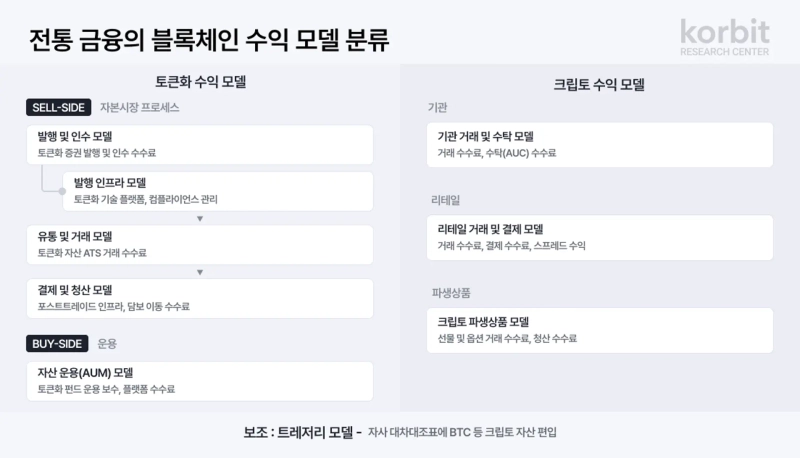
The report says the financial industry's revenue structure is being reshaped around tokenization and crypto. It divides blockchain-based revenue models into two broad categories: tokenization and crypto. Tokenization generates revenue by converting real-world assets into digital assets on blockchain networks, while crypto models earn revenue from digital-asset trading, custody and settlement. Key revenue sources include issuance fees, assets-under-management fees, and trading and clearing fees, mirroring the structure of traditional capital markets.
Korbit Research Center said large financial institutions with established client bases and regulatory infrastructure stand to hold a competitive advantage in the tokenization market. Citing BlackRock and JPMorgan, it said a large customer base is a key driver of monetization.
The report also pointed to Nasdaq's approval of rule changes for trading tokenized securities in March 2026, as well as investment in OKX by the New York Stock Exchange and its parent, Intercontinental Exchange. It identified the entry of traditional exchanges into the market as a key factor that could reshape secondary-market liquidity.
The report also emphasized that the success of tokenization revenue models will hinge on how well they align with investor demand. Institutional investors are focused on operational efficiency, including real-time settlement and more efficient collateral transfers. High-net-worth individuals, by contrast, are more interested in broader access to private markets through fractional ownership.
Kang Dong-hyun, a research fellow at Korbit Research Center, said major South Korean financial firms have entered the stage of preparing blockchain-based products as legislation on the Digital Asset Basic Act nears enactment. He added that he hopes the report, which systematically organizes leading overseas cases, will serve as a practical reference for the South Korean financial industry in designing new business areas.

Suehyeon Lee
shlee@bloomingbit.ioI'm reporter Suehyeon Lee, your Web3 Moderator.