

Ethereum is weaker than Bitcoin... Can it rebound next year? [Hankyung Column]
Summary
- After Donald Trump's victory in the presidential election, the price of virtual assets like Bitcoin has risen significantly.
- There is high expectation about whether Trump's participation in the Ethereum ecosystem will provide new opportunities.
- By 2024, the volatility of Bitcoin's price is expected to be large, and regulatory changes could become a major variable in the asset market.
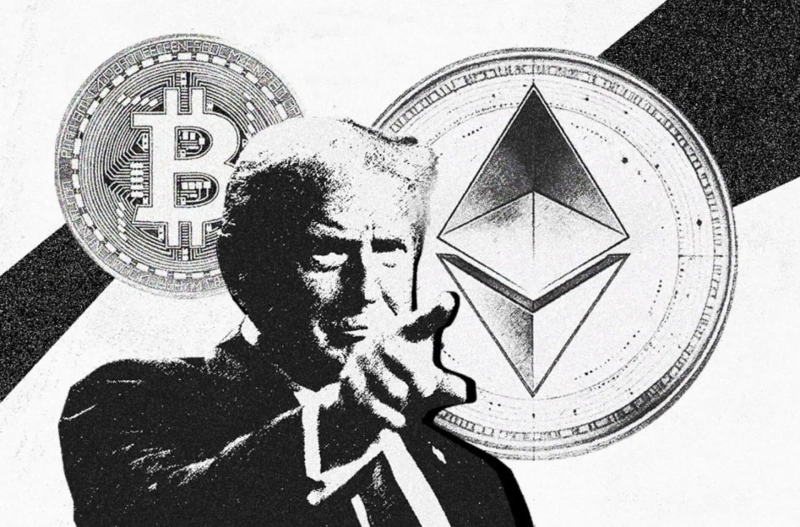
Virtual Asset Market Booms After Trump's Election
In the 2024 U.S. presidential election, as the candidate Trump wins, the price of virtual assets, including Bitcoin, is significantly rising. As of December 3, the price of Bitcoin is fluctuating around 95,000 dollars, aiming for 100,000 dollars. Trump's promise to deregulate virtual assets has reduced market uncertainty, gathering investors' expectations, and this has led to a strengthening of the entire virtual asset market, not just Bitcoin.
A notable point in this boom is that the previously underperforming Ethereum is also showing explosive growth. After Trump's election, the price of Ethereum rose about 50%, reaching 3,600 dollars. The reason Ethereum can be spotlighted after Trump's election is what expectations exist, and what kind of anticipation is there? Ethereum, which had not performed as well as Bitcoin, may show a different aspect in 2025, and several points are being considered.
Trump is also a participant in the Ethereum ecosystem
Trump is not merely a political figure expressing interest in virtual assets, but is noted as the first U.S. president to directly participate in the Ethereum ecosystem. First, in December 2022, Trump launched the NFT project Trump Digital Trading Cards, making a full-fledged entry into the Ethereum ecosystem. The first NFT collection sold out 44,000 pieces in just a week, recording about 4.5 million dollars in revenue, and subsequent NFT collections launched on Ethereum also consistently attracted attention and achieved significant sales results.
Moreover, Trump recently announced the DeFi project "World Liberty Financial (WLF)", further strengthening his position in the Ethereum ecosystem. WLF provides services that allow users to anticipate and replace collateral using Ethereum-based platforms. WLF's governance token WLFI was designed to allow users to participate in protocol direction voting, but it was also criticized for being known to receive up to 75% of project revenue as Trump's family. Although there were many challenges in the operational part, it is seen that Trump’s family would have gained many insights from the fact that they even participated in the project.
Trump's such actions are not merely political declarations supporting Ethereum, but are considered active attempts to understand the actual ecosystem and expand its influence. The possibility that the U.S. can perform a central role beyond the president himself in the Ethereum ecosystem is expected to be strategically approached. The Ethereum ecosystem is expected to attract attention after Trump's election as a starting point.
Expecting a boost with the completion of staking regulation
Ethereum has been embroiled in controversy over whether staking services will be classified as securities after changing the consensus mechanism to proof-of-stake (PoS). In March 2023, SEC Chairman Gary Gensler argued that all tokens with staking consensus mechanisms have securities characteristics and should be under SEC management supervision. The SEC has focused on regulating services related to staking, imposing significant pressure on Ethereum-based projects, and in fact, only approved Ethereum's spot ETF excluding staking services last July. In a situation where staking is excluded, when inflation occurs in Ethereum, the token value is diluted. In this regard, Ethereum spot ETFs show limited supply compared to Bitcoin spot ETFs.
However, after Trump's election, Ethereum has a greater possibility of meeting new opportunities. Trump promised to appoint Gary Gensler, SEC Chairman, as a special advisor with the presidential pledge. Although Gary Gensler's appointment does not directly resolve the securities issue, there is a sense of intention to remove a representative figure who had oppressed the virtual asset market. It can also be expected that the SEC's basic changes will be anticipated. Also, Trump has promised to present a clear regulatory guideline that is different from the ambiguous stance he has taken so far with the SEC. Structurally, if Ethereum spot ETF staking is recognized, it is expected that the fundamental will be greatly strengthened along with the increase in Ethereum ETF demand.
What opportunities are there in the Ethereum ecosystem?
The DeFi market has not been free from regulatory constraints. The SEC pointed out that DeFi projects could potentially violate U.S. securities laws due to unregistered securities sales, investment contract establishment, and unregistered exchange operation. Such regulatory pressure has dampened DeFi's growth potential while raising questions about the legal stability of projects for investors.
A representative case is Uniswap, the largest decentralized exchange (DEX) in Ethereum, which was under the spotlight of regulation with the SEC's investigation in 2021 and the Wells Notice issued in 2024. The SEC raised issues about the securities nature of the UNI token and the possibility of Uniswap protocol functioning as an unregistered securities exchange. As the news spread, the UNI token dropped about -40%, clearly showing the impact of regulation on the token market. Uniswap Labs countered the SEC's claim by stating, "Uniswap is open-source software that anyone can use, and the UNI token has no relationship as an investment contract, and the token value does not depend on Uniswap Labs' efforts," but the SEC's persistent pressure left uncertainty not only on Uniswap but on the entire DeFi ecosystem.
However, as the expectation that regulatory uncertainty will be reduced strengthens, DeFi projects are actively utilizing the Fee Switch mechanism, which shares a portion of the revenue with token holders, to strengthen token utility. Most DEXs distribute trading fees only to liquidity providers (LPs), and token holders do not properly share the profit distribution. In this regard, it is difficult to evaluate the fundamental of token holders based on trading and net profit. However, if the Fee Switch is introduced, as it shares revenue with token holders, it is expected to provide a clearer basis for evaluating the fundamental of DeFi projects. Also, this is expected to play a pivotal role in building a self-sustaining economic structure of the protocol and increasing the intrinsic value of tokens.
In fact, after Trump's election, on November 7, the major U.S. market maker Wintermute proposed the introduction of Fee Switch in the governance forum of the stablecoin Ethena. This proposal aimed to strengthen the fundamental by distributing a portion of the protocol revenue to ENA token holders. After the proposal, the ENA token price rose more than 50%, drawing a positive market reaction. This is a representative case showing that DeFi projects are actively moving to strengthen the fundamental in anticipation of regulatory completion.
Layer2 Ecosystem
The development of Layer 2 technologies such as EIP-4844 upgrade, ZK-Rollup, and OP-Rollup is solving the scalability issue of the Ethereum network and rapidly expanding the ecosystem. Especially, rollup technology utilizes Ethereum as a data availability layer, reducing transaction processing costs and increasing speed. As a result, Layer2 has become able to accommodate more users and transactions, rapidly expanding the ecosystem based on such technological advancement. In fact, the number of transactions occurring in Layer2 over the past year has increased by more than 700%.
Such growth of the Layer 2 ecosystem has filled the gap for services that were difficult to implement on the existing Ethereum mainnet. Representatively, the social protocol Potcaster, based on Base chain, was launched, gaining attention, and the AI-based content creation platform Bubbler also gained great popularity. Due to the launch of such services, the Base chain rapidly grew. The TVL of the Base chain has recently increased by more than 1,000% over the past year, recording $3.9B, and the number of daily transactions increased by 2,800%, recording more than 6.8M transactions. This shows that opportunities and possibilities continue to arise in the Layer 2 ecosystem.
However, the limitation that Layer 2 native token utility insufficiency and Layer 2 expansion do not lead to the increase in Ethereum token value remains a constraint. While looking at the temporary opportunities of the Layer 2 ecosystem, it is necessary to recognize such limitations and strategically approach them.
Liquid Staking
Liquid staking, which solves the liquidity problem of staking and addresses mobility issues, is the largest sector in the Ethereum ecosystem. As of 2024, liquid staking services account for about 30% of Ethereum TVL (Total Value Locked), recording about $36B in value.
Liquid staking also faced scrutiny from the SEC regarding securities issues, temporarily risking. The SEC mentioned the possibility that liquid staking services could fall under investment contracts, and regulatory discussions are ongoing based on the Howey Test. Such risks have acted as one of the major factors hindering the profitability expansion of liquid staking platforms under regulatory uncertainty.
However, if temporary regulatory risks are resolved, liquid staking projects are expected to have greater growth potential than any other project. Lido, the largest liquid staking project, is one of the few projects that consistently records high profits excluding the mainnet. Lido's recent annual revenue amounts to about $100M. Even if only 1% of the annual revenue is distributed to holders, about $1M is distributed to holders. This will provide direct value to Lido's token holders and will be an important opportunity to strengthen the platform's fundamental.
Ethereum Preparing to Break Through Constraints and Leap Forward
The boom in the virtual asset market brought by Trump's election in 2024 is not limited to Bitcoin alone, but also opens new possibilities and opportunities in the Ethereum ecosystem. Trump's promise to deregulate virtual assets reduces the regulatory uncertainty that Ethereum-based projects faced, and is preparing the foundation for strengthening the fundamental. Such environmental changes act as an important moment when new innovations and growth are expected in the Ethereum ecosystem.
The completion of staking regulation is reigniting activity in sectors such as DeFi and liquid staking, and the development of rollup technology is accelerating the expansion of the Layer 2 ecosystem. Especially, various projects within the Ethereum ecosystem are seizing opportunities following regulatory completion, building new revenue models, or showing movements to solve existing problems. For example, the introduction of Fee Switch by Ethena and Lido provides direct value to token holders and promotes continuous growth of the ecosystem.
However, before discussing the bright future of Ethereum, several constraints must be recognized. The fact that Layer 2 expansion does not directly lead to the increase in Ethereum native token value, and the utility insufficiency issue of L2 native tokens remain constraints that the Ethereum ecosystem must resolve. To overcome such constraints, it is necessary to continuously discuss solutions such as expanding block space and improving fee models.
Ultimately, the Ethereum ecosystem is expected to continue to evolve based on the opportunities provided by the technological advancements and new regulatory environment it has shown so far. The movements triggered in various sectors of Ethereum, from DeFi, liquid staking, and rollup-based services, are expected to further strengthen Ethereum's position in the global virtual asset market. The simple declaration that "Ethereum's spring is coming" is not just a statement, but an important signal that guides the current market trends and future.

Korea Economic Daily
hankyung@bloomingbit.ioThe Korea Economic Daily Global is a digital media where latest news on Korean companies, industries, and financial markets.