

Trump's Reset... The Global 'Economic Map' is Changing
Summary
- The Economist predicted that the election of President Trump could lead to trade and currency wars.
- Investment and competition in AI and defense tech sectors are expected to continue, with companies anticipating productivity improvements.
- By 2025, a return to the low-interest era is expected, along with a continued decline in major commodity prices.
The Economist's 'World Outlook'
Intensifying 'Trade, Currency, and Semiconductor Wars'
Most Dangerous State Since the Cold War
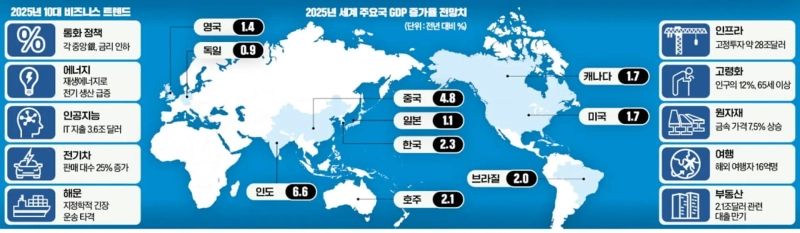
By 2025, the global economic, defense, immigration, and trade systems will be reset. This is because Donald Trump, the U.S. President-elect, is expected to aggressively pursue America-first and protectionist policies upon taking office in January next year. There are also predictions that a 'currency war' will erupt as countries around the world, including China, devalue their currencies in response to the U.S.'s 'tariff bomb'.
The British weekly magazine The Economist predicted in its publication <2025 World Outlook> on the 5th that “when the Trump administration's second term begins early next year, the world will be in the most dangerous state since the Cold War.” This book, exclusively published in Korea by Hankyung, contains deep insights from the world's top experts, including scholars, politicians, and CEOs, who participated as contributors to The Economist.
The U.S. is expected to fiercely engage in a new Cold War with China. There is a possibility of bringing a large number of Taiwan's semiconductor production facilities into the U.S. to curb China's 'semiconductor rise' and support Trump's 'MAGA' (Make America Great Again) policy. In this process, the 'semiconductor war' with China is expected to intensify.
Other countries besides China are also predicted to be swept into the vortex of trade and currency wars next year. If the Chinese government devalues the yuan to mitigate the tariff shock on its manufacturers, other countries are likely to devalue their currencies to maintain price competitiveness.
Return of the Low-Interest Era... Rise of 'Defense Tech' Following Nuclear Competition
'Agentic AI' Achieving Goals on Its Own Boosts Corporate Productivity
'AI on Trial', 'Return to the Low-Interest Era', 'Third Nuclear Age'... These are the key themes for next year presented in The Economist's <2025 World Outlook> published on the 5th. The Economist predicted that it will be determined next year whether the AI investment, called the largest bet in corporate history, will end in a bubble or lead to substantial results. It also predicted that as the war against inflation concludes, the low-interest era of the 2010s will return, and the U.S., China, and Russia will compete over nuclear weapon stockpiles.
○ Rise of 'Defense Tech' Utilizing AI and Drones
The Economist forecasted that the 'AI frenzy' that has swept through the investment industry and companies could be put to the test next year. Global AI data center spending from 2024 to 2027 will exceed $1.4 trillion (about 1,980 trillion won). The market capitalization of Nvidia, a leading AI chip company, which has tripled since the beginning of the year, shows the enthusiastic demand from investors for AI.
In reality, the use of AI in corporate sites is falling short of expectations. According to the U.S. Census Bureau, only about 5% of companies responded that they could utilize AI. Only 7% of companies said they plan to introduce AI within a few months.
This contrasts with the fact that one-third of American workers and 78% of software engineers reported using AI at least once a week in their work. There is an analysis that actual employees are using AI to increase productivity but are hiding it to avoid increased workloads or reduced workforce. The Economist diagnosed that corporate culture, as much as technology, will be the key to AI adoption.
The emergence of 'Agentic AI Systems' is evaluated as an important turning point to accelerate AI adoption. Agentic AI systems, which autonomously act to achieve goals, are expected to be widely used in corporate activities such as supply chain optimization and identifying cybersecurity vulnerabilities.
In the defense industry, 'Defense Tech' using AI and drones is emerging as a hot topic. The importance of low-cost, high-efficiency weapons such as drones has been highlighted through the Russia-Ukraine war, and governments and large defense companies are strengthening cooperation with defense startups.
○ Pessimistic Major Commodity Markets
The global economy is expected to enter a full-fledged low-interest era as inflation calms down. Major central banks, including the U.S. Federal Reserve, the European Central Bank, and the Bank of England, began a cycle of lowering benchmark interest rates last year, and the extent is expected to be greater next year. Although sporadic risk factors such as supply chain crises remain, The Economist predicted that the ultra-low interest rate era that continued throughout the 2010s will return.
The outlook for major commodity markets remains pessimistic for next year, following this year. Oil prices are expected to fall as non-Middle Eastern oil-producing countries, including the U.S., increase oil production, and the prolonged economic downturn in China is expected to keep prices of copper and steel low. Despite the weakness in raw materials, oranges and coffee are expected to continue their upward trend next year. This is due to Brazil, which produces 70% and 40% of the world's supply, respectively, experiencing abnormal weather phenomena such as droughts and frosts. Sanctions against Russia, the world's largest exporter of enriched uranium, and the resurgence of nuclear power are also expected to lead to a shortage of uranium.
○ China Also in Nuclear Competition
There are concerns that the era of disarmament will end and the 'Third Nuclear Age' will begin, triggered by the Ukraine and Middle East wars. Following the first nuclear age, when the U.S. and the Soviet Union aimed tens of thousands of nuclear warheads at each other during the Cold War, and the second nuclear age, when India and Pakistan pursued their own nuclear armament, it is analyzed that the U.S., China, and Russia will enter a period of competition over nuclear weapon stockpiles again. The New START, which limits the number of nuclear warheads held by the U.S. and Russia, expires in February 2026.
The third nuclear age is expected to unfold in a three-way competitive structure with China joining the two superpowers, the U.S. and Russia. Russia and China are closely cooperating, and Iran is also on the threshold of securing nuclear weapons.
Kim Eun-jung/Kim In-yeop, reporters kej@hankyung.com

Korea Economic Daily
hankyung@bloomingbit.ioThe Korea Economic Daily Global is a digital media where latest news on Korean companies, industries, and financial markets.