

Moody's and Fitch Also Sound 'Warning'
Summary
- Fitch warned that if Korea's political risks prolong, the national credit rating will face downward pressure.
- It emphasized that prolonged political uncertainty could lead to a policy vacuum, negatively impacting the economy.
- There is a growing possibility that many economic policies will be completely halted, which could negatively affect domestic recovery.
"If Han's Political Risks Prolong
They Act as Downward Pressure on Credit"
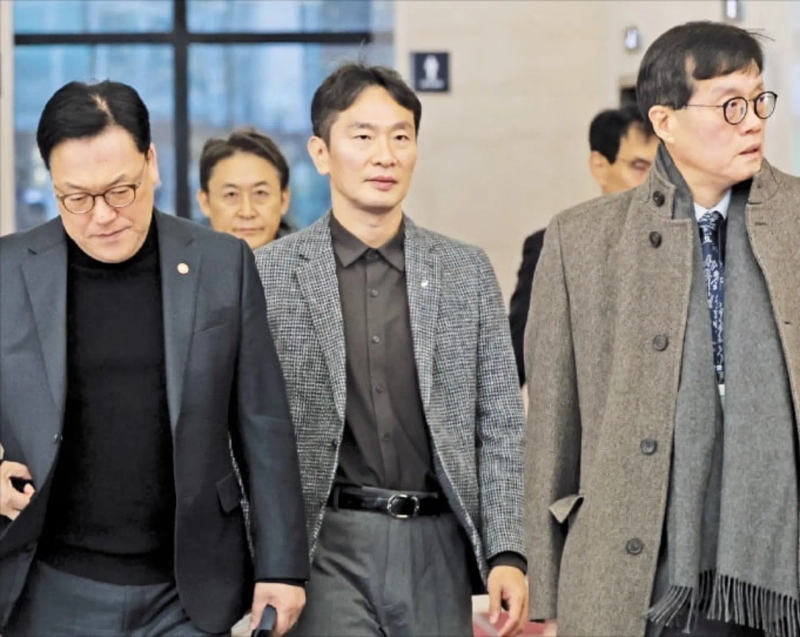
Fitch, one of the world's top three credit rating agencies, diagnosed on the 6th that if Korea's political risks are prolonged, the downward pressure on credit will increase. Following Moody's on the 4th, Fitch also warned that if the aftermath of the martial law situation extends, it could negatively affect Korea's national credit rating.
In a report on Korea's credit, Fitch stated, "If the political crisis prolongs or political division continues, the efficiency of policy decisions, economic performance, and finances may deteriorate, increasing the risk of credit downgrades." Fitch rates Korea as 'AA-', the fourth highest among its overall ratings.
Fitch does not believe that Korea's political uncertainty will substantially threaten the current national credit rating (AA-) and the rating outlook (stable). It explained that issues arising from the declaration of martial law are expected to be resolved through constitutional procedures. It also assessed that market risks, such as the won-dollar exchange rate and financial market pressures, are manageable due to swift actions by the Bank of Korea and the Ministry of Strategy and Finance.
However, Fitch explained that the mere fact of declaring martial law, even temporarily, could worsen investors' perceptions of political risks. It added, "If political uncertainty prolongs, it could weaken the confidence of households and businesses and put pressure on public finances."
Previously, Moody's Analytics, a subsidiary of the credit rating agency Moody's, stated on the 4th that if the aftermath of the martial law situation extends, Korea's national credit rating could be negatively affected.
Moody's Analytics explained, "The government's capacity to deal with numerous crises, such as weak economic growth prospects, a geopolitically challenging environment, and an aging population, may be burdened."
Economic Policy 'All Stop'..."Missing the Golden Time for Domestic Recovery"
4 Trillion Cut Budget Likely to Pass Parliament, Unavoidable Change in Next Year's Sound Fiscal Policy
As the possibility of the National Assembly's impeachment motion against President Yoon Suk-yeol increases, the current government's key economic policies are at risk of being completely halted. The current government's catchphrase of dynamic economy and the four major reforms in medical, pension, education, and labor, which were spearheaded by tax cuts and regulatory reforms, are expected to lose all policy momentum due to the power of the giant opposition party. Analysts suggest that the longer the impeachment situation prolongs, the more negative the impact on the economy, such as downward pressure on the national credit rating, as warned by international credit rating agencies Fitch and Moody's.
Complete 'All Stop' of Economic Policy
Prime Minister Han Duck-soo emphasized in a statement to the public on the 6th, "All public officials in every ministry should fulfill their duties at every moment to ensure that the nation's security and the daily lives of the people remain unwavering." He particularly urged the entire economic team, led by Deputy Prime Minister and Minister of Strategy and Finance Choi Sang-mok, to make every effort to minimize the negative impact of the current situation on the economy. This plan aims to preemptively block any unrest in the public sector ahead of the National Assembly's vote on President Yoon's impeachment motion.
The public sector sees an inevitable national governance vacuum for the time being, regardless of the impeachment motion's outcome. If the impeachment motion is passed, the economic policies that the Yoon Suk-yeol administration has been focusing on will inevitably lose momentum. The four major reforms in medical, pension, education, and labor are also expected to be derailed. Joo Won, head of the economic research department at Hyundai Research Institute, pointed out, "If the president's impeachment is passed and until the Constitutional Court's ruling, there is nothing the government can do," adding, "The longer the policy vacuum lasts, the more negatively it will affect the Korean economy."
Some in the public sector are also considering the possibility that the National Assembly might reject President Yoon's impeachment motion. A senior official from an economic ministry pointed out, "Even if the impeachment is rejected, President Yoon will fall into a 'dead duck' (a more severe power vacuum than a lame duck)," adding, "The government could also become a 'vegetative government.'"
Immediately, the budget cut led by the opposition party, which President Yoon cited as a key reason for the martial law declaration, is analyzed to have a high possibility of becoming a reality. 4.1 trillion won was cut from the government proposal. If the impeachment motion is passed, the opposition-led budget, which cuts reserve funds and special activity expenses for the presidential office, prosecution, and police, is likely to pass the plenary session. The inheritance tax law revision, which lowers the top inheritance tax rate from the current 50% to 40% and abolishes the surcharge for major shareholders, is also expected to be scrapped. This is because the opposition party, which has completely seized the initiative in the political situation, is unlikely to accept the inheritance tax law revision.
Concerns Over Prolonged Domestic Recession Grow
As President Yoon's impeachment becomes visible, there are observations that the semiconductor industry support policy and related law processing may also be scrapped. The measure to raise the integrated investment tax credit rate for semiconductor companies by 5 percentage points from the current level and to include R&D equipment and other R&D facility investments in the national strategic technology investment tax credit target is also likely to be pushed back. Civic groups aligned with the Democratic Party are opposing semiconductor industry support, calling it a tax cut for the rich.
The core keyword of the current government, 'sound fiscal policy,' has also become unavoidable for change. If the opposition-led budget cut passes the National Assembly's plenary session this month, the possibility of an additional supplementary budget being formulated early next year is high. Although the Ministry of Strategy and Finance, the budget and finance authority, opposes the supplementary budget, the dominant view is that it is difficult to continue opposing it in a situation where momentum has been lost in the impeachment situation.
Concerns are also raised that even the consumption promotion measures for domestic revitalization will be pushed back, missing the golden time for domestic recovery. The consumption promotion measures that the government initially intended to include in next year's economic policy direction have become uncertain in terms of implementation.
Seok Byeong-hoon, a professor of economics at Ewha Womans University, predicted, "If political uncertainty increases, consumers will reduce spending, leading to a consumption recession," adding, "Companies also delay investment timing until uncertainty is resolved, which can deepen the economic recession."
Kang Kyung-min/Park Sang-yong kkm1026@hankyung.com

Korea Economic Daily
hankyung@bloomingbit.ioThe Korea Economic Daily Global is a digital media where latest news on Korean companies, industries, and financial markets.