

"Exchange Rate Will Stay Above 1,400 Won Even If It Falls" [Hankyung FX Market Watch]
Summary
- Economic experts predict the won-dollar exchange rate will remain above 1,400 won in the second half of this year.
- While the exchange rate may decline, its continued high level is expected to cause economic burden.
- U.S. inflation rebound and Treasury yield increases could act as factors supporting the high exchange rate.
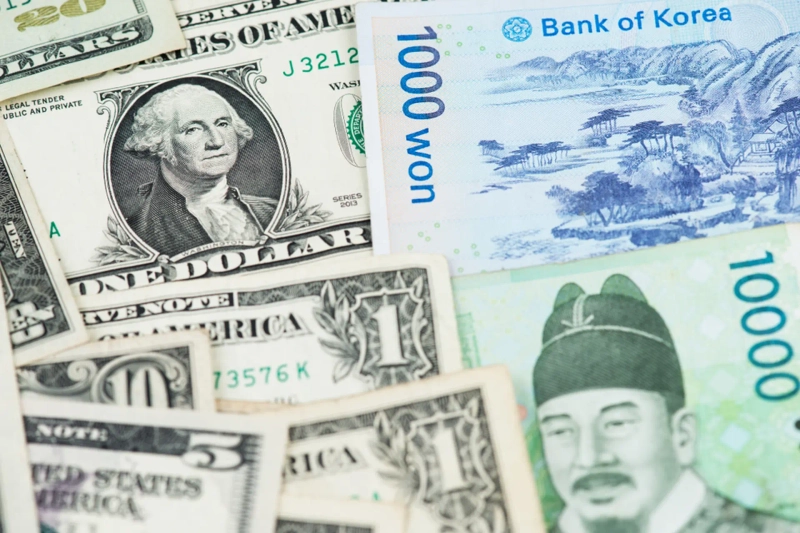
Economic experts from the Hankyung Economist Club projected that the won-dollar exchange rate will remain in the 1,400 won range this year. Many predicted that while the exchange rate would gradually decline in the second half, it would fail to enter the 1,300 won range. Concerns arise that the continued high exchange rate trend could pose a significant burden on the Korean economy.
On the 23rd, the average year-end won-dollar exchange rate predicted by 19 members of the Hankyung Economist Club was 1,402.80 won. The rate, which was 1,452.70 won at the end of January, is expected to gradually decrease through 1,425 won at the end of the first half.
The projected decline in exchange rates is due to expectations that U.S. policy uncertainties will somewhat resolve in the second half. Lee Seung-hoon, an economist at Meritz Securities, explained, "After uncertainties about U.S. trade policy concentrate in the first half, Trump trade flows will somewhat ease in the second half." Lee Nam-gang, an economist at Korea Investment Holdings, noted, "While Korea shows a growth pattern of low first half and high second half, the U.S. is expected to show the opposite," adding, "The exchange rate is likely to lower towards the second half."
The issue is that the suggested year-end rate of 1,402.80 won is still high. It's higher than both last year's average rate (1,364.38 won) and the rate just before the martial law declaration on December 2nd last year (1,402.50 won). Park Chun-sung, a research fellow at the Korea Institute of Finance, said, "Due to the fundamental economic gap with the U.S., it will be difficult for the exchange rate to lower to previous levels." Lee Yun-su, a professor of economics at Sogang University, expressed concern that "The Korea-U.S. interest rate gap might remain difficult to narrow for longer than expected while the U.S. economy remains strong."
The possibility of U.S. inflation rebounding was also raised. Former BOK Deputy Governor Lee Seung-heon explained, "If U.S. inflation rebounds, the Fed might raise interest rates," adding, "The exchange rate is likely to remain above 1,400 won for the time being." Professor Seok Byung-hoon of Ewha Womans University's Economics Department said, "We expect increased uncertainty in the first half and price increases due to U.S. tariff hikes in the second half," predicting "Won weakness will continue as the Fed adjusts its rate cut pace."
U.S. Treasury yield increases are also expected to support high exchange rates. When U.S. Treasury yields rise (bond prices fall), funds may move to the U.S., expanding dollar demand. Professor Shin Kwan-ho of Korea University's Economics Department predicted, "The gap between U.S. and Korean 10-year yields is substantial," suggesting "The exchange rate will stay between 1,400-1,450 won until year-end." Lee Sang-ho, head of the Economic Industry Division at Korea Enterprises Federation, said, "U.S. Treasury yields could rise further as Chinese demand for U.S. bonds decreases."
Reporter Kang Jin-kyu josep@hankyung.com

Korea Economic Daily
hankyung@bloomingbit.ioThe Korea Economic Daily Global is a digital media where latest news on Korean companies, industries, and financial markets.