

Lee Chang-yong: "1.8% Growth Rate Next Year Reflects Korea's Capability... Won't Increase Without Structural Reform"
Summary
- Bank of Korea Governor Lee Chang-yong forecasted that Korea's economic growth rate will be 1.8% next year, stating it cannot be increased without structural reform.
- He emphasized that traditional policies to boost growth rates could have side effects, and new industries must be introduced while enduring social conflict.
- Korea's potential growth rate is expected to gradually decline, and structural reform across the economy is necessary for improvement.
"Must Accept Moving Away from High Growth Era
No New Industries to Drive Growth for Next 10 Years"
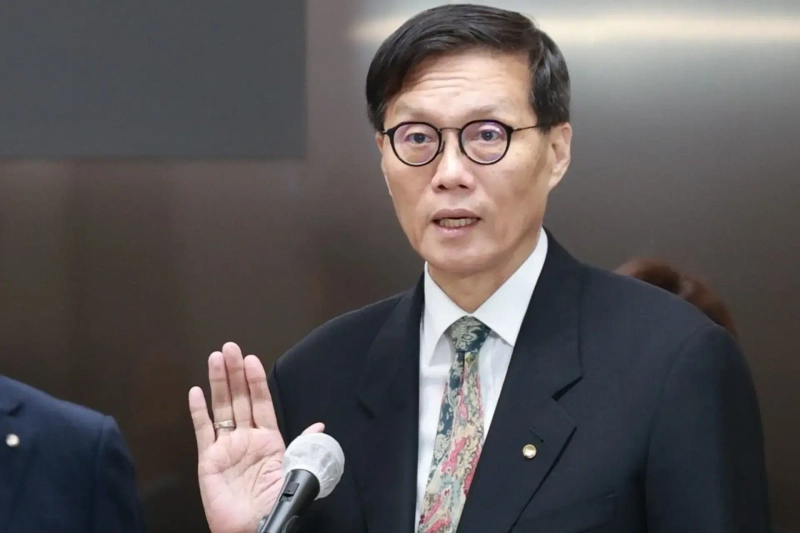
Bank of Korea Governor Lee Chang-yong (pictured) stated on the 25th that regarding BOK's 1.8% economic growth forecast for next year, "we must accept this as our actual capability."
At a press conference held at the BOK headquarters in Seoul's Namdaemun-ro, when asked to 'explain policies to defend next year's economic growth rate (1.8%)', Governor Lee responded, "We're too accustomed to past high growth, so when we hear 1.8% growth rate, people call it a crisis, but I think we need to accept the 1.8% growth rate." This statement was interpreted as emphasizing that attempting to boost growth rates through monetary and fiscal policies without structural reform would lead to adverse effects.
Governor Lee pointedly remarked, "We have relied solely on existing industries without nurturing new growth engine industries through restructuring," adding that "while aging is progressing, we're not even bringing in foreign workers." He continued, "In this situation, to grow beyond 1.8%, we would need to mobilize fiscal spending and lower interest rates, but this would increase household debt and cause fiscal problems." Lee emphasized, "My consistent message is that structural reform is necessary for higher growth."
In last December's 'BOK Issue Note: Korea's Potential Growth Rate and Future Outlook' report, BOK estimated that Korea's potential growth rate would continuously decline from 1.8% in 2025-2029 to 0.6% in 2045-2049. Even then, BOK suggested through the report that "to increase potential growth rate, productivity must be enhanced through economy-wide structural reforms" and "labor market inefficiencies must be improved and efficient resource allocation must be promoted."
Regarding questions about the impact of former U.S. President Donald Trump's tariff policies, Governor Lee strongly stated, "Looking at our economy over the past 10 years, we can no longer expect trickle-down effects solely from exports as in the past." He criticized, "What our government should find most painful is that no new industries were introduced over the past decade," adding "introducing new industries requires creative destruction and someone must bear the pain, but because we avoided social conflict, not a single new industry was introduced."
Reporter Dong-wook Jwa leftking@hankyung.com

Korea Economic Daily
hankyung@bloomingbit.ioThe Korea Economic Daily Global is a digital media where latest news on Korean companies, industries, and financial markets.