

Summary
- The Bank of Korea lowered its economic growth forecast for this year from 1.9% to 1.5% and cut the base rate from 3.0% to 2.75%.
- BOK Governor Lee Chang-yong stated that rate cuts without additional coordination could threaten financial stability and price stability.
- The Bank of Korea indicated the possibility of 1-2 more rate cuts this year and emphasized that fiscal policy is also necessary for economic recovery.
Base Rate Cut by 0.25%P
Significant Downward Revision from Previous 1.9% Forecast
Lee Chang-yong: "U.S. Tariff Uncertainty Has Increased"
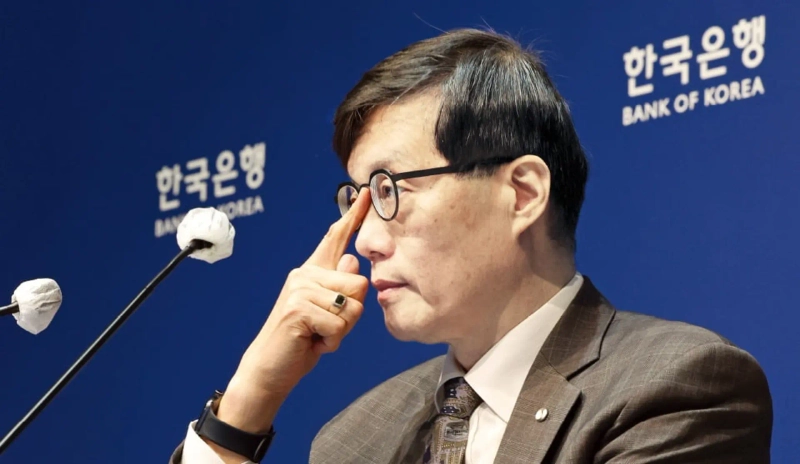
The Bank of Korea significantly lowered this year's economic growth forecast from 1.9% to 1.5% on the 25th. The base rate was cut by 0.25 percentage points from 3.0% to 2.75% annually. After consecutive rate cuts in October and November last year, the BOK, which chose to freeze rates last month citing 'won-dollar exchange rate instability,' resumed rate cuts after one month.
The BOK made this decision at the Monetary Policy Committee meeting held at the BOK headquarters in Namdaemun-ro, Seoul. Governor Lee Chang-yong explained, "We additionally lowered the base rate to respond to economic conditions as this year's growth rate is expected to decrease significantly." This is the first time the base rate has entered the 2% range since October 2022, about 2 years and 4 months ago.
Governor Lee said, "The majority market opinion expects 2-3 rate cuts this year including February, which is not different from our (Monetary Policy Committee) assumption," suggesting the possibility of 1-2 more rate cuts within the year. Regarding the pace of cuts, he stated, "Four out of six Monetary Policy Committee members deemed it appropriate to maintain the current rate level for the next three months, while the remaining two said we should leave room for cuts."
Through its revised economic outlook today, the BOK presented 1.5% as this year's growth rate, lower than the 1.6-1.7% briefly forecast last month. Korea's economic growth rate has fallen below 2% only six times: in 1956 (0.6%), 1980 (-1.6%), 1998 (-5.1%), 2009 (0.8%), 2020 (-0.7%), and 2023 (1.4%). Governor Lee explained, "This reflects increased uncertainty as the timing of tariff impositions by the U.S. Trump administration has been moved forward from initial expectations."
"Growth Won't Recover Just by Lowering Rates... Supplementary Budget Needed but Adverse Effects if Over 20 Trillion"
0.25%P Cut... Base Rate Returns to 2% Range After 2 Years and 4 Months
"From an economic perspective, we need to cut the base rate further. However, rate cuts alone cannot increase the growth rate."
Bank of Korea Governor Lee Chang-yong made these remarks at a press conference after the Monetary Policy Committee lowered the base rate by 0.25 percentage points on the 25th. Governor Lee emphasized, "Without fiscal policy, lowering rates further to boost growth could threaten financial stability and price stability through exchange rates and household debt," adding that "coordination with fiscal policy is necessary."
◇Need for Fiscal and Monetary Policy Coordination
Today, the BOK cut the base rate from 3.0% to 2.75% annually. This year's economic growth forecast was lowered from 1.6-1.7% last month to 1.5%. The BOK explained that increased downside risks to growth were behind the additional rate cut. Governor Lee said, "While exchange market vigilance remains, with inflation stabilizing and household debt growth slowing, the economy is expected to worsen significantly," adding, "We judged it appropriate to ease downward pressure on the economy through additional base rate cuts."
The 1.5% growth rate presented by the BOK today is lower than forecasts by the OECD (2.1%), IMF (2.0%), government (1.8%), and KDI (1.6%). Governor Lee said, "The 1.5% growth rate already reflects the BOK's additional rate cut path," adding that "fiscal policy is needed to achieve higher growth rates."
Governor Lee again mentioned the need for a supplementary budget of 15-20 trillion won for fiscal policy to play its role. He explained it as "a scale that could raise the growth rate by about 0.2 percentage points." Regarding KDI's claim that now is not the time for a supplementary budget, he said, "It's puzzling that KDI, which had been continuously raising economic concerns, now says no supplementary budget is needed."
However, he drew the line at large-scale supplementary budgets exceeding 20 trillion won, saying "the side effects would be significant." This is interpreted as opposition to the Democratic Party's suggestion of a 35 trillion won supplementary budget. Governor Lee pointed out, "A supplementary budget plays a complementary role when growth rates fall in the short term," adding that "trying to make (the economy) soar with painkillers causes side effects." He expressed concern that "if we stimulate the economy through supplementary budget this year, we'll need even more fiscal spending next year to raise growth rates," and "continuously doing more will cause long-term fiscal soundness problems."
◇"1-2 More Rate Cuts"
Today, Governor Lee suggested that the BOK might cut rates 1-2 more times this year. He explained, "The market expects 2-3 cuts including this month, which is not very different from our assumption." However, he was cautious about the pace of cuts. Governor Lee said, "While we agree on expecting rate cuts, there's a difference between cutting quickly and adjusting while monitoring the situation," adding that "(the BOK) must also consider impacts on exchange rates, prices, and household debt."
He also actively defended the decisions to freeze rates in August last year and last month. Governor Lee said, "We delayed (cuts) by a month in August last year due to household debt issues and last month due to exchange rate issues," adding that "we are maintaining the rate cut trend while making good adjustments."
The market interpreted today's Monetary Policy Committee decision and Governor Lee's press conference as somewhat 'dovish' (preferring monetary easing). Unlike expectations of hawkish messages accompanying the rate cut, there were many neutral statements. There was also relief that market expectations aligned with the BOK's assumptions.
In the Seoul foreign exchange market today, the won-dollar exchange rate (as of 3:30 PM) closed weekly trading at 1,430.40 won, up only 3 won from the previous day. The three-year government bond yield closed at 2.596% annually, down 0.014 percentage points.
Reporter Kang Jin-kyu josep@hankyung.com

Korea Economic Daily
hankyung@bloomingbit.ioThe Korea Economic Daily Global is a digital media where latest news on Korean companies, industries, and financial markets.