

Summary
- President Trump announced that he would stockpile five cryptocurrencies including Bitcoin, Ethereum, and Ripple as strategic assets, causing a major impact on the market.
- The cryptocurrency market capitalization increased by approximately $329 billion following Trump's remarks, expanding the total market size to $3.24 trillion.
- The U.S. move to stockpile cryptocurrencies as strategic assets has raised expectations for cryptocurrency mainstreaming and additional purchases, according to reports.
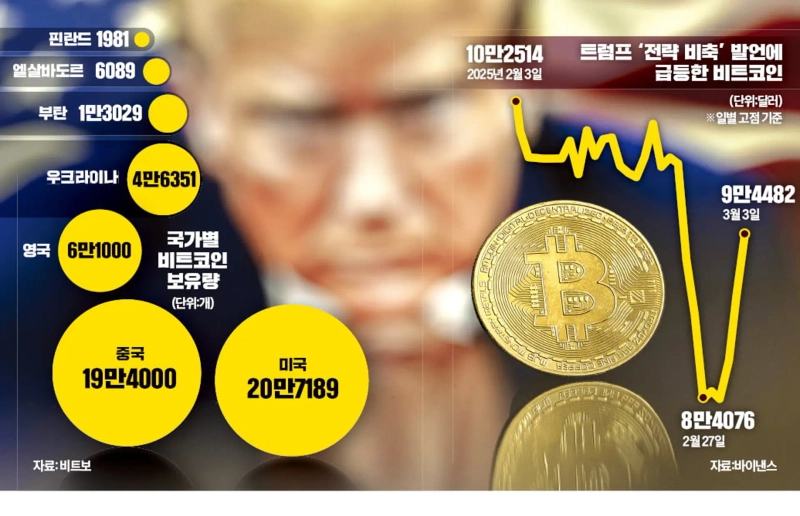
U.S. President Donald Trump said on the 2nd (local time) that he would stockpile five cryptocurrencies, including Bitcoin, as strategic assets. President Trump announced through Truth Social that day that he has instructed a working group to stockpile five cryptocurrencies—Bitcoin, Ethereum, Ripple, Solana, and Cardano—as strategic assets, saying, "I will make America the capital of global digital assets."
President Trump directed the creation of a working group to manage and accumulate cryptocurrency assets through an executive order last January. This is the first time President Trump has specifically mentioned which cryptocurrencies would be stockpiled.
Following President Trump's remarks, Bitcoin prices jumped by as much as 10.38% to $94,482. Ethereum rose up to 15.85%, reaching $2,525. According to cryptocurrency data analytics firm CoinGecko, the total market capitalization of cryptocurrencies increased by approximately $329 billion to $3.24 trillion within three hours of President Trump's 'cryptocurrency stockpiling' announcement.
U.S. to Stockpile Cryptocurrencies Like Gold and Oil... Also Hints at 'Additional Purchases'
Trump: "Bitcoin and 4 Other Cryptocurrencies as Strategic Assets"
As President Donald Trump ordered the stockpiling of cryptocurrencies as strategic assets on the 2nd (local time), some analysts say that cryptocurrencies, which had remained on the periphery of the asset market, have now gained mainstream status. With expectations that the U.S. government will expand its cryptocurrency holdings, cryptocurrency prices, which had been declining this year, rebounded sharply that day.
◇Became a 'Mainstream Asset' Like Gold and Oil
Forbes evaluated on the 2nd (local time) that "this announcement means that officials have come to view certain cryptocurrencies as legitimate financial products that can strengthen the national economy and security." Cryptocurrencies, which first appeared in 2008, had not been recognized as official assets due to high volatility and regulatory uncertainty. Through this announcement, cryptocurrencies have emerged as essential tools for maintaining the U.S. economic system, like oil and gold.
During his first administration, President Trump was so negative about cryptocurrencies that he called them "a scam." He publicly criticized cryptocurrencies, saying he "didn't like them because they are another currency competing with the dollar."
President Trump's shift to a positive stance began around last year's presidential campaign. In July last year, President Trump said, "It will be the policy of the Trump administration that the U.S. government accumulates all Bitcoin currently held or acquired as strategic national Bitcoin."
Concerns that cryptocurrencies pursuing 'decentralization' could shake dollar hegemony are also diminishing with the emergence of stablecoins. This is because the view is spreading that cryptocurrencies can be incorporated into the dollar system through stablecoins, which link their value to the dollar, and rather strengthen dollar dominance. Lucrezia Reichlin, a professor of economics at the London School of Economics, predicted that "stablecoins can be usefully employed as a means of settlement in international trade or as a repository of global reserves, thereby indirectly reinforcing the dollar's supremacy."
Forbes analyzed that the five cryptocurrencies President Trump ordered to be stockpiled each have their own roles. While Bitcoin serves as a safe-haven asset like gold, and Ethereum can bring industrial innovation, Ripple has strengths in remittance system innovation, and Cardano in identity verification.
◇Cryptocurrency Prices Rebound After Decline
Cryptocurrency prices, which had been declining since President Trump's inauguration, rebounded after about a month.
Bitcoin prices, which had been falling since reaching a peak of $109,000 on January 20, the day of the inauguration, rose more than 10% to $94,482 immediately after President Trump's remarks. Ripple and Solana surged 32% and 23%, respectively. Cardano soared more than 65%.
Bitcoin prices had been falling as President Trump avoided mentioning strategic asset stockpiling or specific cryptocurrencies that investors had been expecting after his inauguration. Even when the Trump administration created a cryptocurrency working group within the White House in January, they used the term 'stockpile' instead of 'reserve.' CNBC interpreted that the former implies the government will regularly purchase cryptocurrencies, while the latter means collecting and keeping cryptocurrencies without selling them.
Analysts say that expectations for additional purchases have grown as President Trump officially used the term 'reserve' this time. The United States currently holds Bitcoin worth $19 billion (approximately 27.8 trillion won). Most of it was confiscated from criminals by enforcement agencies such as the Department of Justice. If the U.S. reserves these bitcoins as strategic assets instead of converting them to cash, concerns about selling pressure could be partially alleviated. Spencer Harlan, an executive at cryptocurrency investment firm GSR, evaluated that "Trump's remarks prompted investors to rush to rebuild their buying positions and greatly helped price increases."
However, some point out that congressional approval is needed for cryptocurrencies to gain the status of 'strategic assets' like oil, gold, and foreign exchange. In 1975, the year after the oil shock, the U.S. Congress enacted the 'Energy Policy and Conservation Act,' mandating oil reserves.
Currently, a Bitcoin reserve bill proposed by Senator Cynthia Lummis (Republican-Wyoming) is pending in Congress. The bill centers on the U.S. Treasury purchasing a total of 1 million bitcoins over five years and holding them for at least 20 years. Senator Lummis also proposed a bill with the same content in July last year, but it was discarded due to the expiration of the session.
Reporter Kim In-yeop inside@hankyung.com

Korea Economic Daily
hankyung@bloomingbit.ioThe Korea Economic Daily Global is a digital media where latest news on Korean companies, industries, and financial markets.