

PiCK
"Flexibility only until April 2"...Trump demands lowering trade barriers before then
Summary
- President Trump announced that he can exercise flexibility until April 2, pressuring countries to lower their tariff and non-tariff barriers.
- Trump expressed optimistic views that he would make the US economy stronger even if it means enduring a trade war.
- President Trump mentioned the possibility of imposing tariffs on European cars and stated his intention to respond to retaliatory tariffs from other countries on American products.
Trump "Will reclaim what other countries have stolen"
"It will be a very important day for the US"
To Ireland with low corporate tax
"You took our pharmaceutical companies"
On EU retaliation "We will win"
€26 billion in tariffs imposed on US
Warns of responding with tariffs on European cars
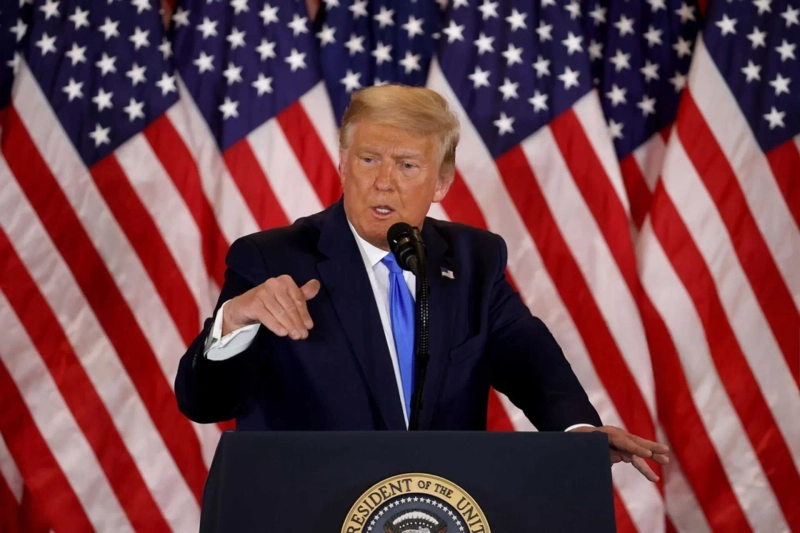
U.S. President Donald Trump has stated that he can exercise flexibility toward various countries until April 2, before imposing reciprocal tariffs. This is interpreted as pressuring each country to lower their own tariffs and non-tariff barriers if they want to avoid or reduce reciprocal tariffs.
"April 2 is the watershed"
President Trump refuted criticism about his lack of consistency in tariff policy during a meeting with Irish Prime Minister Micheál Martin at the White House on the 12th (local time), saying, "It's not inconsistency, it's flexibility." Referring to the one-month postponement of tariffs on Mexican and Canadian automobiles at the request of the U.S. auto industry, he said, "I will always maintain flexibility," but added, "Once we start, flexibility will be greatly reduced from that point."
Bloomberg reported that President Trump hinted at the possibility of deferring tariffs for some countries. However, it is analyzed that he implied there would be no room for compromise after April 2 if results satisfactory to the United States are not achieved by then. President Trump stated, "April 2 will be a very important day for the United States," adding, "We will reclaim what other countries have stolen from us."
Regarding the sharp drop in the stock market due to uncertainty in tariff policy, he expressed optimism, saying, "The U.S. economy will become stronger in the future." He then said, "Watch what happens. The stock market will eventually surge." Regarding the U.S. consumer price inflation rate announced that day, which was slower than market expectations, he also evaluated it as "very good news." President Trump recently expressed in a media interview his intention to proceed with imposing tariffs even if it means risking an economic recession.
President Trump directly criticized the Irish Prime Minister during their summit, saying, "You took American pharmaceutical companies and other companies." He was taking issue with Ireland's corporate tax rate of 15%, which is 6 percentage points lower than the U.S. corporate tax rate (21%). This is a criticism that Ireland is attracting major U.S. companies with its low corporate tax rate and intercepting tax revenue that the U.S. should be collecting. This passage shows the possibility that President Trump may raise the issue of corporate tax when imposing reciprocal tariffs.
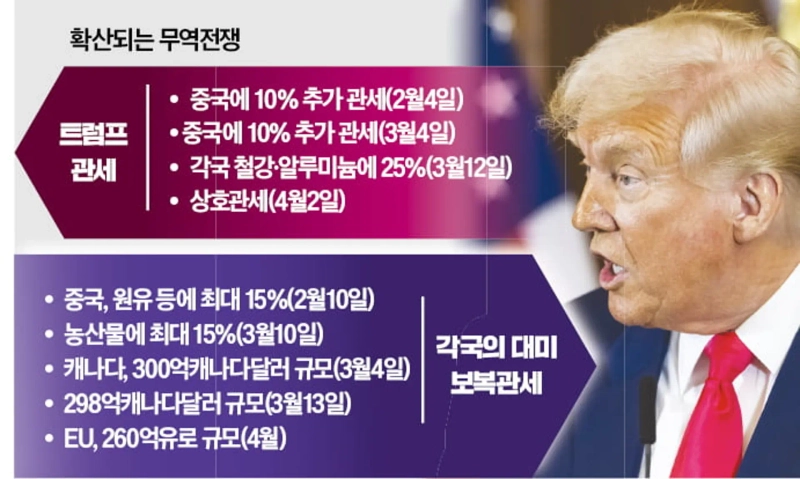
President Trump also clarified his policy of responding to retaliatory tariffs from various countries on U.S. products. He said regarding the EU's retaliatory tariffs, "We will certainly respond," and "We will win this battle." In particular, he repeated his claim that "The problem is that the U.S. did not respond in the past," and that "The EU is an organization created to take advantage of the United States."
In response to the U.S. imposing 25% tariffs on imported steel and aluminum, the EU announced that it would impose tariffs on U.S. products worth a total of €26 billion (approximately 41 trillion won) in two phases starting next month. When asked if he was considering imposing tariffs on European cars, President Trump answered, "Absolutely."
Retaliation vs. Negotiation, Countries Respond Differently
Following the EU, Canada also announced that it would impose the same 25% retaliatory tariffs on U.S. steel and aluminum products worth 29.8 billion Canadian dollars (about 30 trillion won) starting on the 13th. Canadian Finance Minister Dominic LeBlanc said, "We will implement retaliatory measures at exactly the same level as the metal tariffs imposed by the United States." The tariff war, which has been centered around the U.S. and China, is now expanding to U.S. allies such as the EU and Canada.
The UK has indicated it will refrain from direct retaliation, saying it will "take a practical approach to U.S. tariff measures." Brazil plans to consider retaliatory tariffs after attempting negotiations with the Trump administration. Mexico also plans to respond after observing the additional U.S. tariff measures on April 2. South Korea has also made it clear that it is not considering retaliatory tariffs against the United States, with Acting President Choi Sang-mok stating in a Wall Street Journal (WSJ) interview that "taking measures that hinder trade expansion would not be beneficial (to Korea)."
Nevertheless, the tariff war is likely to continue expanding. President Trump has warned of high tariffs on semiconductors, automobiles, pharmaceuticals, and more.
Reporter Im Da-yeon allopen@hankyung.com

Korea Economic Daily
hankyung@bloomingbit.ioThe Korea Economic Daily Global is a digital media where latest news on Korean companies, industries, and financial markets.