

Tesla and BYD: When One Jumps, the Others Crash
Summary
- Tesla and BYD stock prices are showing a 'decoupling' phenomenon, with autonomous driving competition intensifying, according to the report.
- While Tesla showed a significant downward trend, BYD surged, outperforming Tesla in terms of returns, the report stated.
- Contrasting outlooks on autonomous driving technology between the two companies continue, with BYD receiving strong support in the Chinese market, according to the report.
Tesla drops 42% while BYD surges
'Decoupling' evident after Trump's election
Impact of intensifying US-China autonomous driving competition
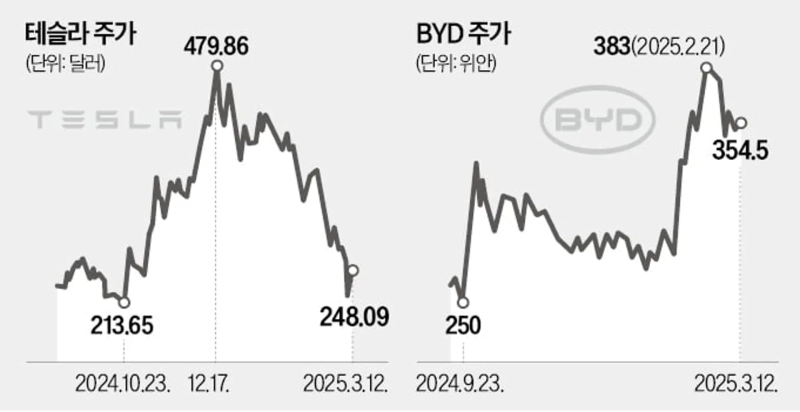
The 'decoupling' phenomenon between Tesla and BYD stock prices is becoming more pronounced. Unlike Tesla, which has halved in value this year, BYD, which was struggling at the end of last year, is surging. Analysis suggests that this decoupling is occurring as competition between the two companies intensifies in the autonomous driving sector.
According to Investing.com on the 13th, Tesla's stock price fell 42.9% this year through the 12th. This has largely given back the 61.6% gain recorded in November-December last year. In contrast, BYD has surged 24.2% this year, significantly outperforming Tesla's returns. While Tesla was rising sharply in November-December last year, BYD's stock price fell 3.6%.
Regarding this trend, analysis suggests it's due to the increasingly intense competition in autonomous driving between the US and China. Until the middle of last year, the stock price movements of the two companies were not significantly different. Although BYD's stock price fell when Tesla rose 8.2% in July-August last year, the decline was limited to 0.3%. In September-October, they recorded similar growth rates of 16.7% and 17.5%, respectively.
The stock prices of the two companies began to diverge significantly from November last year, when Donald Trump was elected as the US President. As strong expectations formed that Tesla would widen the technology gap with support from the Trump administration, BYD could not avoid weakness.
The situation reversed this year. BYD counterattacked by introducing its 'God's Eye' autonomous driving technology. In particular, expectations grew that China's autonomous driving technology would become mainstream when this technology was applied to electric vehicles in the 30 million won range.
Tesla's plummeting sales in China also had an impact. In February, Tesla's sales in China decreased by 49% compared to the previous year. China is a key market accounting for about 36% of Tesla's revenue. During the same period, BYD's sales surged by 164%.
Outlooks for the two companies' stock prices are mixed. Jongkyu Jeon, a researcher at Samsung Securities, said, "If BYD, DeepSeek, and Huawei cooperate with each other and receive strong support from the Chinese government, China will lead the global autonomous driving market." On the other hand, Kihwan Eun, a fund manager at Hanwha Asset Management, analyzed, "Even Chinese technicians admit that it's difficult to catch up with Tesla's advanced autonomous driving technology," adding, "It's difficult to assess that BYD poses a significant threat."
Reporter Han Shin Park phs@hankyung.com

Korea Economic Daily
hankyung@bloomingbit.ioThe Korea Economic Daily Global is a digital media where latest news on Korean companies, industries, and financial markets.