

PiCK
[New York Stock Market Briefing] Markets Fall Again on Trump's Tough Tariff Stance... Apple Plunges 12% in 4 Days
Summary
- The report stated that President Trump's tariff policies are creating uncertainty, causing the New York stock market to continue falling sharply.
- It was reported that tech giants generally showed a downward trend, with Apple in particular falling about 12% over four days.
- The report indicated that market trends in benchmark interest rates, including the increasing possibility of rate cuts, should be closely monitored.
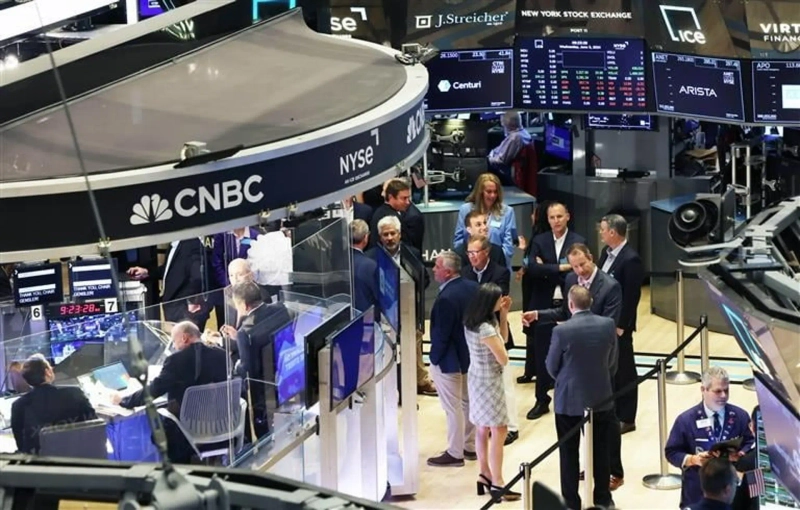
Major indices on the New York stock market fell sharply again. Although U.S. wholesale prices for February came in below expectations, uncertainty about Donald Trump's tariff policies continues to shake the market.
On the 13th (local time), the Dow Jones Industrial Average closed at 40,813.57, down 537.36 points (1.30%) from the previous day at the New York Stock Exchange (NYSE). The Standard & Poor's (S&P) 500 index finished at 5,521.52, down 77.78 points (1.39%), and the Nasdaq Composite index plummeted 345.44 points (1.96%) to close at 17,303.01.
President Trump's comments on tariffs weighed on the market again today. On his social media platform Truth Social, he said, "The EU was established with the sole purpose of taking advantage of the United States and imposes a terrible 50% tariff on whiskey," adding, "If this tariff is not immediately removed, the United States will soon impose a 200% tariff on all wines, champagnes, and spirits from France and other EU countries."
President Trump also repeatedly emphasized that he would push forward with his tariff policy. When asked by reporters about his tariff plans during a meeting with NATO Secretary General Mark Rutte at the White House, he said, "We have been extorted for years, so we will no longer be extorted in the future," adding, "I will not bend (the tariff stance) on aluminum, steel, or automobiles."
Market anxiety intensified as the Trump administration signaled its willingness to accept stock market volatility. U.S. Treasury Secretary Scott Bessent told CNBC in an interview, "I'm not worried about a little volatility over three weeks," adding, "We're focusing on the real economy."
As these comments were reported, major stock indices, which had started with slight losses, steadily expanded their declines throughout the session. The Nasdaq, which had rebounded more than 1% the previous day, widened its losses toward the end of the session, falling 2%, while the S&P 500 and Dow indices continued their step-by-step decline without any significant rebound.
The slowdown in the February Producer Price Index (PPI), announced amid the gloomy atmosphere, was interpreted as a concern about economic slowdown rather than hope for easing inflation worries. The U.S. Department of Labor announced that the February PPI showed no change from the previous month on a seasonally adjusted basis. This marked a significant break from the upward trend of 0.5% in December and 0.6% in January. Compared to the same month last year, it rose 3.2%, a 0.5 percentage point slowdown from January's 3.7%.
In particular, the strength in raw material prices among PPI items further heightened investors' concerns. In the intermediate demand sector, processed goods prices rose 0.5%, and unprocessed goods prices increased by 1.3%, maintaining their upward trend for the fifth and third consecutive months, respectively.
All seven 'Magnificent 7' giant tech companies fell in today's market. Meta dropped around 4%, while Amazon and Alphabet recorded declines of over 2%. Microsoft also fell more than 1%. Notably, Apple declined by 3.36%. This stock has fallen 12.29% over the four trading days this week.
Adobe plunged 13.57% as its fourth-quarter results from last year disappointed.
Intel surged 14.56% as buying interest concentrated on expectations for the new Chief Executive Officer (CEO).
By sector, all sectors except utilities declined. Consumer discretionary and communication services recorded the largest drops, falling 2.58% and 2.67% respectively, while technology and industrials also fell more than 1%.
According to the Chicago Mercantile Exchange (CME) FedWatch Tool, the probability of a 50bp cut in the benchmark interest rate by the end of June rose to 24.9% in the federal funds futures market. Meanwhile, the probability of rates remaining unchanged fell from 23.1% the previous day to 18.6%.
The Chicago Board Options Exchange (CBOE) Volatility Index (VIX) recorded 24.66, up 0.43 points (1.77%) from the previous session.
Case Han, Hankyung.com reporter case@hankyung.com

Korea Economic Daily
hankyung@bloomingbit.ioThe Korea Economic Daily Global is a digital media where latest news on Korean companies, industries, and financial markets.