

US Stock Index Futures Fall Following Bessent's "Market Correction is Healthy" Comment
Summary
- US Treasury Secretary Scott Besent expressed his view that the stock market correction is healthy, which caused US stock index futures to fall on the 17th.
- Market concerns related to global trade wars have promoted a preference for safe assets, with gold approaching a record high and treasury yields falling slightly.
- US consumer sentiment has fallen to its lowest level in 29 months, and major policy meetings this week, including the Federal Reserve, are expected to keep interest rates unchanged.
Interpreted as "Trump Administration Unlikely to Take Market Stimulation Measures"
US Consumer Sentiment Decline Amid Trade War Concerns Also Casts Shadow on Market
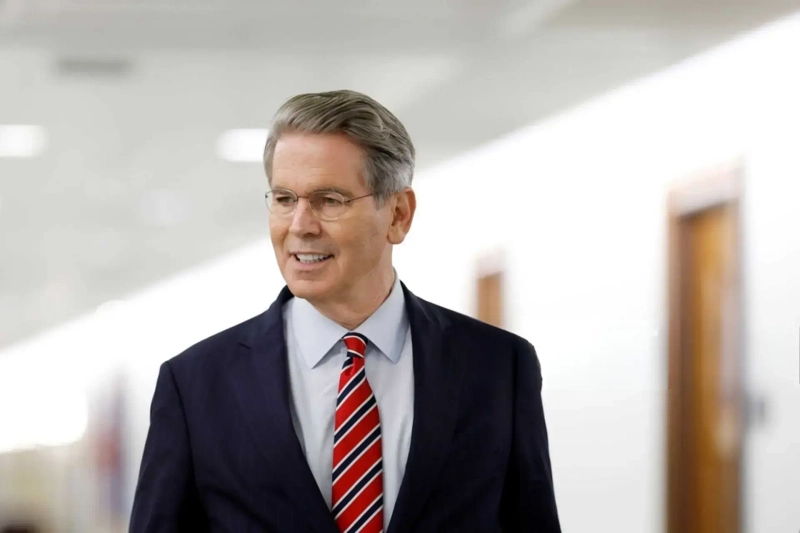
US Treasury Secretary Scott Bessent emphasized that while Wall Street is going through a difficult period, he is "not worried about market downturn and the decline is healthy." Following Bessent's remarks, US stock index futures fell on the 17th (local time). This was interpreted as an indication that the Trump administration is unlikely to take measures to stimulate the market.
As of the morning of the 17th Eastern Standard Time, S&P 500 futures and Nasdaq 100 contracts each fell 0.6%. Dow Jones Industrial Average futures also dropped 0.6%. While Tesla and most large tech stocks showed downward trends, Nvidia rose 0.7% in pre-market trading ahead of the GTC conference.
Last week, the S&P 500 entered a 'correction' territory, typically defined as a 10% drop from recent highs. The Nasdaq Composite had already fallen into correction territory earlier this month.
In contrast, Asian markets rose on data showing Chinese consumption recovery, and Europe's Stoxx 600 started 0.3% higher on the same day.
Bessent, who previously ran hedge fund Key Square Capital, claimed on NBC's 'Meet the Press' the previous day that "(market correction) is healthy." He said that "what's unhealthy is a euphoric market," adding that's exactly how financial crises occur.
Benjamin Picton, a strategist at Rabobank who was interviewed by Bloomberg on the 17th, said, "This statement raised alarm bells on Wall Street, which had expected Bessent to be the 'voice of reason' in the Trump administration."
Fears of a global trade war have fueled a preference for safe assets, with gold approaching a record high of $3,000 per ounce. Bonds also saw increased buying demand, causing treasury yields to fall slightly. Bond prices and yields move in opposite directions.
The Trump administration's mention of ruthless military attacks on Yemen's Houthi rebels is also raising market concerns. In response, the Houthi rebels stated they would target US vessels in the Red Sea. The incident pushed Brent crude futures above $71 per barrel, up 1.1%, while European shipping stocks such as AP Moller-Maersk and Hapag-Lloyd rose.
Later this week, the Federal Reserve, Bank of England, and Bank of Japan will hold policy meetings. All are expected to keep interest rates unchanged.
Steve Innes, managing partner at SPI Asset Management, pointed out that "macroeconomic uncertainty remains high, so Monday's retail sales data results could drive significant market volatility."
US consumer sentiment fell to a 29-month low last week due to persistent inflation, large-scale federal job restructuring, and concerns about global trade wars.
Kim Jung-a, Contributing Writer kja@hankyung.com

Korea Economic Daily
hankyung@bloomingbit.ioThe Korea Economic Daily Global is a digital media where latest news on Korean companies, industries, and financial markets.