

NVIDIA Officially Declares "We Will Build a Quantum Accelerator" [Haesung Lee's Quantum Solus]
Summary
- NVIDIA announced the establishment of the 'NVIDIA Accelerated Quantum Research Center (NVAQC)' in Boston, USA, with the goal of providing quantum computing technology.
- CEO Jensen Huang stated that he will collaborate with Harvard University, MIT, and others to advance quantum computing and develop CUDA-Quantum hybrid computing.
- Considering the potential of the quantum technology market, NVIDIA plans to expand its business model by developing next-generation AI accelerators such as 'Feynman'.
Is NVIDIA Transferring Supercomputer Hegemony to Quantum Computers?
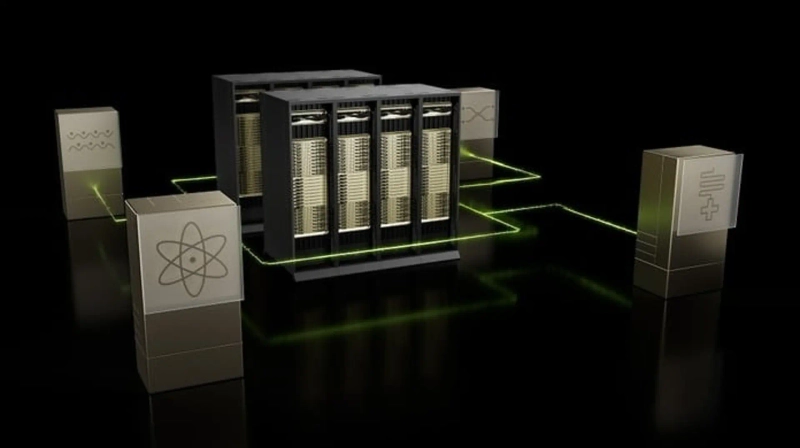
NVIDIA announced on the 20th that it will establish the 'NVIDIA Accelerated Quantum Research Center (NVAQC)' in Boston, USA, with the goal of providing technology for the advancement of quantum computing. This was revealed at the company's annual developer conference 'GTC 2025'. They also announced plans to collaborate with Harvard University, Massachusetts Institute of Technology (MIT), and others.
NVIDIA CEO Jensen Huang said, "Quantum computing can solve the world's most important problems, from drug development to materials development," adding, "We will collaborate with various quantum research communities to advance CUDA-Quantum hybrid computing and play a groundbreaking role in creating useful large-scale accelerated quantum computers."
This is the first time CEO Jensen Huang has officially declared that they will develop quantum computers. Until now, NVIDIA has been developing CUDA-Q, the software (SW) needed to operate quantum computers.
NVIDIA announced that it will provide developers from companies or research institutions participating in NVAQC with the 'GB200 NVL Rack-scale' system, the most powerful hardware currently in existence. They explained that this will enable the deployment of 'low-latency quantum hardware control algorithms' essential for complex simulations of quantum systems and quantum error correction.
Quantum computers vastly outperform supercomputers in specific operations such as combinatorial optimization, but errors are frequent in the qubit implementation process, requiring error correction technology.
Professor Mikhail Lukin, head of Harvard University's Quantum Initiative, said, "NVIDIA's NVAQC will be a very special element in Boston's quantum ecosystem, which includes world-class universities and startups," adding, "The accelerated quantum and traditional supercomputing technologies provided by NVIDIA have the potential to lead quantum computing from quantum error correction to finally becoming a reality."
William Oliver, director of MIT's Quantum Engineering Center, also said, "The integration of NVIDIA's accelerated computing platform and qubits will enable unprecedented utilization of the expertise needed to solve quantum computing challenges." NVAQC is scheduled to begin operations in the second half of this year.
NVIDIA also announced that it will mass-produce the next-generation AI accelerator Rubin, which is 900 times faster than the H100 accelerator, in the second half of next year, and introduce 'Feynman', the next generation AI accelerator after Rubin, in 2028. Feynman is named after Nobel Prize-winning physicist Richard Feynman, who first proposed the physical structure of quantum computers. This reveals their plan to expand their business model (BM) from GPU supercomputer accelerators to quantum computer accelerators.
NVIDIA's declaration to enter quantum technology contradicts CEO Jensen Huang's position until recently that "quantum computer commercialization would take 20-30 years." Analysis suggests that he may have rapidly changed strategy after Google, followed by Amazon, D-Wave Quantum, and other leading quantum technology companies, recently announced research results claiming to have achieved 'quantum supremacy'. China also announced on the 15th that it had developed the 105-qubit quantum processor 'Zuchongzhi 3.0', which surpasses Google's latest quantum processor 'Willow'.
As the quantum war among Big Tech companies intensifies, South Korea, a 'quantum technology wasteland', has also quickened its pace. On the 12th, the government held the first meeting of the public-private Quantum Strategy Committee, chaired by Acting President Choi Sang-mok. They announced 10 initiatives in three major areas: securing core quantum technology capabilities and outstanding talent, establishing a foundation for quantum industrialization, and global cooperation.
A Ministry of Science and ICT official emphasized, "Quantum science and technology is a game-changer that will have a profound impact on the future nation's economy, society, and security." Quantum computers have the potential to break the current RSA cryptographic system and blockchain system that forms the basis of Bitcoin transactions. Quantum sensors are expected to detect invisible nuclear-armed stealth fighters and bombers, while quantum communication technology is expected to implement absolute secure communication that cannot be tapped or eavesdropped. According to market research firm Precedence Research, the quantum technology market size is expected to grow to $24.6 billion by 2033, about 10 times larger than last year ($2.3 billion).
Reporter Lee Haesung ihs@hankyung.com

Korea Economic Daily
hankyung@bloomingbit.ioThe Korea Economic Daily Global is a digital media where latest news on Korean companies, industries, and financial markets.