

Reemergence of Mutual Tariff Risks... Exchange Rate Nears 1470 Won
Summary
- It was reported that the recent mutual tariff increase and political uncertainty are causing the won-dollar exchange rate to rise.
- Hana Bank and Kookmin Bank predicted that after the conclusion of global events, tariff uncertainty will negatively impact the won.
- Woori Bank stated that the delay in the presidential impeachment ruling is acting as a major factor for the won's weakness.
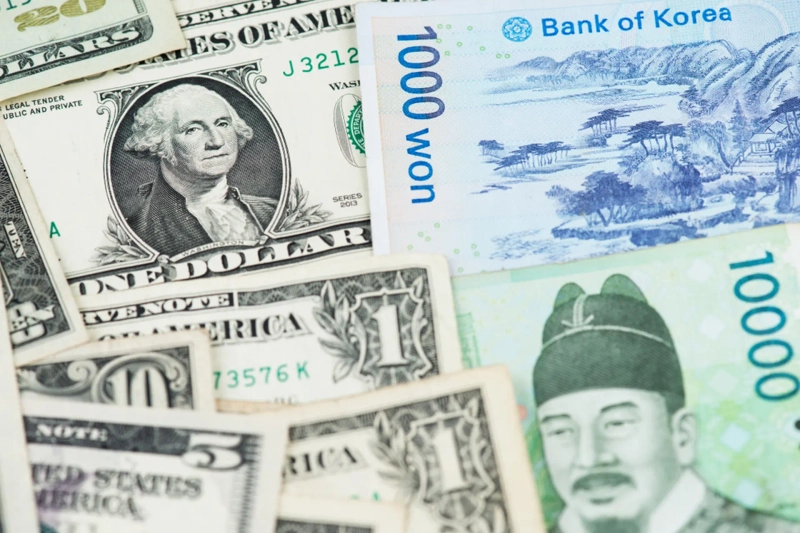
In early April, with the mutual tariff increase imminent and the presidential impeachment ruling delayed, the won-dollar exchange rate is increasing due to domestic and international uncertainties surrounding Korea.
On the 21st, the won-dollar exchange rate opened at 1,466.5 won, up 7.6 won in the Seoul foreign exchange market.
In the overnight market, it closed at 1,466.7 won, increasing in line with the euro's weakness due to tariff uncertainties, and the offshore NDF rate was finally quoted at 1,464.50 won, up 8.10 won from the previous day's closing price.
Overnight, the euro showed weakness and the dollar showed strength following the European Central Bank (ECB) President's mention of the possibility of stagflation due to US tariffs.
Christine Lagarde, ECB President, appeared at a parliamentary hearing on the 20th (local time) and expressed concern that if the US imposes a 25% tariff on European Union (EU) goods, the eurozone's growth rate could fall by 0.3%p in the first year.
She added that if the EU retaliates, the growth rate decline could expand to 0.5%p.
The dollar index, reflecting the value of the dollar against six major currencies, soared to the 104 level.
As the end of March approaches, with President Trump setting April 2 as the date for the mutual tariff to take effect, tariff uncertainties are expanding again.
On this day, the exchange rate is expected to have upward pressure reflecting the global dollar strength.
Hana Bank stated, "The strong dollar continues due to the ECB President's remarks, US employment indicators, and real estate indicators," and "with domestic political uncertainties persisting, upward factors for the exchange rate are dominant both domestically and internationally." The expected band is 1,462~1,472 won.
Kookmin Bank analyzed, "As global monetary policy meetings and other events conclude this week, market attention has shifted back to tariffs," and "uncertainties such as concerns over growth slowdown due to tariffs are negative for the won." The expected band is 1,463~1,471 won.
Additionally, the delay in the presidential impeachment ruling is also negatively impacting the won.
Comparing the major currency fluctuations over the past month, the Turkish lira (-4.1%) and the won (-2.2%) ranked first and second from the bottom.
Woori Bank analyzed, "The common point of the two currencies is the high level of domestic political uncertainty," and "the prolongation of uncertainty related to impeachment is acting as an Achilles' heel for the won."
Reporter Kim Yewon yen88@wowtv.co.kr

Korea Economic Daily
hankyung@bloomingbit.ioThe Korea Economic Daily Global is a digital media where latest news on Korean companies, industries, and financial markets.