

NVIDIA, Quantum Computing is Far Away...Suddenly Collaborates with Three Quantum Companies [Lee Hae-sung's Quantum Solace]
Summary
- NVIDIA announced collaboration with key companies such as QuEra, Quantinuum, and Quantum Machines in quantum computer development.
- NVIDIA's supercomputer plays a crucial role in reducing quantum errors, which can translate into investment value.
- They aim to contribute to the advancement of quantum systems with a goal of a gate-based 100-qubit system by 2027.
NVIDIA GPU-Based Supercomputer Used to Enhance Qubit Performance
QuEra Quantum Machines Join NVIDIA Quantum Computing Ecosystem
This is Lee Hae-sung, a journalist covering advanced tech and science at Korea Economic Daily. I will be serializing an online column under the name Quantum Solace. I plan to deeply cover national strategic technologies such as quantum technology, which is soaring on the back of a century of accumulated history, as well as artificial intelligence (AI), semiconductors, space and aerospace, defense industry, nuclear power, nuclear fusion, hydrogen energy, advanced robotics, and AI-quantum bio. Please subscribe.
Jensen Huang, CEO of NVIDIA, recently retracted his statement that "it will take more than 20 years to develop quantum computers," as NVIDIA disclosed its first collaboration plans with companies specializing in quantum computing.
NVIDIA announced on the 24th that it will collaborate with three quantum computing companies, QuEra, Quantinuum, and Quantum Machines, at the 'NVIDIA Quantum Acceleration Research Center (NVAQC)' to be established in Boston, where Harvard University and MIT are located. They specifically mentioned the technology to be developed with these companies and pointed out the number of GPUs to be included in the NVAQC.
An NVIDIA representative stated, "The NVAQC will house a supercomputer equipped with 576 Blackwell GPUs," adding, "This facility is equipped with the GB200 NVL72 system and the NVIDIA Quantum-2 InfiniBand networking platform."
He further added, "Quantum computers will now evolve into 'accelerated quantum supercomputers' integrated with AI supercomputers to solve the world's most difficult problems."
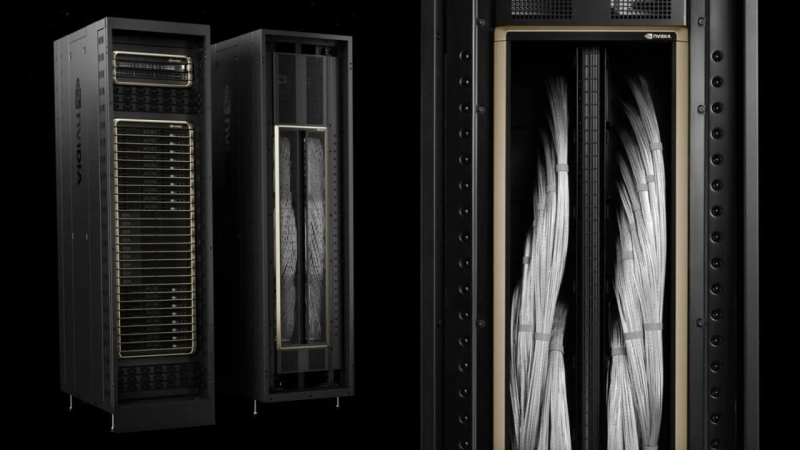
The NVIDIA GB200 NVL72 refers to a workload system designed to run both training and inference AI, such as large language models (LLM). It features a rack-scale liquid cooling system for high efficiency. It consists of 72 Blackwell GPUs and 36 Grace GPUs. The Quantum-2 InfiniBand is a networking platform designed to support such workloads.
QuEra, Quantum Machines, and Quantinuum, along with researchers from Harvard and MIT, will join the NVAQC to develop the 'NVIDIA Quantum Supercomputer.'
Quantinuum plans to develop hardware and emulators linked with NVIDIA's quantum computing software toolkit 'CUDA-Q' platform. They aim to unveil a gate-based 100-qubit system by 2027. Rajeev Hazra, CEO of Quantinuum, said, "We will combine Quantinuum's powerful quantum systems with NVIDIA's cutting-edge accelerated computing."
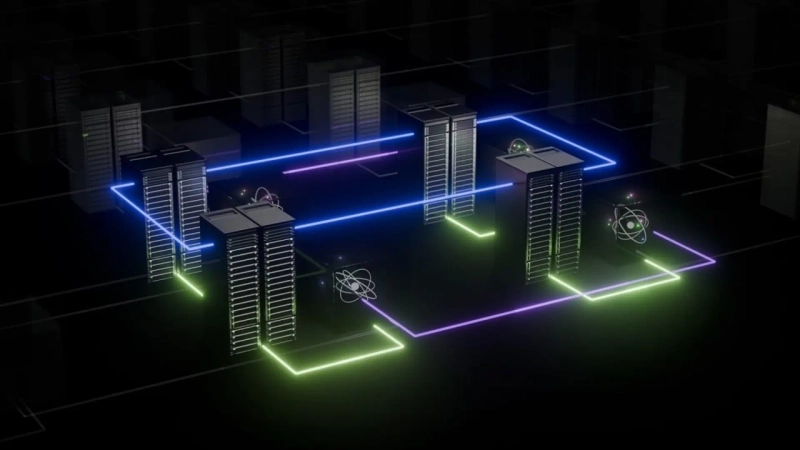
NVIDIA plans to focus on correcting quantum errors through GPU decoding. Qubits require superposition, entanglement, and coherence among bits, during which errors are likely to occur. This requires qubit encoding and decoding.
Qubits must interact with the surrounding environment for control and measurement, but such interactions simultaneously cause 'noise.' Noise refers to unintended changes in the qubit state. Noise affects the result of quantum calculations, and when this result exceeds the allowable error, it is called an error. Quantum algorithms can only operate when noise can be controlled. Embedding logical qubits in physical devices is called qubit encoding, and identifying the location of errors and corrections is called qubit decoding.
Qubit decoding aims to prevent errors from exponentially increasing when they become uncontrollable. This requires communication technology that can allow millions of qubits to move back and forth between classical supercomputers and quantum systems without delay in an extremely short time. Quantum Machines plans to collaborate with NVIDIA at the NVAQC to develop controller technology that supports ultra-fast, high-bandwidth interfaces between quantum processors and the GB200. In quantum computing, a controller is an intermediary that receives SW commands and delivers them to the hardware.
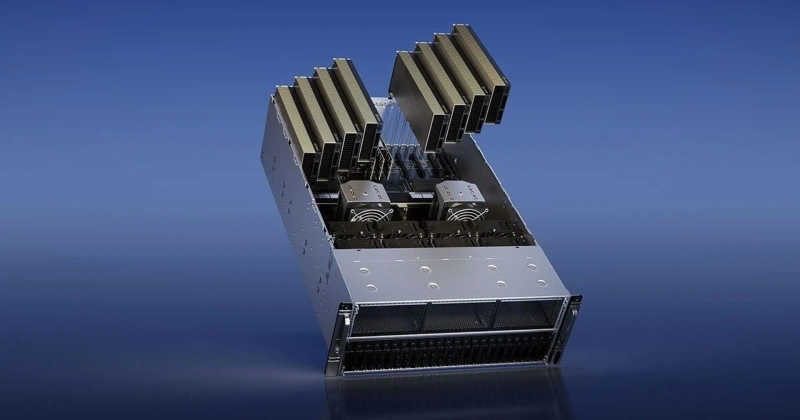
QuEra plans to search for quantum error correction codes and evaluate the performance of these codes through quantum simulation.
An NVIDIA representative stated, "The main goal of the NVAQC is to find ways for AI supercomputing to accelerate qubit decoding," adding, "The NVAQC will become the epicenter of quantum computing development."
Reporter Lee Hae-sung ihs@hankyung.com

Korea Economic Daily
hankyung@bloomingbit.ioThe Korea Economic Daily Global is a digital media where latest news on Korean companies, industries, and financial markets.