

Constitutional Court does not judge the legality of martial law... No hint from Yoon's ruling
Summary
- The Constitutional Court stated that it did not make a clear judgment on the legality of martial law in the impeachment trial of Acting President Han Duck-soo.
- As a result, the outcome of President Yoon Suk-yeol's impeachment trial remains uncertain, and it is expected that a unanimous decision will be difficult due to the divided opinions of the judges.
- Investors have stated that with this continued uncertainty, additional caution regarding domestic political variables is necessary.
Yoon's ruling still unclear
Judges' opinions divided, unanimous decision unlikely
Despite 'rebellion' mentioned 16 times in the decision
No direct judgment or explanation from the Constitutional Court
Whether the martial law cabinet meeting was legal, etc.
Concerned about conflicting with Yoon's impeachment ruling
Seems to have omitted any related content
Possibility of Yoon's ruling being delayed to April increases
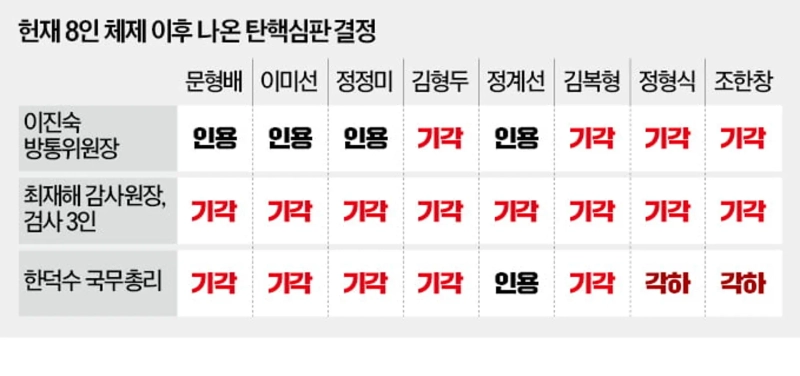
Attention is drawn to how the Constitutional Court's impeachment decision on Acting President Han Duck-soo, with judges' opinions split as 'dismissal 5, rejection 2, acceptance 1', will affect the impeachment ruling of President Yoon Suk-yeol. The National Assembly previously presented 'tolerating and abetting the unconstitutional declaration of martial law by the president' as one of the five grounds for impeachment against Han. The legal community expected that if the Constitutional Court's judgment on this matter was made, it could partially infer the conclusion of President Yoon's impeachment trial.
However, on the 24th, the Constitutional Court did not directly judge the legality of the martial law in the impeachment ruling against Acting President Han. It only concluded that Acting President Han did not intervene in President Yoon's actions.
◇Constitutional Court did not judge the legality of martial law or rebellion
Six out of eight constitutional judges, excluding the two who gave a rejection opinion, did not recognize the National Assembly's impeachment grounds that Acting President Han conspired, tolerated, or abetted the declaration of martial law.
The judges determined, "(Acting President Han) only heard about the plan from the president about two hours before the declaration of martial law, and there is no evidence or objective material to acknowledge that he knew about it beforehand." They added, "It is acknowledged that the respondent proposed convening a meeting to hear the opinions of the cabinet members," but "there is no evidence or objective material to acknowledge that he actively acted, such as proposing the convening of a cabinet meeting to give procedural legitimacy to the declaration of martial law."
The Constitutional Court's judgment on martial law related to Acting President Han's case ends here. No judgment was made on whether President Yoon's declaration of martial law was legal or whether the cabinet meeting before the declaration was a legitimate meeting with substance. The decision did not include any content on other procedural issues claimed by President Yoon's side. Investigation records prepared by the police and the Corruption Investigation Office for High-ranking Officials were submitted as evidence in Acting President Han's case and partially adopted. However, the Constitutional Court did not separately clarify whether it recognized the evidential power of these records.
The Constitutional Court also did not judge the content of the impeachment resolution against Acting President Han, which stated 'conspired in rebellion,' so the intention behind the 'withdrawal of rebellion charges' controversy could not be inferred. Although the word 'rebellion' appears 16 times in the decision, there was no part where the Constitutional Court directly judged or explained it. Therefore, the final judgment on the judicial judgment of the legality of martial law, including the adoption of investigation record evidence, is expected to be revealed in President Yoon's impeachment ruling, which is anticipated as early as the 28th or early April.
◇Prospects for President Yoon's impeachment trial
In the legal community, despite the ruling on Acting President Han's case, many opinions suggest that the outcome of President Yoon's impeachment trial remains unclear. In the ruling on Acting President Han's impeachment, five out of eight judges gave a dismissal opinion, one gave an acceptance, and two gave a rejection opinion. Among the five judges who gave a dismissal opinion, conservative judge Kim Bok-hyung did not recognize the illegality of any of the five impeachment grounds against Acting President Han. In effect, the judges' opinions were divided into four factions. As the ruling on President Yoon's impeachment is delayed, there is speculation that a unanimous decision might be sought for national unity, but the prospect of divided opinions among the judges is gaining traction.
Cha Jin-ah, a professor at Korea University's School of Law, evaluated, "There would have been no need to judge the substance or procedural legitimacy of the martial law act."
A lawyer who is a former chief judge said, "They did not judge the unconstitutionality of martial law due to concerns that it might conflict with President Yoon's impeachment ruling."
Reporter Heo Ran why@hankyung.com

Korea Economic Daily
hankyung@bloomingbit.ioThe Korea Economic Daily Global is a digital media where latest news on Korean companies, industries, and financial markets.