

PiCK
US to Move to Phase 2 of Reciprocal Tariffs… "Up to 50% 'Tariff Bomb' Before Negotiations"
Summary
- The Trump administration plans to impose emergency tariffs of up to 50% first and then adjust the tariff rates through investigations and negotiations.
- The implementation of reciprocal tariffs by the US government is likely to affect Korean cars, potentially causing significant impact on the domestic automobile industry.
- Korean trade authorities emphasized efforts to receive favorable treatment through working-level negotiations with the US.
Trade Authorities Prepare Countermeasures
"US to Impose Emergency Tariffs as Announced on the 2nd of Next Month
Korean Cars Likely Not Exempt"
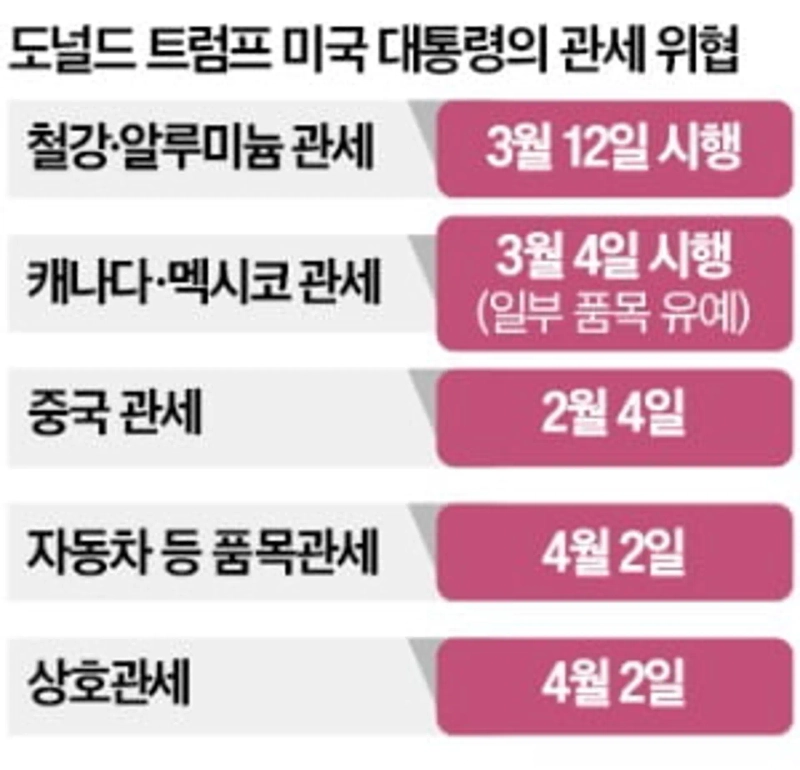
There is a growing expectation that the US government will take a two-phase approach regarding the reciprocal tariffs that President Donald Trump is set to announce on the 2nd of next month. The approach involves imposing emergency tariffs of up to 50% on major trading partners, followed by adjustments through investigations and negotiations. Korean trade authorities also consider this scenario likely and are preparing countermeasures.
The Financial Times (FT) reported on the 25th (local time) that the US government is strongly considering imposing emergency tariffs until the investigation of trade practices with trading countries is completed, and then imposing additional tariffs based on the investigation, citing statements from US administration officials.
The legal basis for the first phase of tariff imposition is mainly the International Emergency Economic Powers Act (IEEPA) and Section 338 of the Tariff Act, which grants the US President authority to act in national emergencies. Section 338 of the Tariff Act allows for tariffs of up to 50% on countries that have taken unfair actions in trade with the US. Although it has been rarely used since its enactment in 1930, it is being revisited in the Trump administration's second term.
The second phase involves the US authorities adjusting tariff rates while investigating unfair trade practices. During this phase, Section 301 of the Trade Act, which specifies regulations for investigating and retaliating against foreign trade practices, is likely to be the basis, according to analysis.
Trade authorities also view this plan as likely. Trade experts have anticipated a 'first impose, then negotiate' scenario where the US categorizes countries by grade or imposes tariffs uniformly before entering bilateral negotiations. Yang Juyoung, head of the Economic Security and Trade Strategy Research Office at the Korea Institute for Industrial Economics and Trade, explained, "The US lacks the physical time to impose tariffs based on non-tariff barriers, exchange rates, and policies of each country."
The 2nd of next month is the day President Trump previously declared as 'Tariff Liberation Day.' It cannot be ruled out that item tariffs, which President Trump has repeatedly emphasized, such as on automobiles, will be imposed along with reciprocal tariffs on that day.
At an event at the White House on the 24th, where Hyundai Motor Group's US investment was announced, he said, "We will announce additional tariffs on automobiles, lumber, semiconductors, etc., within days," adding, "These tariffs may be implemented before the announcement of reciprocal tariffs."
As the Trump administration's intention to impose automobile tariffs is reaffirmed, the government's sense of crisis is escalating. Although Hyundai announced a large-scale US investment of about $21 billion, it is widely viewed that item tariffs on cars made in Korea and exported to the US will not be exempt. The government is particularly concerned that if reciprocal tariffs and automobile tariffs are imposed together, the impact on the domestic automobile industry will be significant.
A government official emphasized, "The expression 'tariff exemption' mentioned by President Trump at the White House, referring to Hyundai, is likely a general statement about vehicles produced in the US," adding, "We will strive to receive favorable treatment through working-level negotiations with the US until the end."
Reporter Ha Ji-eun hazzys@hankyung.com

Korea Economic Daily
hankyung@bloomingbit.ioThe Korea Economic Daily Global is a digital media where latest news on Korean companies, industries, and financial markets.