

Summary
- Eurozone's March CPI stabilized at 2.2%, raising the possibility of a rate cut.
- The market estimated the likelihood of an ECB rate cut at about 76%, showing a positive reaction.
- News of Eurozone's inflation slowdown led to a 1.2% rise in the Stoxx 600 index.
EU May Retaliate with Tariffs in Response to Trump's Reciprocal Tariffs, Raising Inflation Concerns
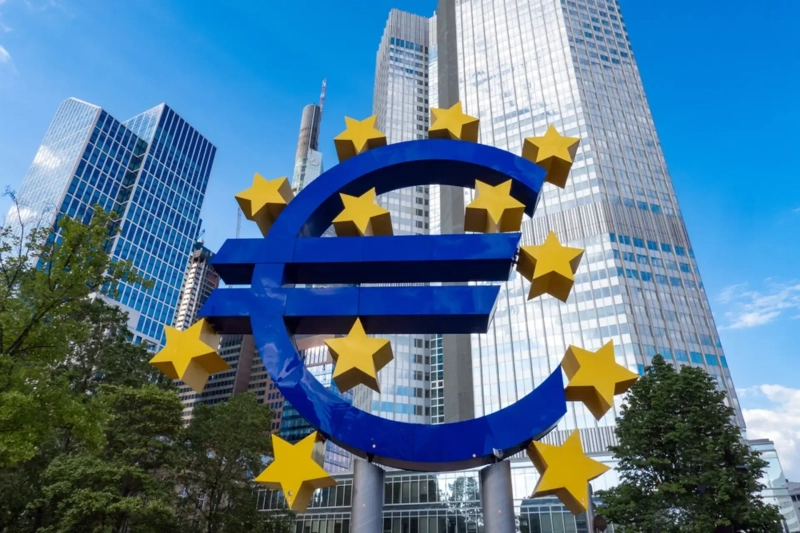
Eurozone's March consumer prices slowed as expected to an annual rate of 2.2%. This gives the European Central Bank (ECB) room to cut rates amid rising inflationary pressures from Trump's reciprocal tariffs and expected retaliatory tariffs.
On the 31st (local time), Eurostat, the statistical office of the European Union (EU), announced that the annual inflation rate in the Eurozone recorded 2.2% in March. This is lower than the 2.3% from a month ago, indicating that inflation across the Eurozone has entered a stable phase.
As a result, there is growing expectation that the ECB will implement a 25 basis point (1bp=0.01%) rate cut at the meeting on the 17th of this month. According to LSEG data, before the Eurozone inflation data was released, the market estimated the likelihood of a rate cut at about 76%.
The Trump administration is expected to announce reciprocal tariffs on the EU this week. A 25% tariff on imported cars is also expected to affect a significant number of European car manufacturers. The EU has repeatedly mentioned retaliatory tariffs in response to US tariffs. Economists have warned of the inflationary effects of rising import tariffs.
With news of the Eurozone's inflation slowing, the Stoxx 600 index, which covers a wide range of European companies, showed a 1.2% increase as of 10:30 AM London time.
Guest reporter Kim Jung-ah kja@hankyung.com

Korea Economic Daily
hankyung@bloomingbit.ioThe Korea Economic Daily Global is a digital media where latest news on Korean companies, industries, and financial markets.