

Trump Claims '50% Tariff on US Imports from Korea'... A Look at the 'Ridiculous Numbers' Calculation Method [US Reciprocal Tariffs Intensify]
Summary
- President Trump's claim of a 50% tariff rate on US imports from Korea is based on arbitrary calculations and is an exaggerated figure.
- The actual tariff rate on US imports from Korea is 0.79%, effectively 0% after rebate procedures, as a result of the Korea-US FTA.
- It emphasizes that there is no basis for the US to impose additional tariffs on Korea, with the Korean government continuously correcting the erroneous figures.
Higher than Korea 25%, EU 20%, Japan 24%
Claims to have arbitrarily calculated using US trade deficit, asserting 'reflection of exchange rates and non-tariff barriers'
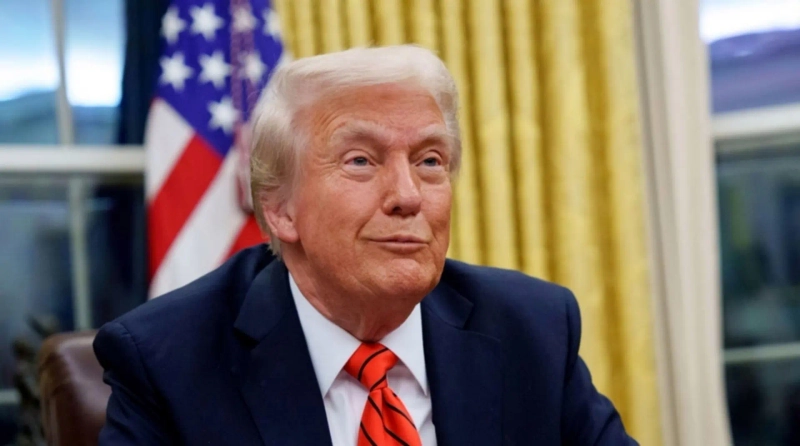
On this day, President Trump presented a chart listing China's tariff rate on US imports as 67%, Taiwan's as 64%, Korea's as 50%, and Japan's as 46%. This was to show that reciprocal tariff rates were set at half of these numbers.
However, Korea's tariff rate on US imports is 0.79%, and even this is effectively 0% after rebate procedures. This is the result of the renegotiated Korea-US Free Trade Agreement (FTA) during Trump's first term. Although President Trump attached a note to the chart stating 'tariff rates on the US, including exchange rate manipulation and non-tariff barriers,' no calculation could suddenly make the tariff rate on US imports 50%.
In this regard, the interpretation that he arbitrarily used the export volume and US trade surplus of each country to derive the tariff rate is gaining traction. According to a post by Eurasia Group's Ian Bremmer on social media X, the European Union (EU) exported $605.8 billion last year and recorded a $235.6 billion US trade surplus. Dividing these figures matches the 39% shown in President Trump's chart.
Similarly, Korea exported $131.5 billion last year and recorded a $65.8 billion US trade surplus. Calculating this results in 50%. China's export amount of $438.9 billion and $295.4 billion US trade surplus also match the 67% figure for all countries.
The White House attempted to gloss over this by claiming it included exchange rate manipulation and non-tariff barriers, but in reality, it admitted that there was neither the time nor the capability for rigorous calculation. Bremmer stated, "This is unbelievably stupid," adding, "This is why the tariff rate chart on the US seems to have been created."
The same interpretation is emerging from many others. It cannot be interpreted differently. James Surowiecki, a financial columnist for The New Yorker, expressed bewilderment, saying, "I don't know how Treasury Secretary Scott Besant could sign off on this," pointing out that the figures only reflect goods trade and exclude the fact that the US records a service surplus with the world. He also noted, "President Trump is trying to impose a 32% tariff on Indonesian coffee, but the US exports coffee to almost no countries, including Indonesia," adding, "President Trump literally does not understand the concept of 'comparative advantage.'"
Previously, the US Trade Representative (USTR) mentioned in its national trade barrier report that Korea's trade barriers included the inability to export beef for over 30 months and the practice of giving 'bonuses' such as technology transfer when exporting military supplies (offset trade), but most of these were common practices in other countries or issues with a small market size.
Before the press conference and signing of the executive order, the Trump administration again mentioned the erroneous data that Korea's tariff rate on US imports is four times the tariff rate the US applies to Korea during a pre-briefing for some media. Despite numerous corrections by the Korean government, including Minister of Trade, Industry and Energy Ahn Deok-geun and Head of Trade and Industry Jeong In-kyo, they ignored this and cited data that suited their narrative. Conversely, this implies that without citing such false figures, there is no basis for imposing tariffs on Korea.
Washington Correspondent Lee Sang-eun selee@hankyung.com

Korea Economic Daily
hankyung@bloomingbit.ioThe Korea Economic Daily Global is a digital media where latest news on Korean companies, industries, and financial markets.