

PiCK
Can Ethereum Rebound...Industry Says 'Stop Expanding and Recover Identity'
Summary
- Investors reported that the weakness of Ethereum is prolonged, and the lack of strategic priorities and excessive complexity are pointed out as major issues.
- Industry figures emphasize that establishing identity is more important than scalability for recovering the competitiveness of Ethereum.
- It was revealed that changes in the regulatory environment could affect the future competitiveness of Ethereum, suggesting the need for clear strategy establishment.
Urgent Need to Recover Competitiveness and Identity Over Expansion
Developer-Centric Roadmap Neglects User Experience
"The Era When Ethereum Was the Only Choice Has Ended"
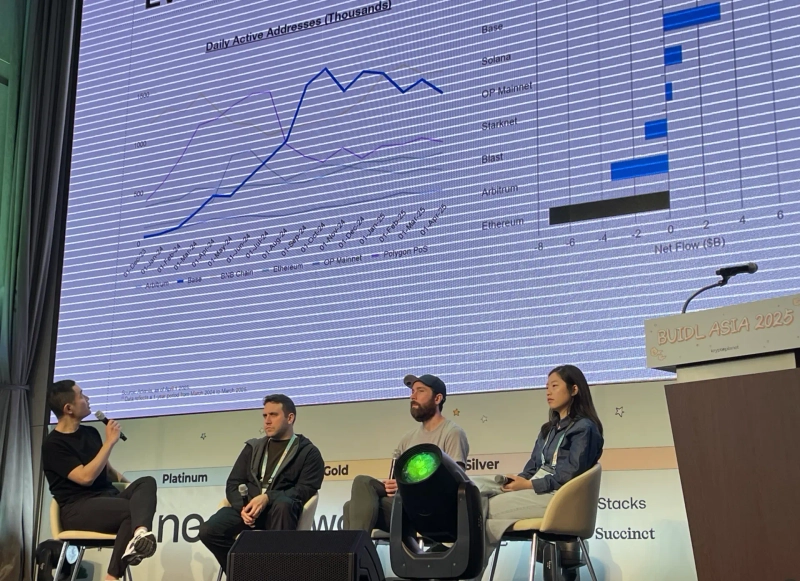
"Can Ethereum Rebound Again?"
As the weakness of Ethereum (ETH) prolongs, key figures in the Ethereum ecosystem gathered to diagnose the direction and identity of Ethereum. The panel pointed out the biggest challenges facing Ethereum as ▲ lack of strategic priorities ▲ excessive ecosystem complexity ▲ lack of clear direction.
On the 16th, at 'BUIDL Asia 2025' held in Songpa-gu, Seoul, a fireside chat was held under the theme 'Can Ethereum Win Again?'. Jacob Arluck, Head of Strategy at Celestia Labs, Lane Rettig, Head of Research at the Near Foundation, and Christine Kim, Ethereum Core Developer Whisperer, who attended the event, unanimously said, "Establishing identity is more important than scalability for Ethereum."
Arluck stated, "Ethereum is now not just a single blockchain but a brand and network," adding, "However, current users and developers are migrating to Layer 2 (L2) or other blockchains. The Ethereum mainnet is showing limitations in accommodating high-performance applications." He continued, "The lack of strategic priorities is causing division within the ecosystem."
Rettig criticized Ethereum's complexity. He said, "Today's Ethereum has tried various narratives such as decentralized finance (DeFi) chain and non-fungible token (NFT) chain but has not established a clear identity," advising, "It should set a clear direction as the most reliable neutral payment infrastructure. This is why BlackRock, Securitize, etc., issue assets on Ethereum."
Regarding this, Kim Whisperer evaluated, "Ethereum is still the most successful project in the open-source ecosystem," but diagnosed, "The accumulation of value as a gas token or protocol asset is still limited." She also said, "Now is the time to focus on making Ethereum a decentralized data availability layer rather than L1 scalability."
There was also an analysis that changes in the regulatory environment could affect Ethereum's future competitiveness. Kim argued, "Since the inauguration of the Trump administration, the deregulation trend has accelerated, weakening the 'regulatory stability premium' that Ethereum has enjoyed," emphasizing, "Now, clear strategy establishment and resource concentration are urgent."
However, Arluck disagreed. He argued, "An asset issuance-centric strategy is not sustainable," adding, "Especially stablecoins and real-world asset tokenization (RWA) have high inter-chain transferability. Ultimately, Ethereum infrastructure must operate autonomously to maintain competitiveness."
There was also a point that the lack of strategic priority setting and excessive complexity are the core issues Ethereum is currently facing. In particular, the developer-centric roadmap has pushed user experience to the back, and although dependence on the L2 ecosystem has increased, the lack of clear governance leadership is increasingly weakening Ethereum's identity.
Arluck said, "Ethereum is currently too complex. Users are confused about what Ethereum exists for," adding, "In the past, Ethereum was the only choice, but now it is not."
Rettig also criticized, "Ethereum is trying to do too much. It has lost its direction by trying to satisfy too many people," adding, "The attempt to accommodate the demands of various stakeholders without a clear vision is rather blurring Ethereum's identity."
Kim emphasized, "Ethereum developers have so far been greedy to 'have their cake and eat it too,' but now is the time to set realistic priorities." She continued, "Recently, there is a growing consensus among developers on practical measures such as raising the block gas limit or increasing blob capacity," adding, "Establishing the role as a data availability layer is more important than simple scalability discussions."

Doohyun Hwang
cow5361@bloomingbit.ioKEEP CALM AND HODL🍀