

PiCK
Trump imposes '100% tariff bomb' on imported films… "I will save Hollywood"
Summary
- President Trump announced plans to impose a 100% tariff on films produced overseas, aiming to revive the Hollywood industry.
- This is interpreted as a retaliation against China's restriction on U.S. film imports, potentially causing chaos in the film industry.
- Experts expressed concerns that the tariffs could significantly harm U.S. film production companies.
Film Industry Defined as 'National Security'
Countermeasure against China's Restriction on U.S. Film Imports
Indiscriminate Taxation Despite Ambiguous Film Nationality
Criticism for Lack of Understanding of Industry Structure
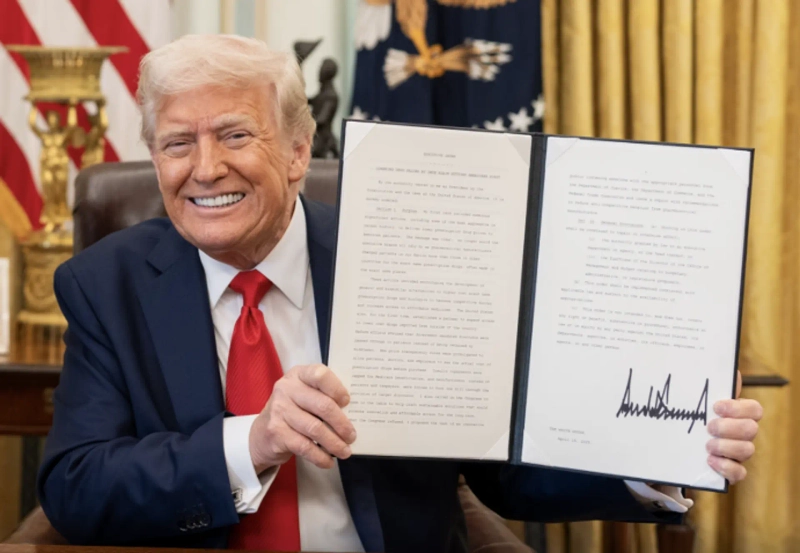
U.S. President Donald Trump announced on the 4th (local time) that he plans to impose a 100% tariff on films produced overseas. He defined the film industry as an issue directly linked to 'national security.' There are criticisms that tariffs are being imposed indiscriminately on areas unrelated to national security.
President Trump stated on social media that he has authorized the Department of Commerce and the United States Trade Representative (USTR) to initiate procedures to impose a 100% tariff on all imported films. He further claimed that "the American film industry is dying very quickly" and that "other countries are providing various incentives to make American filmmakers and studios disappear from the U.S."
Since taking office, President Trump has imposed high tariffs on major items such as steel and aluminum, citing 'national security threats.' He applied the same logic to the film industry this time. President Trump said, "These incentives are an organized effort by foreign governments and thus a threat to national security," and called them "a means for message delivery and propaganda." He added, "We want films made in America again."
The prevailing interpretation is that President Trump's announcement to impose a 100% high tariff on imported films is a retaliatory measure against China's announcement last month to reduce imports of U.S. films. At that time, the China Film Administration stated in a statement, "As a retaliation for the aggressive tariff measures by the U.S., we will strengthen restrictions on Hollywood film imports," and "this will further decrease Chinese audiences' favorability towards American films."
The market share of Hollywood films in China has been on the rise recently. Last year, the market share of imported films in China increased from 16% the previous year to 21%. Of the 93 new foreign films approved for screening in China last year, 42 were Hollywood productions.
The problem lies in the difficulty of simply classifying the 'nationality' of films due to the globalized production structure. While scriptwriting, editing, and sound work are mainly done in the U.S., filming is increasingly being conducted overseas to reduce costs. In this process, foreign governments often provide tax benefits.
'Minecraft Movie,' considered the top-grossing film this year, was filmed in Canada, and 'Mission Impossible: Final Reckoning,' scheduled for release this summer, was mostly produced outside the U.S. Disney's Marvel Studios is filming two sequels to Avengers in the UK.
The New York Times (NYT) reported, "Nowadays, it is common for more than six specialized companies scattered around the world to participate in a single superhero movie." President Trump emphasized that "Hollywood and other regions in the U.S. are being severely hit" and that tariffs will solve this, but there are concerns that domestic production companies may suffer even greater damage.
Hollywood is already in crisis. Earlier this year, the aftermath of large wildfires that swept through the Los Angeles (LA) area damaged film production infrastructure, leading to predictions that production companies and technical personnel could quickly leave LA. According to the nonprofit organization FilmLA, the number of film and TV productions in the LA area has already decreased by about 40% over the past decade.
On the same day, President Trump took a tough stance on the 145% high tariff imposed on China in an interview with NBC. When China demanded that the U.S. lower tariffs first for tariff negotiations, he questioned, "Why should I do that?" and drew a line that there would be no preemptive tariff reduction. He further claimed, "China is now virtually (economically) dying," and "factories are closing, and unemployment is soaring." He was reserved about whether tariffs would be lowered.
When asked about the possibility of future reductions, he said, "At some point, it could be lowered," but also suggested that tariffs could be prolonged by saying, "If they believe tariffs will be excluded, why would they build factories in the U.S.?"
Reporter Lim Dayeon allopen@hankyung.com

Korea Economic Daily
hankyung@bloomingbit.ioThe Korea Economic Daily Global is a digital media where latest news on Korean companies, industries, and financial markets.