

Jonathan Pingle "Global Investors Flee Amid Tariff Storm…US to Face Severe Fiscal Pressure"
Summary
- Jonathan Pingle, Chief Economist at UBS, warned of the slowdown in US economic growth due to tariffs, stating that the scenario of global investors withdrawing funds is the biggest risk.
- He mentioned that US tariff policies would raise prices by 2 percentage points and that a decline in asset prices is inevitable.
- He expressed concern about the severe fiscal pressure on the US federal government due to the withdrawal of global investors' funds.
US Growth Rate Likely to Stall at 0.5%
Employment Market Worsening Due to Slowing Growth
Bearish Trend Expected to Reflect Fully by June-August
Tariffs to Raise Prices by Additional 2%P
Biggest Risk is US Capital Withdrawal
Corporate Investment Deceleration to Accelerate from Q2
Unavoidable Shrinkage in Treasury Demand and Asset Decline
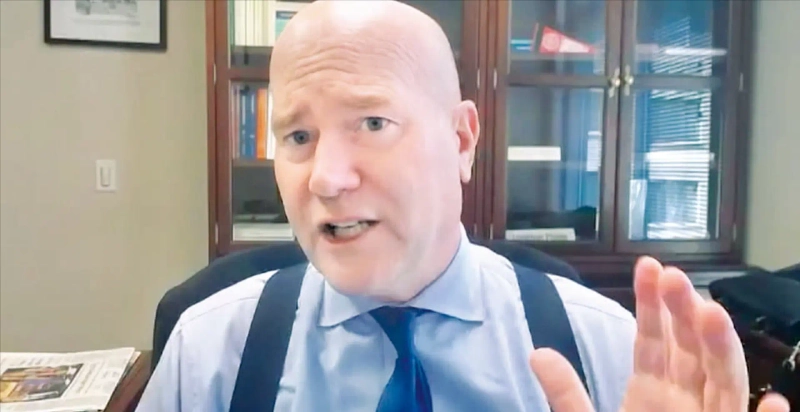
"This year, the US economic growth rate will stall at 0.5%. The scenario of global investors withdrawing massive funds from the US is the biggest risk this year." Jonathan Pingle, Chief Economist at global investment bank UBS, said this in a video interview with Korea Economic Daily on the 29th of last month. Pingle is one of the most cited economists on Wall Street. He recently warned of the possibility of a US economic recession due to 'Trump tariffs'. In the interview, Pingle predicted that the US economy would significantly slow down this year due to the impact of tariffs. He foresaw that the decline in US asset prices would be inevitable if global capital, which has been flowing into the US for decades, exits due to policy uncertainty.
Jonathan Pingle, Chief Economist at UBS, warned in a video interview with Korea Economic Daily that "the US economy will significantly slow down this year due to the impact of US tariffs." He expressed concern that if global funds exit the US due to policy uncertainty, the decline in US asset prices would be inevitable. Shin-Young Park, New York Correspondent
Jonathan Pingle, Chief Economist at UBS, warned in a video interview with Korea Economic Daily that "the US economy will significantly slow down this year due to the impact of US tariffs." He expressed concern that if global funds exit the US due to policy uncertainty, the decline in US asset prices would be inevitable. Shin-Young Park, New York Correspondent
▷Which should we focus on, consumer indices or employment indicators?
"Since COVID-19, consumer sentiment indices have become difficult to trust. They showed very low figures when the US Federal Reserve (Fed) sharply raised interest rates. This time, the impact will eventually be revealed in employment indicators, etc. Noticeable changes such as increased layoff notices and decreased equipment orders are appearing. Most occurred before March, so the tariff impact has not yet been reflected in the indicators."
▷Will a recession hit within a year?
"There is a high possibility of entering a phase of very sluggish growth. The UBS global team has downgraded the world economic growth rate. Even if the Donald Trump administration partially withdraws tariffs, the uncertainty from the measures already implemented remains. The economy will significantly slow down this year compared to 2023 or 2024."
▷When will the recession signals become clear?
"I expect it to become clearer in the April corporate investment and employment report released in May. Especially since it takes time for it to appear in employment indicators, the full bearish trend could become more pronounced around June-August. It will take a few more months for the tariff impact to be fully reflected."
▷How will tariff uncertainty affect economic growth?
"Uncertainty burdens corporate management plans. Around 2011-2012, when former President George W. Bush's tax cuts were about to expire, tax uncertainty caused companies to delay investments. In a UBS report last November, it was predicted that the US economy would slow down this year due to trade and tax uncertainty, but the outlook has worsened since President Trump's recent tariff announcement. The slowdown in corporate investment is expected to appear from Q2 and become more pronounced in the second half. If global investors distance themselves from the US market and assets, severe pressure could be placed on the federal government's finances."
▷What is your outlook for US growth this year?
"At the beginning of the year, it was seen at 1.75%. However, since the scale and scope of Trump's tariffs were larger than expected, the growth forecast was lowered by 1 percentage point, and now it is seen at around 0.5%."
▷The US employment market appears robust on the indicators.
"The April employment report may be relatively good, but the signal that the overall employment market is gradually cooling is clear, and if growth continues to slow, employment is likely to worsen. Job postings have also been on a decline since the tariff announcement, showing signs of a gradually slowing employment market."
▷Is tariff reduction negative for the US?
"Yes. The current administration is adjusting to prevent overlapping tariffs rather than granting tariff exemptions. Some semiconductors, pharmaceuticals, etc., have tariff exemption benefits, but there are also plans to apply tariffs based on other legal grounds."
▷Do tariffs help with jobs?
"Automation and productivity improvement are important variables. Even if manufacturing increases in the US, if the use of robots increases, jobs may not increase significantly. Attempts to reorganize the supply chain and shift overseas production domestically can lead to short-term growth slowdown and inflation. The administration's goal is to establish a manufacturing base and positively impact the middle class, but there is economic pain involved."
▷There are concerns about price increases due to high tariffs on China.
"This tariff is expected to raise the inflation rate by an additional 2 percentage points. Tariffs are a strong factor exerting upward pressure on prices. If tariffs were applied only to China, the impact would be limited. However, with tariffs imposed so broadly now, it is difficult to secure substitutes, and it is likely to lead to price increases."
▷What is your assessment of US Treasury bonds?
"After the tariff announcement, the dollar weakened, and there was a selling trend in the Treasury market. It shows that global investors' confidence in the US growth outlook has partially collapsed. However, signs of the return of the bond vigilantes (responding to anti-market policies by dumping held bonds) were already present even before the Trump tariffs. The increase in US Treasury issuance and the expansion of the fiscal deficit in 2023 were burdening the market."
▷In the stock market, the belief in 'American exceptionalism' is disappearing.
"I see the S&P 500 index at around 5300 by the end of the year. It implies a sideways movement in stock prices. However, tariff uncertainty is too high."
▷What is the biggest risk globally?
"The scenario of global investors massively withdrawing funds from the US. If foreign capital, which has been flowing into the US for decades, exits due to policy uncertainty, tariffs, and the trend of de-globalization, several issues such as US asset price declines and Treasury demand shrinkage could arise."
New York = Shin-Young Park, Correspondent nyusos@hankyung.com

Korea Economic Daily
hankyung@bloomingbit.ioThe Korea Economic Daily Global is a digital media where latest news on Korean companies, industries, and financial markets.