

PiCK
90% of economists express concerns about the U.S. dollar's safe-haven status within 5–10 years due to Trump's actions
Summary
- Over 90% of economists indicated concerns that the U.S. dollar may lose its status as a safe-haven asset.
- President Trump's policies and actions that undermine the Fed's independence are said to be negatively impacting the dollar's value and related assets.
- More than three-quarters of respondents predicted that the yield on the 10-year U.S. Treasury Bonds would reach 5% by mid-next year.
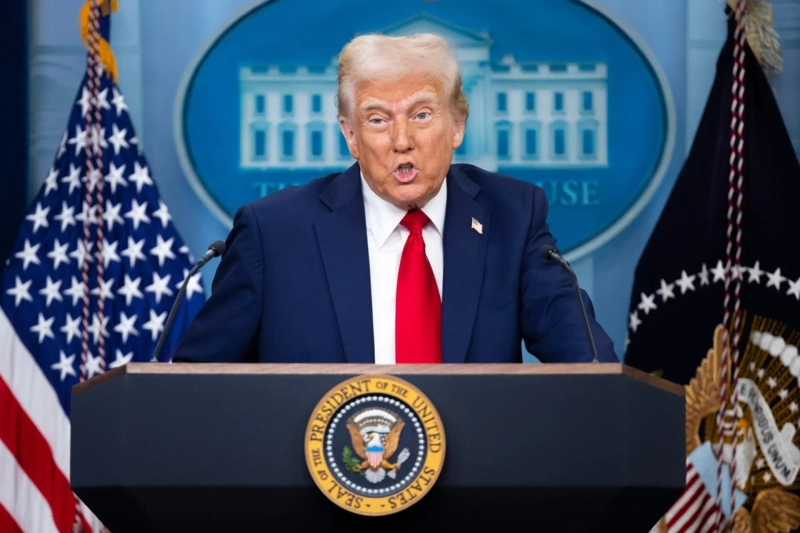
A survey has found that over 90% of economists are concerned about the potential weakening of the U.S. dollar’s status as a safe-haven asset.
According to Yonhap News Agency and others on the 30th, a survey conducted this month by the Financial Times (FT) and the Kent A. Clark Global Markets Center at the University of Chicago’s Business School of 47 economists showed that more than 90% of respondents were worried about a weakening role for dollar-denominated assets as safe assets within the next 5–10 years.
Roughly 60% responded that they were 'somewhat' concerned, while about 30% indicated they were 'very' concerned.
The FT noted that Donald Trump’s policy initiatives and actions undermining the independence of the United States Federal Reserve have fueled worries about the dollar’s standing.
After President Trump unilaterally announced a country-specific reciprocal tariff policy in April, U.S. stock prices, Treasury bond prices, and the value of the dollar all declined. The U.S. Dollar Index, which tracks the value of the dollar against the currencies of six major countries, continues to trade below its benchmark level of 100.
Robert Barbera, director of the Center for Financial Economics at Johns Hopkins University, commented, "(If President Trump effectively takes over the Federal Reserve) my concern about dollar assets would shift from 'somewhat' to 'very' serious."
Anna Cieslak, professor at Duke University, pointed out that issues such as the fiscal deficit, government actions intentionally weakening the dollar’s value, uncertainty over the next Fed chair, and questions about Fed independence are all having negative effects.
There was also discussion of a possible rise in the yield on the 10-year U.S. Treasury Bonds as a result of the dollar's weakening status. Over three-quarters of respondents forecasted that the yield on the 10-year U.S. Treasury Bonds would reach 5% by mid-next year. Currently, it is moving around 4.3%.
In addition, respondents offered a more pessimistic outlook on U.S. economic growth and inflation stability compared to previous surveys. The median forecast for the U.S. Gross Domestic Product (GDP) growth rate for 2025 was 1.5%. The December survey last year showed 2.3%, and the March survey this year recorded 1.6%.
While the growth outlook was revised downward, the projection for this year’s core Personal Consumption Expenditures (PCE) price index growth rate (excluding volatile food and energy prices) was raised: 2.5% in December last year, 2.8% in March this year, and 3% in the latest survey.
Hankyung.com journalist Han Kyungwoo case@hankyung.com

Korea Economic Daily
hankyung@bloomingbit.ioThe Korea Economic Daily Global is a digital media where latest news on Korean companies, industries, and financial markets.