

Wi Sung-rak: "We are narrowing down the timing for the South Korea-U.S. summit"
Summary
- Director of National Security Wi Sung-rak announced that he proposed a 'package deal' to the United States in the tariff negotiations, including South Korean companies’ investment in the U.S., purchases of American energy, and shipbuilding cooperation.
- Trade negotiations with the United States are quite advanced, and most of the agendas desired by both countries have been identified and are currently being adjusted.
- Although the issue of defense cost-sharing for U.S. Forces Korea was not discussed, he emphasized that South Korea is already paying about ₩1.5 trillion and providing both direct and indirect support.
'Tariff Negotiation' U.S. Visit Briefing
Package deal includes investments in the U.S. and shipbuilding
"Trade talks with the United States are progressing fairly well
We have identified nearly all of each other’s agendas"
Defense cost-sharing was not discussed
"₩1.5 trillion paid and direct/indirect support provided"
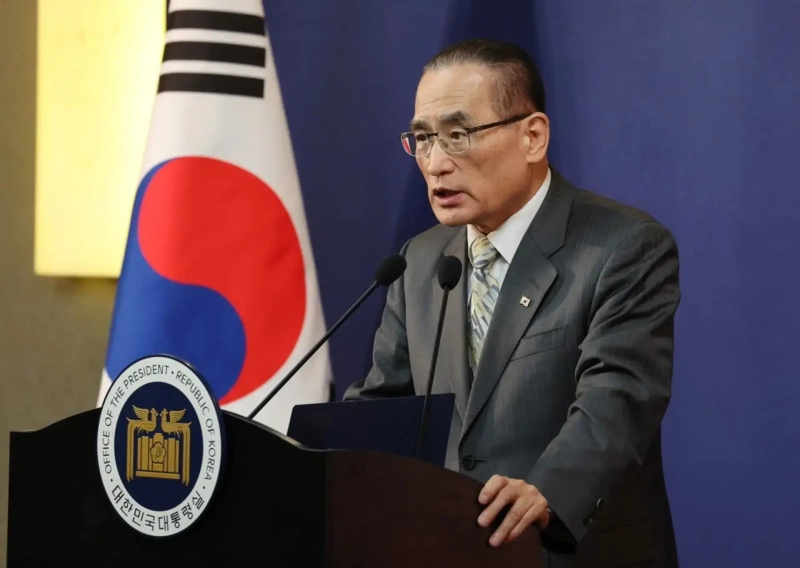
Wi Sung-rak, Director of National Security at the Presidential Office, explained that the 'package deal' proposed to the United States for the tariff negotiation includes South Korean companies’ investments in the U.S., expanded purchases of American energy (such as Liquefied Natural Gas (LNG)), and strengthened cooperation in defense and security (including the shipbuilding industry). The U.S. government, based on its trade deficit, has been raising tariffs by country, and South Korea has raised the idea of negotiating in a way that encompasses benefits already provided or that could be provided to the United States. Marco Rubio, U.S. Secretary of State and National Security Advisor, partially agreed with this approach, which is seen as a result of this visit to the U.S.
◇ U.S. shows consensus on package deal
After returning from Washington, D.C., where he held trade and security negotiations with the U.S. government, Director Wi held a briefing on the 9th, partially disclosing the contents of the talks. He said that, in his meetings with Secretary Rubio and others, he focused on three main issues: reaching an agreement to strengthen the South Korea-U.S. alliance, the package deal, and the swift promotion of a bilateral summit. Among these, the proposal for shipbuilding cooperation (construction of merchant and naval vessels) is an area of interest for President Donald Trump.
While Director Wi was negotiating tariffs in Secretary Rubio's office, a letter sent to South Korea, Japan, Malaysia, Myanmar, and others appeared in real time on a screen. He stated, “The U.S. trade departments seem to confine the issue to tariffs alone.” He added, “I said we should discuss the 'end state' of the South Korea-U.S. alliance, keeping it in view,” and further commented, “There are people inside the U.S. who agree and some who do not, so we will have to see how much this will be reflected in the policy decision process.”
The emergence of negotiating agendas is a positive sign. Director Wi remarked, “Trade talks with the United States are fairly well advanced, and we have roughly identified what each side wants,” adding, “The sides are currently adjusting positions on each agenda.” President Lee Jae-myung recently stated in a press conference on the 3rd, “It is still not clearly defined what both parties want,” but the negotiations are seen as having become much more concrete compared to that time.
◇ "Not defining the summit as before or after August 1"
Director Wi also discussed the possibility of a summit with Secretary Rubio. He stated, “We agreed with Secretary Rubio to reach mutually beneficial agreements on current issues through a South Korea-U.S. summit as soon as possible, and Secretary Rubio also agreed with this,” he said. Regarding the timing, he commented, “While we have not discussed exact dates, we are narrowing down the ‘timing’ in our talks. We are not defining it as being before or after August 1.” He added, “We will continue negotiations as planned, and it would be most ideal to wrap up discussions through various channels and proceed all the way to a summit.”
Director Wi said that the Special Measures Agreement (SMA) on U.S. Forces Korea defense cost-sharing was not discussed during this visit. When President Trump remarked that “South Korea should pay $10 billion annually,” Director Wi was on the return flight. However, he noted, “Under the SMA, South Korea pays around ₩1.5 trillion, and also provides direct and indirect support,” emphasizing, “This is not an issue to be handled diplomatically.” He further explained, “We addressed the overall defense budget during the security discussions, and are coordinating to gradually increase it in line with international trends. Security discussions are likely to take longer than trade issues.” He also commented, “We are also conducting long-term negotiations regarding the transfer of wartime operational control, which is one of President Lee’s campaign pledges.”
Regarding President Trump having repeatedly raised issues such as tariffs and defense costs in relation to South Korea, Director Wi said, “It seems that South Korea has come into the area of interest recently.”
By Kim Hyung-kyu khk@hankyung.com

Korea Economic Daily
hankyung@bloomingbit.ioThe Korea Economic Daily Global is a digital media where latest news on Korean companies, industries, and financial markets.