

Bank of Korea Keeps Interest Rate Unchanged, "Concerns Over Household Debt Rise and Economic Slump Eases"
Summary
- The Bank of Korea announced its decision to keep the base interest rate at 2.50% per year.
- The bank highlighted concerns over increasing household debt and overheating in the housing market, stating that it is necessary to monitor the impact of government measures.
- Attention is needed regarding future domestic demand recovery, Korea-USA trade negotiations, and other uncertainties.
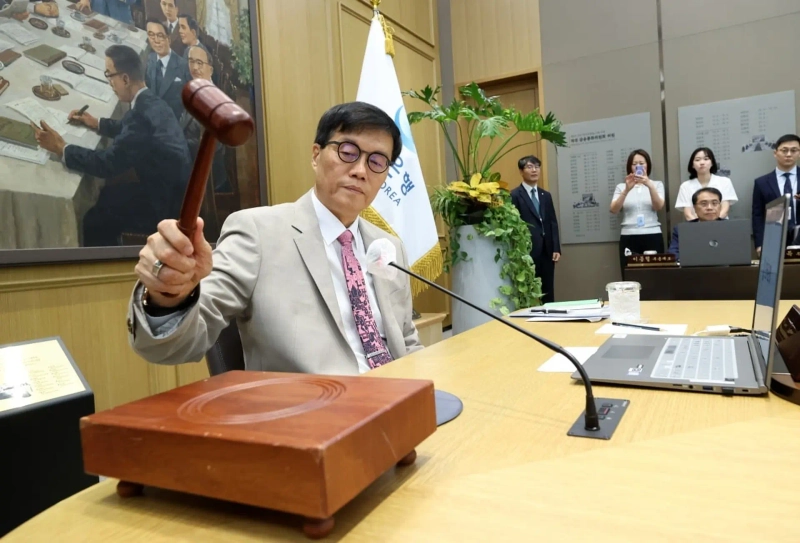
The Bank of Korea held a Monetary Policy Committee meeting on the 10th to determine the direction of monetary policy and decided to maintain the base interest rate at 2.50% per annum. The reason cited was the need to observe the effects of the government’s real estate measures introduced to curb rapid house price increases and soaring household debt. The easing of the economic slowdown, which was a consideration at the last policy meeting, was also cited as a reason for keeping the rate unchanged.
On this day, the BOK held the meeting at its main building on Namdaemun-ro in Seoul and made this decision. After cutting the base interest rate from 2.75% to 2.50% per annum in May, the bank opted for a pause, leaving the rate unchanged this time.
Through the monetary policy decision statement released, the BOK explained the background of its decision: “There has been a significant surge in housing prices in the capital region and a marked increase in household debt, so it is necessary to monitor the impact of recently strengthened measures on household debt,” and added, “We judged that maintaining the current level of the base interest rate is appropriate.”
The BOK is paying close attention to overheating signs in the housing market. The BOK evaluated, “The housing market, including Seoul and the metropolitan area, had shown signs of overheating, but is now exhibiting a degree of stabilization following the implementation of government measures on household debt,” and added, “Household lending continued to grow rapidly due to the expanded housing transactions.”
Regarding the domestic economy, the BOK noted, “Low growth is expected to persist for the time being,” but mentioned that “the economic slump has somewhat eased.” “Although contraction in construction investment continued, consumption improved thanks to the resolution of domestic political uncertainties, and the uptrend in exports also persisted,” it said.
For its outlook, the bank considered uncertainties to be high. The BOK pointed out, “Consumption is gradually recovering driven by improved economic sentiment and supplementary budgets, but exports are expected to slow due to tariffs imposed by the USA,” and commented, “The growth trajectory is highly uncertain depending on developments in Korea-USA trade negotiations and the pace of domestic demand improvement.”
However, it projected that the inflation rate would remain stable. The BOK forecasted, “Amid low demand pressure and stable international oil prices, inflation will continue at around 2%,” and specified, “Accordingly, the consumer and core inflation rates for this year are expected to generally align with the May projections (both 1.9%).”
The BOK stated, “We will continue the policy of lowering rates to ease downside risks to growth, while closely monitoring changes in domestic and external policy conditions, related trends in inflation, and financial stability, in order to determine the timing and pace of any further rate cuts.”
Jin-Kyu Kang, reporter josep@hankyung.com

Korea Economic Daily
hankyung@bloomingbit.ioThe Korea Economic Daily Global is a digital media where latest news on Korean companies, industries, and financial markets.