

Japan's Long-Term Interest Rate at Highest in 17 Years..."Concerns Over Worsening Fiscal Health"
Summary
- Japan's 10-year government bond yield reached 1.595% per annum, its highest level in about 17 years.
- Concerns over fiscal deterioration due to the opposition's consumption tax cut pledge were cited as the backdrop for the decline in government bond prices.
- The rise in U.S. government bond yields and expectations of an additional policy rate hike by the Bank of Japan are also influencing the upward movement of Japanese government bond yields.
10-year government bond yield at 1.595% per annum
Impact from opposition party's consumption tax cut pledge
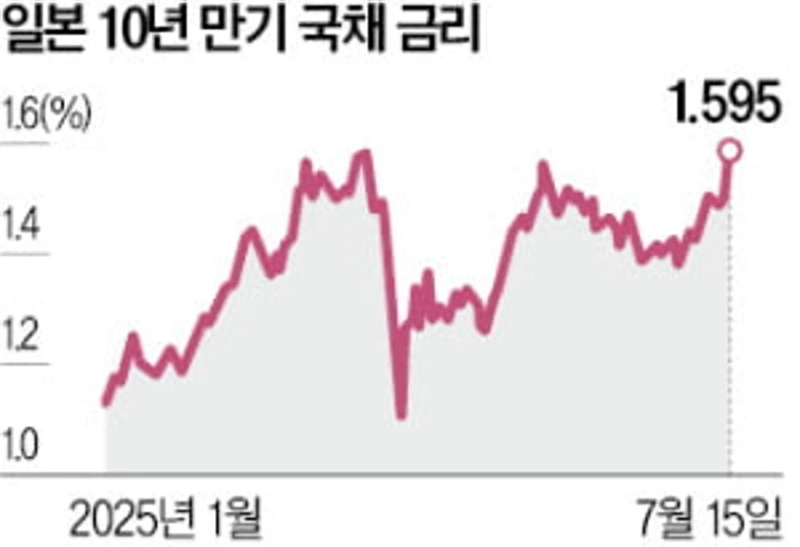
Japan's 10-year government bond yield, a key long-term interest rate indicator, surged to its highest level in about 17 years (implying a fall in bond prices). The rising concern over fiscal deterioration—triggered by the opposition's call for consumption tax reductions—was analyzed to have grown after speculation emerged that the ruling party may fail to maintain a majority in the upcoming House of Councillors election on the 20th.
On the morning of the 15th, the Tokyo bond market saw the 10-year government bond yield reach 1.595% per annum. This is the highest since October 2008, immediately after the Lehman Brothers shock, marking a 16 year and 9 month high. This development was influenced by Japanese local media projecting that the Liberal Democratic Party and its coalition partner Komeito may struggle to maintain their majority in this election.
The Asahi Shimbun, based on opinion polls conducted on the 13th and 14th, analyzed that the LDP would secure around 34 seats (between 27 and 39), while Komeito was expected to win about 9 seats (between 6 and 12). Together, LDP and Komeito must win a total of 50 seats to maintain a majority (125 seats) including their current 75 seats. The opposition parties, including the Constitutional Democratic Party of Japan (CDP), made a 'consumption tax cut' a key campaign pledge, proposing to lower the current 8% consumption tax on food to 'zero' (0). According to the Ministry of Finance, eliminating the consumption tax on food may reduce annual tax revenues by about ¥5 trillion.
Japan's consumption tax is a key resource supporting the social security system. There are mounting concerns that tax cuts without alternative funding measures could lead to an increase in 'deficit bonds.' Takashi Fujiwara, Head of Bond Investment at Resona Asset Management, told Nihon Keizai Shimbun (Nikkei), "As support for the opposition parties rises, the possibility of implementing consumption tax cuts is increasing." In addition, the rise in U.S. government bond yields and expectations of an additional policy rate hike by the Bank of Japan (BOJ) this year are also cited as factors behind the rise in Japanese government bond yields.
Tokyo = Ilgyu Kim, Special Correspondent black0419@hankyung.com

Korea Economic Daily
hankyung@bloomingbit.ioThe Korea Economic Daily Global is a digital media where latest news on Korean companies, industries, and financial markets.