

"Strengthening Bank of Korea's Macroprudential Role"… Lee Chang-yong Raises His Voice for Supervisory Authority [Kang Jin-kyu's BOK Watch]
Summary
- Lee Chang-yong, Governor of the Bank of Korea, highlighted the need to strengthen the macroprudential role and emphasized the necessity of expanding supervisory authority.
- The Bank of Korea stated that acquiring supervisory authority can improve the speed and effectiveness of monetary policy.
- He pointed out that Korea's high levels of household debt and credit concentration in real estate are factors that may weaken growth potential, stressing the need for appropriate mitigation measures.
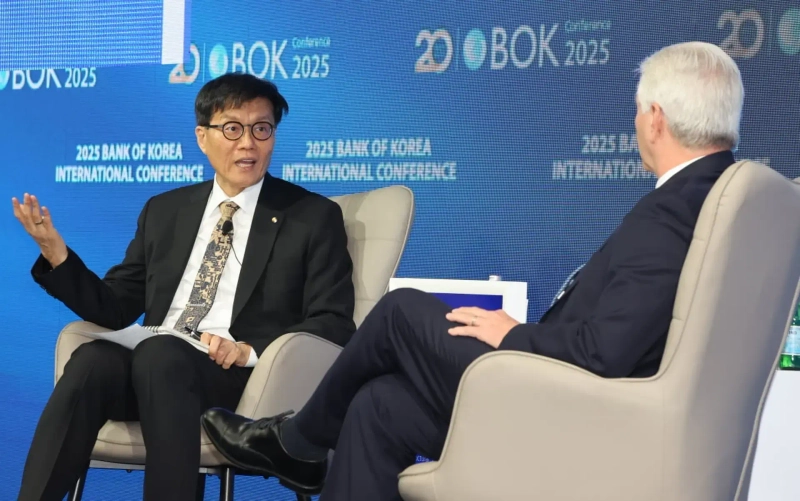
On the 16th, Lee Chang-yong, Governor of the Bank of Korea, stated, "The macroprudential role of central banks should be further strengthened." This is because, unlike major countries, the Bank of Korea lacks supervisory authority, leading to concerns about delays and diminished effectiveness in policy implementation.
On this day, Governor Lee expressed this view in his keynote speech at a conference co-hosted by the Asian Development Bank (ADB) and the Journal of International Money and Finance (JIMF). He also remarked that, in the macroprudential management of household debt, policy coordination among institutions is essential, but "it is difficult to respond effectively when there are disagreements with the government."
Recently, Governor Lee has repeatedly advocated for expanding the Bank of Korea’s supervisory authority amid discussions about the restructuring of financial authorities. At a press briefing following the Monetary Policy Committee on the 10th, he notably stated, "The Bank of Korea must raise its voice and establish a governance structure capable of executing macroprudential policies powerfully and independently of political influence." There has also been news that, during a briefing to the State Affairs Planning Advisory Committee last month, the Bank of Korea requested 'sole inspection rights.'
The Bank of Korea’s call for expanded supervisory rights aims to enhance the efficiency of monetary policy operations. Without such authority, it is difficult to quickly ascertain the condition of banks and non-bank financial institutions, raising the risk of misjudgment when making interest rate decisions, etc. Most central banks in major countries take this into account and have established supervisory authority within their central banks. The United Kingdom previously operated a separate supervisory agency, similar to Korea’s current structure, but has since moved the agency under the central bank, recognizing its limitations.
In Korea as well, until 1998, the Bank Supervisory Office was under the Bank of Korea and managed macroprudential functions. However, after the foreign exchange crisis and the ensuing government restructuring, the Financial Supervisory Commission was established to take over these supervisory functions.
On this day, Governor Lee cited several recent situations as examples of the Bank of Korea's top goal of price stability conflicting with its other monetary policy objectives, such as financial and exchange rate stability. For instance, in the second half of 2022, the Bank maintained high interest rates while managing financial instability through a separate organization. In August last year, although the need to cut rates increased, the Bank refrained from doing so because of concerns over household debt. In January of this year, the policy rate was held steady in consideration of exchange rate volatility.
He also reiterated concerns about rising housing prices in the Seoul metropolitan area and high household debt. Governor Lee explained, "In Korea, the ratio of household debt to GDP is already high at about 90%, restricting consumption," and that "the concentration of credit in the low-productivity real estate sector can act as a factor in weakening growth potential." He added, "Because real estate makes up an unusually high portion of household and financial institution assets in Korea compared to other major countries, it is necessary to address this appropriately."
At the conference, research findings were also presented showing that the higher the level of household debt, the more fiscal policy's economic stimulus effects are constrained. Lee Ye-il, Deputy Research Fellow at the Bank of Korea, explained, "Differences exist in fiscal policy effects depending on household debt levels, and the asymmetry appears to be larger in non-reserve currency economies like Korea."
Reporter Kang Jin-kyu josep@hankyung.com

Korea Economic Daily
hankyung@bloomingbit.ioThe Korea Economic Daily Global is a digital media where latest news on Korean companies, industries, and financial markets.