

Trump Finalizes Indonesia Trade Deal: Tariffs Cut from 32% to 19%, 0% on U.S. Products
Summary
- The U.S. and Indonesia have signed a trade agreement, reducing tariffs from 32% to 19% and granting zero tariffs on U.S. products.
- Indonesia has committed to opening its market by agreeing to purchase U.S. agricultural goods, energy, and aircraft.
- There are predictions that the U.S. will increase pressure on other countries to further open their agricultural markets.
Third Agreement Following the U.K. and Vietnam
Indonesia to Purchase Agricultural Goods, Energy, and Aircraft
Market Opening and Mutual Tariff Reduction
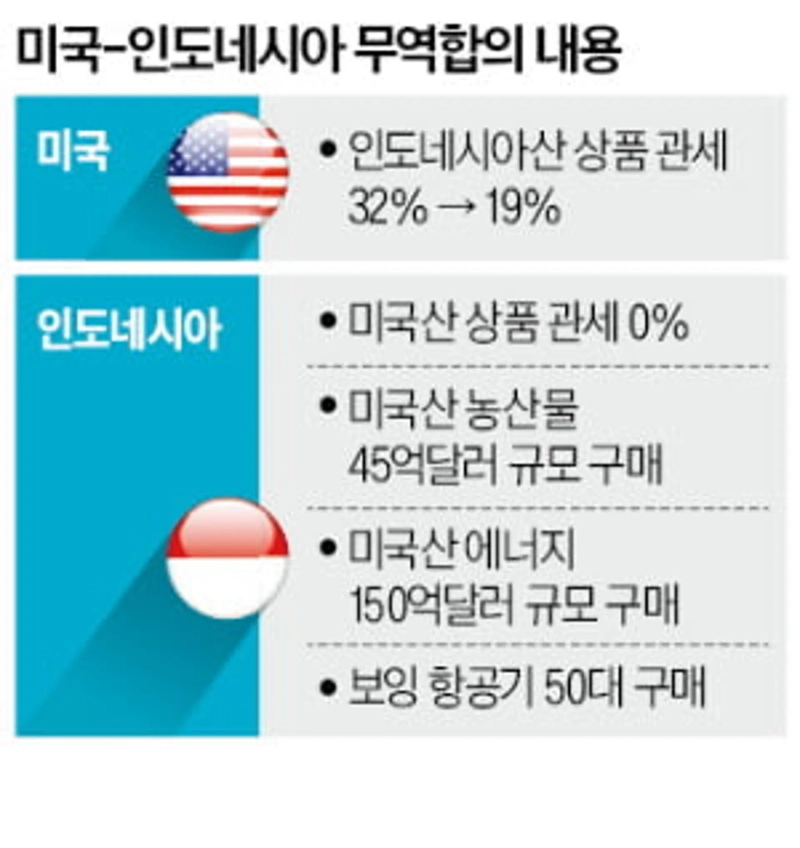
The United States and Indonesia have concluded a trade agreement. Indonesia has opened its market by applying zero tariffs to U.S. products, while reducing tariffs on goods exported to the U.S. from 32% to 19%. Market opening pressure on other countries negotiating tariffs with the U.S. is expected to increase.
Donald Trump, President of the United States, announced on social media on the 15th (local time), "After a call with Indonesian President Prabowo Subianto today, we have finalized an important trade deal," and added, "Indonesia will pay a 19% tariff on all goods exported to the U.S., while products exported from the U.S. to Indonesia will be exempt from all tariffs and non-tariff barriers." Indonesia is the third country to sign a new agreement with the U.S. following the U.K. and Vietnam.
A notable aspect of this agreement is the Trump administration's strategy of 'market opening through tariff pressure.' Indonesia has agreed to purchase $4.5 billion (approx. ₩6.25 trillion) worth of U.S. agricultural products, as well as $15 billion (approx. ₩20.8 trillion) in U.S. energy and 50 Boeing aircraft. President Trump stated, "We appreciate Indonesia's commitment to balancing its trade deficit." As of last year, trade volume between the U.S. and Indonesia was about $40 billion (approx. ₩55.5 trillion). Last year, U.S. exports to Indonesia increased by 3.7%, while imports rose 4.8%, resulting in a U.S. goods trade deficit of approximately $18 billion (approx. ₩25 trillion).
President Trump placed more significance on Indonesia's market opening than on tariff reductions. He explained, "This agreement is a historic milestone in fully opening Indonesia's entire market to the U.S. for the first time ever," and that "our farmers and fishermen will have comprehensive access to Indonesia's market of 280 million people."
Previously, in negotiations with the U.K., the U.S. secured a commitment for 13,000 tons of annual imports of U.S. beef. With Vietnam, a contract to purchase $2.9 billion worth of agricultural products was signed. Negotiations of a similar nature are reportedly underway with India after Indonesia. Thus, there is speculation that U.S. demands for agricultural market opening in South Korea will intensify in the future. Indeed, President Trump said, "Several more agreements like these will be announced, and similar progress is being made with India," adding, "We have gained access to these countries through tariffs." Yeo Han-koo, Minister for Trade at the Ministry of Trade, Industry and Energy, recently remarked, "There is no pain-free negotiation in the agricultural sector," suggesting that some concessions on sensitive items such as rice, beef, and apples are inevitable.
U.S. pressure in the energy sector is also likely to intensify. The Trump administration had previously included $1.4 billion in ethanol exports in its trade agreement with the U.K. Accordingly, there are expectations that South Korea will continue to face pressure to participate in the Alaska LNG Project.
Reporter Hyein Lee hey@hankyung.com

Korea Economic Daily
hankyung@bloomingbit.ioThe Korea Economic Daily Global is a digital media where latest news on Korean companies, industries, and financial markets.