

"Korean Won Stablecoin, Banking Integration Essential...Should Be Driven by the Private Sector"
Summary
- It was emphasized that the "Korean won stablecoin" industry requires both banking integration and a private sector-led approach.
- The issuer must have the status of an electronic financial business operator and meet regulatory requirements such as an AML system and multi-chain support capability.
- If institutional won stablecoins emerge, won-based exchanges will likely be the initial major distribution channels, followed by expansion into various financial institutions and global exchanges.
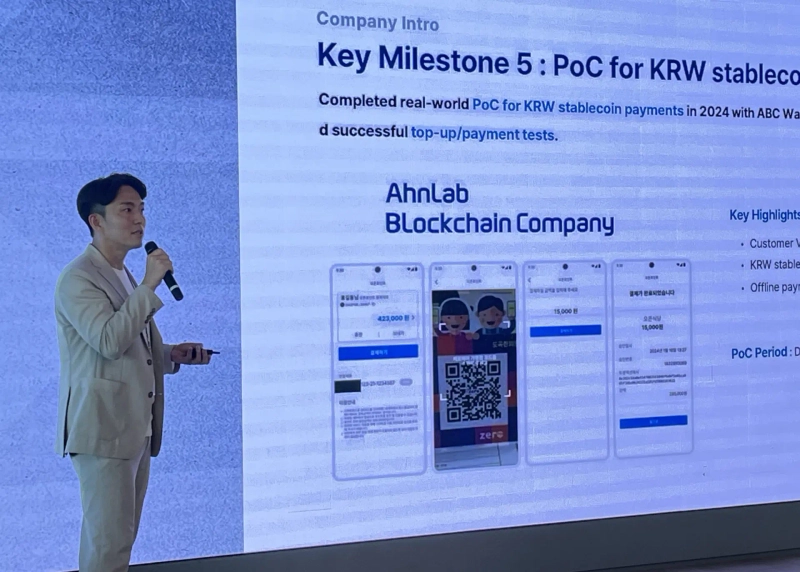
As technical and regulatory preparations for the issuance of Korean won stablecoins gather pace, the argument has been made that linkage with banks is essential for the won stablecoin industry.
Kim Kyung-eop, CEO of OpenAsset, attended the 'Internet Capital Markets' seminar hosted by Solana (SOL) at Gangnam Hashed Lounge on the 21st, and remarked, "Banking linkage must be a prerequisite for the Korean won stablecoin," adding, "Our view is that the issuer should have the status of an electronic financial business operator."
He continued, "The Korean won stablecoin we are preparing must be led by the private sector, not the central bank," and added, "Since the issuance is based on funds received from banks, the issuance system must be thoroughly structured."
The regulatory requirements in Korea necessary for the issuance of stablecoins include: ▲electronic financial business registration ▲authority to issue prepaid electronic payment means ▲implementation of anti-money laundering (AML) systems, etc. He also mentioned the need for systems that can securely issue stablecoins on the blockchain and multi-chain support capabilities.
CEO Kim said, "Stablecoins should be issued on various chains, such as Ethereum (ETH) and Solana (SOL)," emphasizing, "When stablecoins move between chains, the match between deposit reserves and issuance amount must be verified in real time." He further stated, "Since this transition process is inevitably repeated, a security system combining cold wallets and hard wallets is also essential."
He also discussed routes for the market spread of stablecoins. He said, "If a won stablecoin appears within the institutional sector, the first place for distribution will be won-based exchanges," explaining, "Since these already have AML frameworks, they are suitable for initial distribution." He added, "Afterwards, all institutions dealing with won, such as payment service providers, banks, and securities companies, will equip e-wallets and distribute digital assets," predicting, "This trend will expand to personal wallets, overseas wallets, and global exchanges."
He also saw a high possibility for the revitalization of utility token-based ICOs (Initial Coin Offerings). CEO Kim said, "ICOs for various virtual assets may resume. With the advent of the won stablecoin, an era will dawn in which Korea-based assets are actively traded in the decentralized finance (DeFi) ecosystem," adding, "This trend will create a new paradigm for asset distribution in Korea."

Doohyun Hwang
cow5361@bloomingbit.ioKEEP CALM AND HODL🍀