

One week left until the deadline for the 'tariff showdown': Will Korea bring rice and beef import cards?
Summary
- Korea and the U.S. are holding final negotiations with a focus on tariff reduction and trade surplus reduction ahead of the August 1st tariff negotiation deadline.
- The U.S. is strongly demanding an expansion of beef imports, further opening of the rice market, and relaxation of non-tariff barriers from Korea.
- The Korean government has prepared various negotiation cards, such as additional purchases of U.S. energy and cooperation in shipbuilding and steel, and meaningful progress is expected in the form of a joint statement if the negotiations are successful.
Gu Yoon-cheol and Yeo Han-gu to hold '2+2 trade talks' in the U.S. on the 25th
All-out efforts in economy, industry, security, and trade
Ministers of Foreign Affairs and Industry also join the U.S. trip
Each likely to meet with their respective 'counterparts'
Strong pressure from the U.S. Treasury ahead of negotiations
"A high-quality agreement is more important than speed"
The key issue is opening up sensitive food markets
"The goal is to reach an agreement before the grace period ends, but even a joint statement would be meaningful"
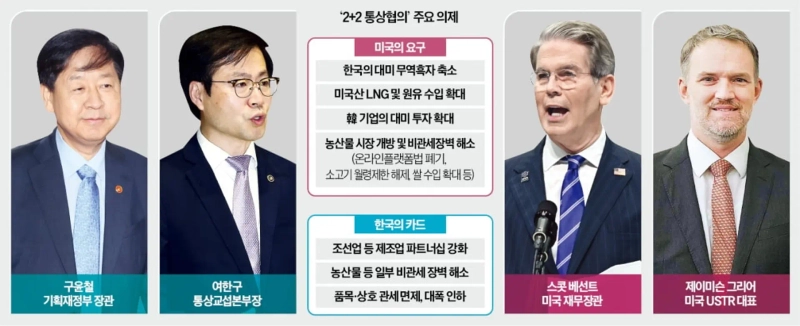
After being suspended since a round held in late April, the 'Korea-U.S. 2+2 trade talks' will resume in Washington, D.C. on the 25th, three months later. With one week left until the U.S. tariff negotiation deadline set for the 1st of next month, ministers responsible for economic and trade relations from Korea and the U.S. will engage in final negotiations. Ahead of this, the U.S. side has been ramping up pressure for further concessions through media interviews, among other means.
◇ All-out efforts from Korea's economic and security lines
Gu Yoon-cheol, Deputy Prime Minister and Minister of Strategy and Finance, told reporters after the external economic ministers' meeting held at the Government Complex Seoul on the 22nd, "Trade Minister Yeo Han-gu and I, as well as U.S. Treasury Secretary Scott Besant and U.S. Trade Representative (USTR) Jamieson Greer, have agreed to a '2+2' meeting on the 25th."
Minister of Foreign Affairs Cho Hyun and Minister of Trade, Industry and Energy Kim Jung-kwan will also each travel separately to the U.S., likely to meet with National Security Advisor and Secretary of State Marco Rubio and Secretary of Commerce Howard Lutnick, respectively. In addition, Director of National Security Wi Sung-rak at the Presidential Office is already holding negotiations in the U.S. A senior government official commented, "With the appointments of Deputy Prime Minister Gu and Minister Kim now finalized, our economic and trade teams are fully in place, and Korea can put forth all-out efforts in economy, industry, security, and trade in the talks with the U.S."
Ahead of Korea's all-out efforts, the U.S. has raised its level of pressure even further. On the 21st (local time), Secretary Besant appeared on CNBC and said, "We are focusing more on achieving a higher quality agreement than on closing a deal by August 1." This sent a message that the U.S. expects more concessions from negotiating countries, including Korea.
◇ Will a 'Korea-U.S. agreement joint declaration' be announced this month?
Korea's goal is to reduce its trade surplus with the U.S.—the world's eighth largest at $55.7 billion in 2024—in exchange for the removal or reduction of the 25% reciprocal tariffs and the 25–50% tariffs imposed on automobiles, steel, and other items. To achieve this, Korea is planning to propose expanded cooperation with the U.S. in industries where Korea has a strategic advantage, such as shipbuilding and steel, as well as additional purchases of U.S. energy and the relaxation of non-tariff barriers, to help narrow the trade surplus.
The key issue is the relaxation of non-tariff barriers. The U.S. is reportedly demanding Korea lift the ban on beef imports from cattle 30 months or older and further open its rice market. Currently, 132,304 tons of low-tariff quota (TRQ) rice is allocated to the U.S., and discussions are underway to potentially expand this. Demands to open agricultural markets are a sensitive issue for the government as it could face strong backlash from farmers. The legislation on regulating monopolies by online platforms, currently being promoted by the Fair Trade Commission, has also met resistance, with around 40 U.S. House representatives sending protest letters to the USTR.
Given that Minister of Agriculture, Food and Rural Affairs Song Mi-ryeong, the Vice Chair of the Fair Trade Commission, and the Vice Minister of Land, Infrastructure and Transport attended the external economic ministers' meeting, it is believed that Korea has adjusted the issues on non-tariff concessions it might offer. The government's move to swiftly promulgate the 'Hanwoo Act' (an act for the transition and support of the Hanwoo industry in line with carbon neutrality), which includes financial support for Hanwoo farmers, is also seen as an attempt to alleviate farmers' concerns over agricultural market opening. The ruling party and government also decided to process agricultural reform legislation, including the amendment of the Grain Management Act (which introduces mandatory rice purchases), during this month’s extraordinary session of the National Assembly.
The optimal scenario for both countries is to announce a 'joint statement on the conclusion of talks' with countries like the United Kingdom, Singapore, and Vietnam before August 1. Thus far, countries that have concluded tariff negotiations with the U.S. have first issued a joint statement outlining key agreements such as reduction of trade surpluses and cuts to reciprocal and product-specific tariffs, then wrapped up with detailed negotiations.
Kim Tae-hwang, a professor in the Department of International Trade at Myongji University, said, "It's realistically difficult to conclude all negotiations by August 1," adding, "even reaching a consensus on directions for trade balance adjustment, relaxation of non-tariff barriers, and cooperation in shipbuilding would constitute meaningful progress."
Nam Jung-min / Ha Ji-eun / Washington = Lee Sang-eun, correspondent peux@hankyung.com

Korea Economic Daily
hankyung@bloomingbit.ioThe Korea Economic Daily Global is a digital media where latest news on Korean companies, industries, and financial markets.