PiCK
2,900% ‘storm growth’ in a year… “Stock tokenization, a growth engine that could create a ‘KOSDAQ 3,000’”
Summary
- The global stock tokenization market surged to $963 million, up about 2,900% in a year, marking rapid growth.
- The Democratic Party and experts said stock tokenization could be a growth engine for the capital market, driving structural change that could make KOSPI 5,000 and KOSDAQ 3,000 possible.
- However, they pointed to major constraints in terms of institutions and business models, including limits on public blockchains, the absence of a KRW stablecoin, and the risk of capital outflows from the Korean stock market.
Forecast Trend Report by Period


Eugene Securities’ ‘Stock Tokenization Open Seminar’
Tokenized securities market to fully take off next year
Democratic Party: “Will upgrade the capital market”
Some point to the need to address institutional limitations
“Business-model expansion may be limited”
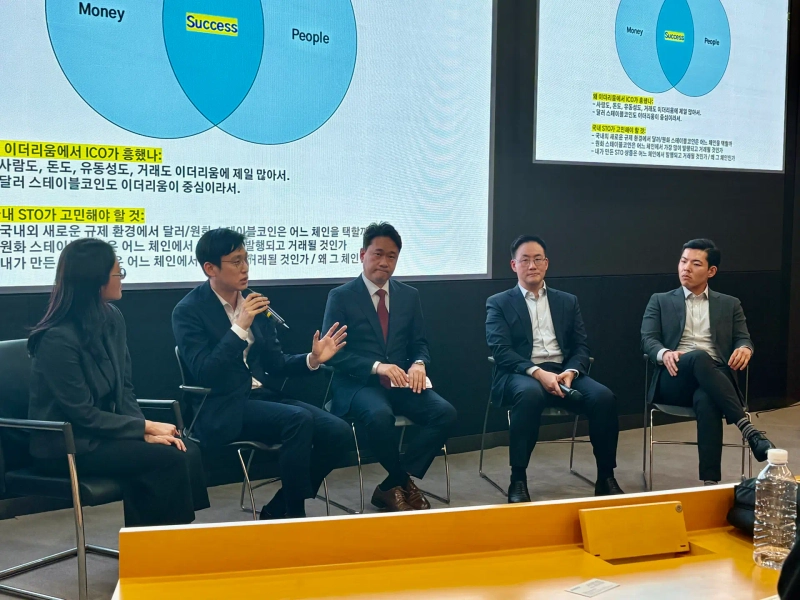
With tokenized securities (STOs) set to be brought into the regulatory fold in earnest starting next year, attention is also turning to stock tokenization. The Democratic Party of Korea sees stock tokenization as a potential driver of the “Korea premium” that lifts share prices. Some analysts also say it could structurally reshape Korea’s capital markets.
Rep. Min Byung-deok of the Democratic Party of Korea said in a written congratulatory message delivered at the ‘Stock Tokenization Open Seminar’ held on the 6th at Eugene Investment & Securities’ headquarters in Yeouido, Seoul, that “stock tokenization can become a new growth engine that makes it possible not only to surpass KOSPI 5,000 but also to reach KOSDAQ 3,000.” He added, “Competition over on-chain financial infrastructure is accelerating in global capital markets, led by large institutions, and stock tokenization sits at its core,” and said, “In the digital era, the pace of evolution in capital markets will be far faster than the speed at which horse-drawn carriages were replaced by cars.”
Rep. Kim Hyun-jung of the Democratic Party also said in a written message that “(stock tokenization) will raise the level of our capital markets by one notch.” She added, “Tokenized securities reduce information asymmetry and the risk of disputes through a structure in which transactions and ownership transfers are transparently recorded and verified,” calling it “an important change that can enhance market trust.”
Stock tokenization refers to converting existing shares into tokens using blockchain technology. In Korea, legislation to institutionalize tokenized securities cleared a key hurdle in the National Assembly last month, and the related market is expected to take off in earnest starting next year. That is why Eugene Investment & Securities held the seminar that day in partnership with law firm Robex and blockchain research firm Poplous.
“Will redesign capital-market infrastructure”
The global stock tokenization industry is already growing rapidly. According to blockchain analytics firm DL Research, the global stock tokenization market was tallied at $963 million (about KRW 1.4 trillion) as of last month. Compared with a year earlier ($32 million), it surged by nearly 2,900%.
CoinDesk, a U.S. digital-asset media outlet, reported that “companies are actively considering tokenization to improve settlement efficiency, broaden market access, and build financial products that operate 24/7,” adding that “stock tokenization has emerged as a representative example showing that the real-world assets (RWA) market is expanding into the domain of mainstream financial products.”
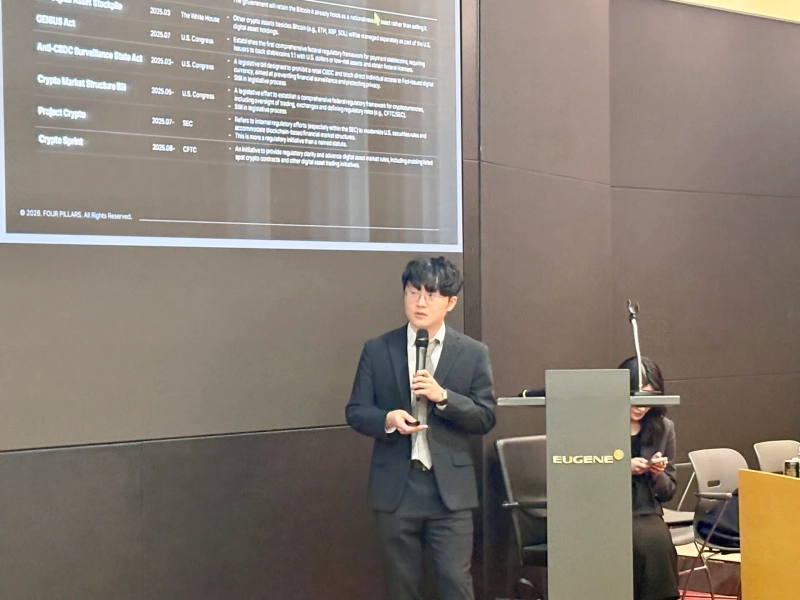
Experts agreed that “stock tokenization will bring structural changes to capital markets.” Kim Dan, a partner attorney at law firm Robex, said, “Stock tokenization is a major shift in which traditional financial markets are converging with the digital-finance ecosystem,” adding, “The essence of (stock tokenization) goes beyond simply improving transaction speed—it lies in redesigning capital-market infrastructure.”
Bok Jin-sol, research lead at Poplous, said, “Stock tokenization is a powerful tool that can address structural inefficiencies in existing equity markets,” adding, “Its impact is in no way inferior to that of stablecoins or bond tokenization.”
Some also argued that institutional limitations must be addressed. Bok noted, “For tokenized securities in Korea, only blockchain networks in which more than 51% of blockchain nodes are made up of financial institutions are allowed,” adding, “This means that only private blockchains—not public blockchains such as Ethereum (ETH)—can distribute tokenized securities.”
Bok continued, “Whether public blockchains are permitted (in the distribution process) is a major issue that will determine the scalability and international competitiveness of Korea’s tokenized-securities ecosystem,” adding, “Current domestic discussions remain focused on fractional investment, and the limited scope of permitted underlying assets is also a constraint on business-model expansion.”
“Urgent to introduce a KRW stablecoin”
Calls are also growing to swiftly enact the Basic Act on Digital Assets. One of the key elements of the bill currently pending in the National Assembly is the introduction of a KRW stablecoin.
Kim Gap-rae, head of the Financial Law Research Center at the Korea Capital Market Institute, said, “If securities settlement is conducted with dollar stablecoins, side effects could include the dispersion of domestic liquidity and the circumvention of short-selling regulations,” adding, “Without a KRW stablecoin, (stock tokenization) could even hinder policies aimed at revitalizing Korea’s stock market.”
Some observers also say the stock tokenization business model may be more limited than expected. Kim Yu-gyeom, a researcher at Poplous, said, “Stablecoins and tokenized bonds have clear revenue models because they can increase issuance size to maximize passive management returns,” adding, “In contrast, tokenized equities have a limited passive income stream, such as quarterly or annual dividends.”
Lee Se-il, head of the digital assets department at Shinhan Securities, said, “Stock tokenization implies maximizing the mobility of capital and investor choice,” adding, “The more tokenized equities are activated, the investment universe could be reshaped around U.S. assets, which could also have a negative impact on Korea’s stock market.”

JOON HYOUNG LEE
gilson@bloomingbit.ioCrypto Journalist based in Seoul