PiCK
Bessent, U.S. Treasury Secretary: "No Bitcoin bailout"… With AI shock added, $60,000 level put to the test [Kang Min-seung’s Trade Now]
Summary
- Scott Bessent, U.S. Treasury Secretary, said he rejects the U.S. government’s Bitcoin bailout and plans for additional purchases, weakening policy-related expectations.
- Bitcoin spot ETFs saw $1.48777 billion in net outflows, and a negative flow signal emerged as whales sell while retail buys.
- Multiple analysts warned that if key support/resistance levels such as $60,000, $70,000, and $74,000 break, further declines and a potential shift into a bear market could follow.
Forecast Trend Report by Period


As AI skepticism and signs of cooling in the labor market sharply dampen investor sentiment and extend the pullback in tech stocks, Bitcoin (BTC) is also moving in step with the risk-off mood, maintaining a weak tone around the $64,000 level.
In the market, losses among institutional investors and large-scale leveraged liquidations in the futures market have unfolded simultaneously, prompting analysis that this drop has moved beyond a simple price correction into a phase of “structural reset.” Attention is shifting to whether the $60,000 level can hold. Experts warn that if Bitcoin fails to quickly regain $74,000—seen as a near-term inflection point—additional downside pressure could follow.
As of 13:28 on the 6th, Bitcoin is trading at $64,855 on Binance’s USDT market, down 8.85% from the previous day. On Upbit’s KRW market, it is priced at 96.20 million won. Bitcoin has fallen more than 20% so far this year, and is down about 48% from the record high set in October last year. At the same time, the kimchi premium (the price gap between overseas and domestic exchanges) stands at 0.96%.
Tech stocks swept by AI headwinds and the “Bessent shock”... and Japan fiscal risks add a “triple whammy”
Global equities and the virtual asset (crypto) market are moving lower in tandem as a reassessment of the AI industry’s profit model intersects with uncertainty over the direction of U.S. policy. With the recent selloff in digital assets intensifying, remarks by U.S. Treasury Secretary Scott Bessent also acted as a drag on sentiment.
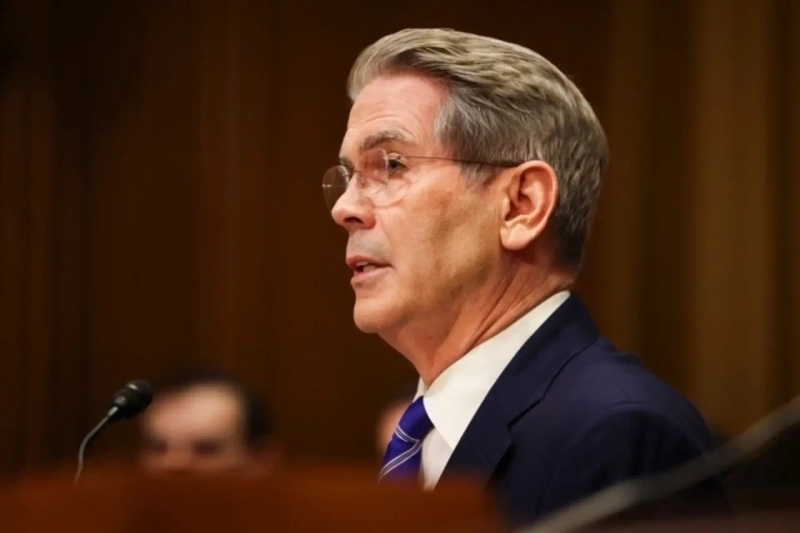
At a congressional hearing held on the 5th, Secretary Bessent said, “The U.S. government has neither the authority nor the will to prop up Bitcoin with a bailout,” dismissing the possibility of government intervention. He went on to stress that the Bitcoin held by the U.S. government is limited to amounts seized through legal procedures, making clear there are no plans for additional purchases. The market interpreted the comments as a signal that weakens expectations for a policy backstop during the downturn. Bitcoin later extended its losses.
With the “Lummis bill,” aimed at stockpiling Bitcoin as a strategic asset for the U.S. federal government, stalled in Congress for 11 months, policy optimism is fading further as the Treasury also pushes back on new purchases. Michael Burry, the investor who foresaw the 2008 global financial crisis, warned that further declines in Bitcoin could trigger a “death spiral” of cascading selling across broader financial markets.
In particular, on Wall Street, following Anthropic’s unveiling of its new enterprise AI tool “Claude CoWork,” a reassessment of business models across the software sector has accelerated, pushing the tech-led correction into full swing. The market capitalization of related companies fell by about 440 trillion won ($300 billion) in a single day, while risk aversion is spreading across risk assets more broadly.
In addition, ahead of Japan’s general election scheduled for the 8th, concerns are growing that Prime Minister Takaoichi’s fiscal expansion policies could translate into a medium- to long-term fiscal burden. With Japanese government bond yields facing upward pressure, the possibility of unwinding yen carry trades is also emerging as a market risk. If yen funding raised at low rates is pulled back, outflow pressures could intensify in the crypto market as well.
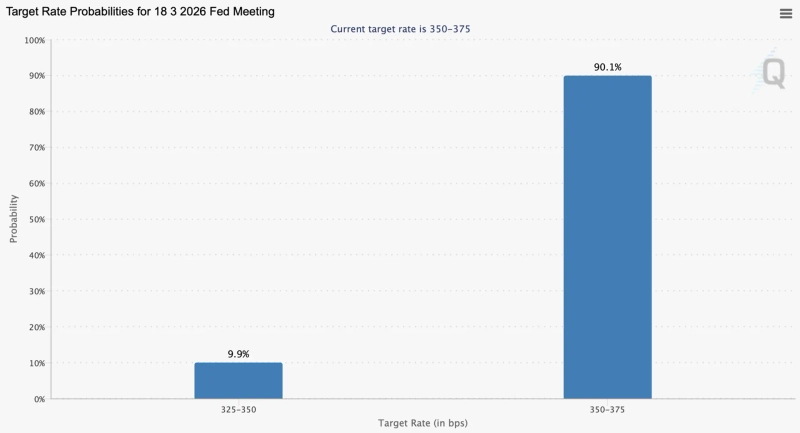
As of 13:00, CME FedWatch shows the interest-rate futures market pricing a 90.1% probability that the U.S. central bank, the Federal Reserve (Fed), will hold rates steady in March, and a 9.9% probability of a cut. Fed Chair Jerome Powell, after the January FOMC meeting, cited upside inflation risks, signaling a cautious stance on rate cuts.
ETF investors rack up losses… signs of “Wall Street whales” heading for the exits
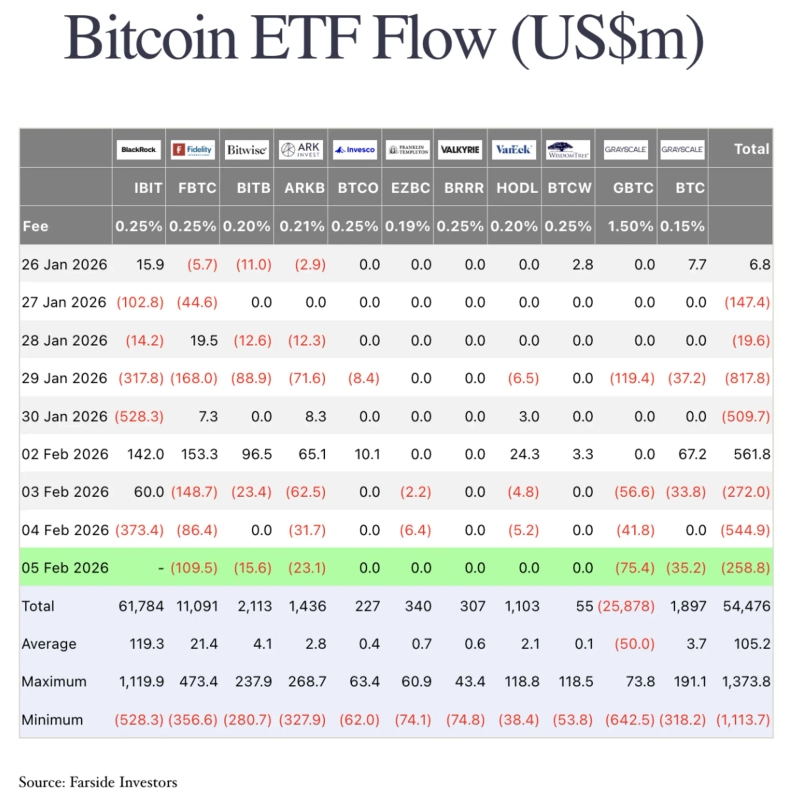
Last week, Bitcoin spot exchange-traded funds (ETFs) saw total net outflows of $1.48777 billion (about 2.1878 trillion won), increasing downside pressure. Net outflows have continued into this week. The market is focusing on the fact that Bitcoin’s price has fallen below the average purchase price for ETF investors ($87,830). Typically, slipping below the average entry price can further sour investor sentiment.
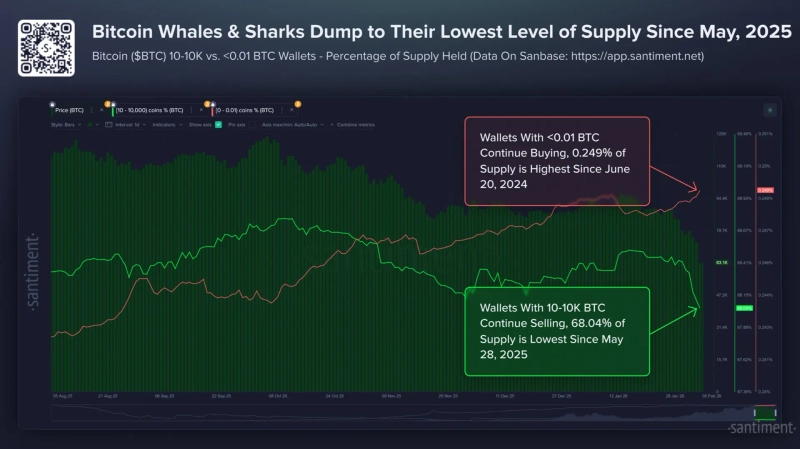
On-chain supply-demand indicators also point to weakened sentiment. In a research note on the 5th, crypto analytics firm Santiment said, “Over the past week, the crypto market has drawn a steep downward curve, with sentiment toward Bitcoin and Ethereum deteriorating to an extreme.” It added, “Over the past two weeks, whale wallets holding 10–10,000 BTC have sold more than 50,000 Bitcoin into the market, while retail investors have been quickly accumulating,” noting that “this is a typical negative supply-demand signal seen when market value is falling.”
Uncertainty around U.S. policy remains an overhang. Crypto trading firm QCP Capital said in a report that “(on the 4th) passage of the budget bill in the U.S. House temporarily eased the risk of a partial federal government shutdown, but the market is still in a phase of reacting immediately to news rather than operating on conviction.” It added that “because the Department of Homeland Security budget is only funded through the 13th, renewed tension around fiscal negotiations could pressure markets again.”
Some interpret this correction as a process of excessive leverage being flushed out. Global crypto exchange Bitfinex said in its weekly research report that “the selloff began as a combination of worsening macro conditions, including the possibility of a hawkish Fed chair succession and geopolitical risks,” adding that “the market is passing through a painful ‘structural reset’ phase as leverage is unwound.” In fact, after speculation grew over Kevin Warsh’s possible appointment, about $2.5 billion in long positions were forcibly liquidated in the crypto futures market.
Crypto analytics firm Swissblock said in a report on the 5th, “The impact of the correction phase that followed last October’s large-scale liquidations remains strong,” and assessed that “the attempt in mid-month to shift back into an uptrend also failed after being blocked by heavy selling pressure.” It added, “As a result, the current market structure is becoming more entrenched under the dominance of downside momentum.”
The fateful $60,000… an inflection point between “further downside vs technical rebound”
Market experts say that whether Bitcoin can defend the $60,000 level will be a key inflection point for easing near-term downside pressure and reversing the trend.
Ayush Jindal, a NewsBTC researcher, said, “After extending losses toward the $60,000 level, Bitcoin is struggling to stage a technical rebound, and the area around $70,600 is acting as strong resistance.” He added, “If it fails to break through the $67,200–$68,500 range in the near term, additional downside pressure could persist,” and “in that case, there is a strong likelihood it could be pushed back down toward the psychological line at $60,000.”
Alex Kuptsikevich, senior analyst at FxPro, said, “With Bitcoin making a new low versus last year and retreating to around the November 2024 level, the price action of progressively lower highs suggests sellers are in control.”

Minseung Kang
minriver@bloomingbit.ioBlockchain journalist | Writer of Trade Now & Altcoin Now, must-read content for investors.