

Kim Seo-joon, CEO of Hashed, "Nationality is becoming a membership... 400 million K-pop fans as digital citizens"
Summary
- Kim Seo-joon, CEO of Hashed, emphasized that even foreigners can voluntarily participate and contribute through a digital citizenship platform.
- He stated that by connecting Korea's soft power such as K-pop to digital citizenship, it can turn cultural energy into substantive assets.
- With a blockchain-based 'K-Digital Citizenship Platform', it would be possible to attract foreign investment through various digital services including stablecoins, asset investment, and STO.
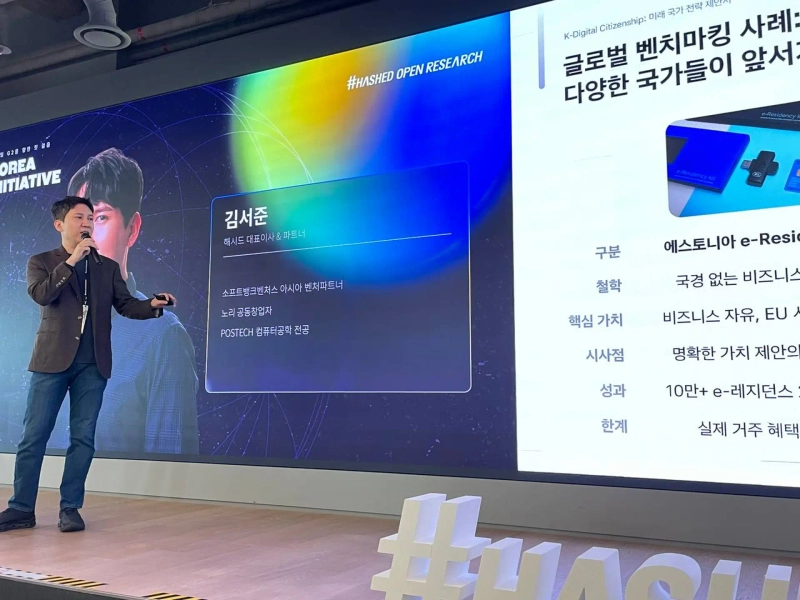
Kim Seo-joon, CEO of Hashed, emphasized, "Nationality is now becoming a form of membership, and the digital space is becoming a new territory." He evaluated that South Korea has entered a ‘golden time’ where it can newly design the concepts of citizenship and identity in the digital world, leveraging its cultural power.
At the "Korea Initiative: The First Step Towards Digital G2" forum held at Hashed Lounge in Gangnam, Seoul on the 7th, Kim said, "The relationship between nations and citizens is being reorganized into a contractual nature, identities are shifting from single to multiple, and nationality is changing from exclusive to inclusive," adding, "Through digital citizenship platforms, foreigners can also be given opportunities for voluntary participation and contribution."
He explained, "Korea’s soft power, represented by K-pop, K-movie, and K-beauty, has already formed global fandoms and communities." He continued, "There are more than 400 million K-pop fans around the world, many of whom have visited South Korea, and over 20% of those visitors return the following year." He added, "If this global fandom is connected to digital citizenship, we can provide both pride and benefits, turning Korea's cultural energy into substantive assets."
Kim explained that the digital citizenship platform could become an operating system for a digital nation, encompassing not only apps for tourists, but also payments, investment, civil services, governance, and community functions. He stressed, "South Korea must take the initiative in building a digital citizenship platform that people around the world can easily access and receive digital citizenship voluntarily," and added, "Through this, we can present a new value-driven global standard."
Kim cited Estonia, Singapore, and the United Arab Emirates (UAE) as representative examples of digital administration, saying, "These countries may lead in function-oriented digital administration, but South Korea can take the lead in value-oriented digital citizenship platforms."
However, he pointed out that Korea’s administrative infrastructure is still unfriendly to foreigners, noting, "Foreigners face complicated administrative procedures when trying to use communication services or open bank accounts, and most daily infrastructures are designed only for locals. Without a Korean mobile number, it’s hard to use key apps, and related civil services are also inefficient."
As a solution, a blockchain-based 'K-Digital Citizenship Platform' was proposed. Kim stated, "Citizenship issued through Digital ID (DID) will utilize KYC-based identity verification and connect with stablecoins to offer various digital services such as payments and asset investments." He added, "If foreigners are allowed to invest in tokenized securities (STO), content IP, or specific Korean company assets, it can have a real economic inflow effect."
He emphasized, "All of this digital infrastructure will run on blockchain, but users should not feel the blockchain at all. It should be as naturally usable as reading a webtoon—identity authentication should be easy and based on biometric information, and the UI should be as intuitive as existing Web2 services."

Doohyun Hwang
cow5361@bloomingbit.ioKEEP CALM AND HODL🍀