

Summary
- It was reported that the United States and China agreed to extend the tariff truce by 90 days.
- Because of this agreement, a trade rupture has been avoided for now, and trade tensions between the U.S. and China are expected to subside until November.
- Ahead of the summit, the two countries are expected to debate export controls on semiconductors and rare earths, as well as additional purchases of U.S. agricultural products.
Possibility of Summit at Gyeongju APEC
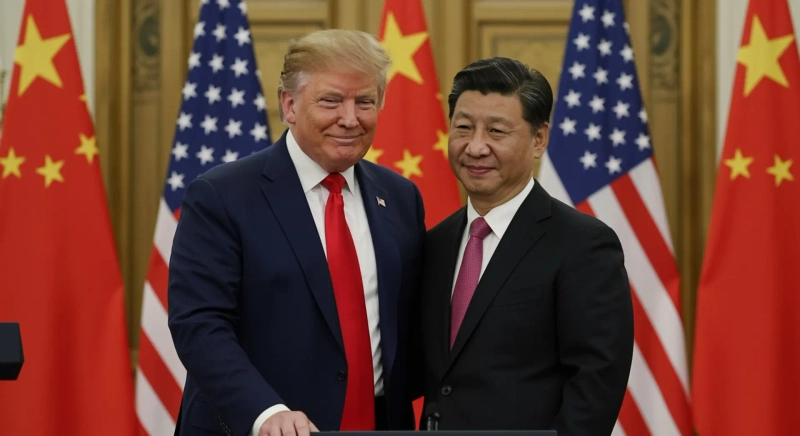
The United States and China agreed on the 11th (local time) to extend the tariff truce between the two countries by 90 days.
U.S. President Donald Trump wrote on his social media on the last day of the previously agreed 90-day 'tariff truce' with China, "I have just signed an executive order to extend the suspension of tariffs on China for an additional 90 days," adding that "all other terms of the (existing U.S.–China) agreement remain unchanged." The White House announced that the end time for the new tariff truce would be '12:01 a.m. on November 10, U.S. Eastern Time.' In a joint statement, it was stated that "the U.S. is extending the 24% point additional tariff, which was in effect since May 12, by another 90 days, and China will suspend retaliatory measures." Accordingly, there is growing possibility that the first U.S.–China summit of Trump's second term will be held around the Asia-Pacific Economic Cooperation (APEC) leaders' meeting in Gyeongju at the end of October.
U.S.–China Avoid Trade Rupture...China Suspends Export Curbs on 45 U.S. Companies
U.S. Chooses Stability Over Market Turmoil...Renegotiations Around Gyeongju APEC at End of October
By formalizing the extension of the tariff truce with China, President Donald Trump has averted—for now—a 'trade rupture' that could have greatly impacted the world economy. With the truce continuing until November 10, the two nations are expected to seek solutions to trade disputes through possible summits.
Upon confirmation of the truce extension on the 11th (local time), the Chinese government suspended export control measures imposed on 45 U.S. companies. On the 12th, the Ministry of Commerce of the People's Republic of China announced an additional extension on the implementation of sanctions related to exports of dual-use items to U.S. companies. It further explained that applications by Chinese companies seeking to do business with these U.S. firms would be reviewed and approved as appropriate.
Previously, in the first high-level negotiations, the U.S. and China each agreed to lower steep tariffs (over 100%; 145% on Chinese goods, 125% on U.S. goods) by 115% points. In the second negotiations, the U.S. relaxed its semiconductor technology controls on China, while China eased export controls on rare earth elements to the U.S.
This extension of the tariff truce was a provisional agreement from the third high-level trade negotiations held in Stockholm, Sweden, on the 28th–29th of last month, but it required President Trump's signature to become official. As the negative effects of the tariff war have started to weigh on the U.S. economy, there is analysis that President Trump opted to maintain the status quo rather than escalate market instability.
With U.S.–China trade tensions expected to remain below the surface until November, the environment is shaping up for a potential first summit between the two countries' leaders around the Asia-Pacific Economic Cooperation (APEC) summit in Gyeongju, North Gyeongsang Province, in late October to early November, during Trump's second administration. It is likely that negotiations will accelerate to reach an agreement before the leaders' summit and President Trump's visit to China.
As President Trump seeks to reduce the U.S. trade deficit with China, the extent to which China accepts U.S. demands will be key. In particular, it's anticipated that issues such as halting Chinese imports of Russian crude oil and additional purchases of U.S. soybeans will be at the forefront. Though China agreed to increase its purchase of U.S. agricultural goods like soybeans during the first Trump-era trade war, it fell short of actual targets.
Since the U.S. imposed additional tariffs on India for importing Russian crude oil, similar pressure may be applied to China. Attention is also turning toward how much more the U.S. will ease export controls on semiconductors and China on rare earth elements. In addition, discussions may include tariff readjustments imposed on China for illicit exports of fentanyl (synthetic drugs) and the business environment for U.S. firms operating in China.
Experts believe that during the tariff truce, the U.S. and China are unlikely to impose additional tariffs or escalate the trade war by other means. However, factors such as U.S. additional transshipment tariffs, stricter technology restrictions on China embodied in a new AI action plan, and pressure for large-scale purchases of U.S. products may remain obstacles to improved trade relations between the two nations.
Kim Dong-hyun / Beijing correspondent: Kim Eun-jung 3code@hankyung.com

Korea Economic Daily
hankyung@bloomingbit.ioThe Korea Economic Daily Global is a digital media where latest news on Korean companies, industries, and financial markets.