

Lutnick: "We should receive equity in exchange for CHIPS Act subsidies"… Targeting Samsung
Summary
- Howard Lutnick, U.S. Secretary of Commerce, announced plans to seek corporate equity in exchange for CHIPS Act subsidies.
- The U.S. government plans to use funds from Korea and Japan to expand domestic infrastructure such as semiconductors, pipelines, and nuclear power.
- The equity acquisition plan targets global semiconductor companies like Samsung, with no emphasis on managerial control or governance.
Mentioned "Utilizing funds received from Korea and Japan"
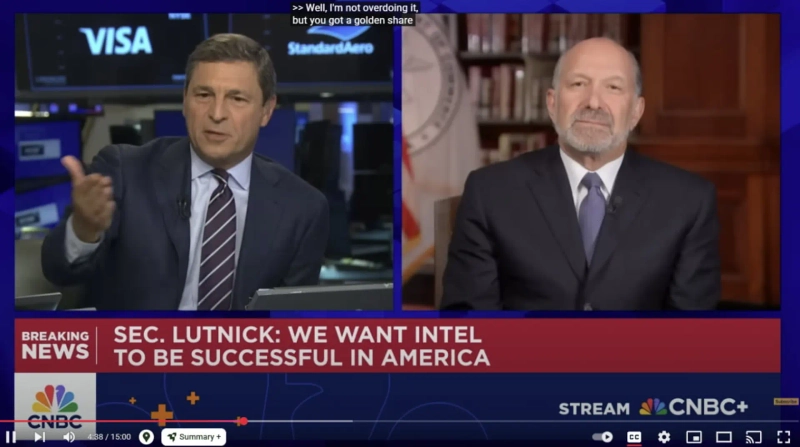
The Donald Trump administration publicly announced that it would promote a plan to receive equity in companies in exchange for the subsidies granted under the CHIPS and Science Act.
On the 19th (local time), during an interview with CNBC, Howard Lutnick, U.S. Secretary of Commerce, was asked whether the 10% equity investment plan, currently under discussion with Intel, means that CHIPS Act support funds would be converted into capital, to which he replied, "Yes." He explained, "President Trump believes that the United States should receive benefits for its negotiations (support). For President Trump, the answer to what benefits accrue to American taxpayers is to receive equity."
Secretary Lutnick stated, "It’s not about giving away subsidies for free, but about restructuring to secure economic gains." He continued, "A company like TSMC has a market capitalization of 1 trillion dollars — why should American taxpayer money be used to support such firms?" He added, "If we say that companies will face 100% tariffs unless they build factories in the U.S., companies will come on their own."
When asked whether such equity implies managerial control or governance, he responded, "That’s not the case." He argued, "It’s simply converting the Biden administration’s subsidies into equity investments under the Trump administration." When the host followed up with, "If you own 10% equity, does governance such as voting rights come with it?" Secretary Lutnick replied, annoyed, "We’re not considering that — that’s not the focus."
When the host recalled that Secretary Lutnick previously demanded a golden share in the case of U.S. Steel, Lutnick stated, "When Nippon Steel acquired U.S. Steel, it was to ensure they kept about a dozen promises they made."
Regarding why the semiconductor industry must be based in the U.S., he said, "99% of advanced semiconductors are produced only in Taiwan — Taiwan is 9,500 miles from the U.S. and only 80 miles from China. We cannot leave the situation as it is; we must build production capacity within the U.S." He noted that Japan and Korea agreed to provide $550 billion and $350 billion to the U.S., respectively, and added that the combined $900 billion would be used "to rebuild the infrastructure that China took away."
Secretary Lutnick posited that U.S. industries can no longer manufacture because China relies on dumping: "By selling products at half of production costs, Chinese firms have pushed American companies out." He added, "We originally invented rare earth (permanent) magnets, but now China sells them at half the cost, so we no longer produce them." He emphasized, "We must rebuild ourselves — manufacturing semiconductors, building pipelines, and constructing nuclear power plants."
Secretary Lutnick said that funds used to acquire equity stakes in semiconductor companies will come from money received from Japan and Korea. "We made deals with Japan and also with Korea. By utilizing their funds, we’ll build pipelines, develop nuclear power, manufacture semiconductors, and secure pharmaceutical production within the U.S.," he asserted.
As for when official documentation regarding agreements with Japan or Korea may be confirmed, he said, "The Japan and Korea models should wrap up in a few weeks, but other models have already been finalized." He added, "You won’t see a 250-page sprawling trade deal as with the Biden administration; it will be very simple."
Secretary Lutnick described the U.S. as having suffered from "Stockholm syndrome" for years, saying, "We’ve been pounded for decades to the point that we’ve forgotten what it’s like to sell goods in the global market." He commented, "President Trump is finally opening up these markets." He expects that, "While the European market still won’t buy our cars, Korea and Japan will buy American cars."
Washington, D.C. — Sang-eun Lee, Correspondent selee@hankyung.com

Korea Economic Daily
hankyung@bloomingbit.ioThe Korea Economic Daily Global is a digital media where latest news on Korean companies, industries, and financial markets.