PiCK
"Crypto exchanges are public infrastructure"… FSC signals resolve to introduce limits on controlling shareholders’ stakes
Summary
- Financial authorities said they view virtual asset exchanges as public infrastructure and will push to cap controlling shareholders’ stakes at 15–20%.
- Lawmakers from both parties said a cautious approach is needed, citing concerns over infringement of property rights, potential unconstitutionality, and the risk of weakening founder leadership.
- Industry figures and experts criticized the exchanges as private companies, warning that excessive stake limits could undermine industrial competitiveness and shrink the investor base.
Forecast Trend Report by Period


As financial authorities once again signal their determination to define virtual asset (cryptocurrency) exchanges as “public infrastructure” and limit controlling shareholders’ stakes, the National Assembly and the virtual asset industry are pushing back, warning it could infringe on private property rights and shrink the industry.
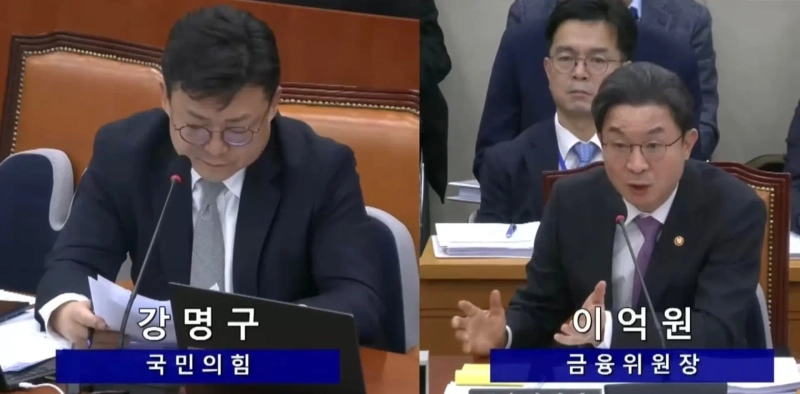
On the 5th, FSC Chairman Lee Eok-won attended a financial sector briefing to the National Assembly’s Political Affairs Committee and, in response to a question from Rep. Kim Sang-hoon of the People Power Party about the purpose of a provision to “cap controlling shareholders’ stakes at 15–20%,” said, “As we expand and reorganize the exchange framework—currently operated under a reporting system—into a licensing system, we also intend to adjust governance accordingly.”
Lee emphasized, “At present, exchanges must file a report every three years, but if we shift to a licensing regime, exchanges will take on a permanent status along with the characteristics of public infrastructure,” adding, “As their status and role expand, there needs to be a corresponding framework for accountability and regulation.” He added that “(the cap on controlling shareholders’ stakes) is part of a design process that considers the ecosystem as a whole, not a measure targeting a specific company.”
Financial authorities are pursuing a plan to cap the stakes of controlling shareholders of virtual asset exchanges at 15–20% through the “Framework Act on Digital Assets,” which is currently being promoted. The idea is to view virtual asset exchanges as a public good comparable to stock market exchanges and mandate dispersed ownership.
In response to this plan, lawmakers from both ruling and opposition parties called for a cautious approach, noting that the government forcibly reshaping stakes in private companies could run counter to the principles of a market economy.
Rep. Kang Myung-gu of the People Power Party said, “It is hard to find cases where ownership stakes in exchanges are forcibly dispersed, and there are also arguments that it could be unconstitutional as an infringement of property rights,” adding, “If financial authorities move to limit controlling shareholders’ stakes, founder leadership and responsible management could be weakened.” He stressed that “a cautious approach is needed at a time when we should be promoting technological innovation and industrial growth.”
Rep. Lee Kang-il of the Democratic Party of Korea also said differentiated regulation that reflects market realities is necessary. He noted, “The exchange market is effectively structured around top players, and if the same ownership rules are applied even to late entrants with less than 1% market share, the investors themselves will disappear.”
The industry has been unable to hide its bewilderment. An industry official said, “Until just recently they treated virtual asset exchanges like online casinos, and now they suddenly call them public infrastructure—it’s absurd,” adding, “If excessive regulation is repeated, it will become difficult for any business to step forward.”
Attorney Kim Hyo-bong of Bae, Kim & Lee LLC pointed out, “Virtual asset exchanges are private companies, not public infrastructure.” He added, “Governance issues should be addressed by invigorating competition; imposing ex post limits on stakes is a burden on industrial competitiveness,” and criticized the move, saying, “There is no compelling public interest significant enough to restrict property rights and freedom of business.”
Hwang Doo-hyun, Bloomingbit reporter cow5361@bloomingbit.io

Bloomingbit Newsroom
news@bloomingbit.ioFor news reports, news@bloomingbit.io