

The Central Bank Governor’s 'Voice' Matters More Than Policy Rate Decisions [Jin-Kyu Kang’s BOK Watch]
Summary
- Professor Eric Swanson stated that speeches by the Fed Chair have a greater impact on the financial market than official FOMC statements.
- Former committee member Ki-Young Park analyzed that the Governor of the Bank of Korea’s remarks generate more volatility in the Korean government bond yield and credit spread than actual rate hikes, depending on the tone in the news.
- Professor Aiyue Deng reported that if the Fed Chair makes more dovish remarks, the S&P index ETF rises 5% after 10 days.
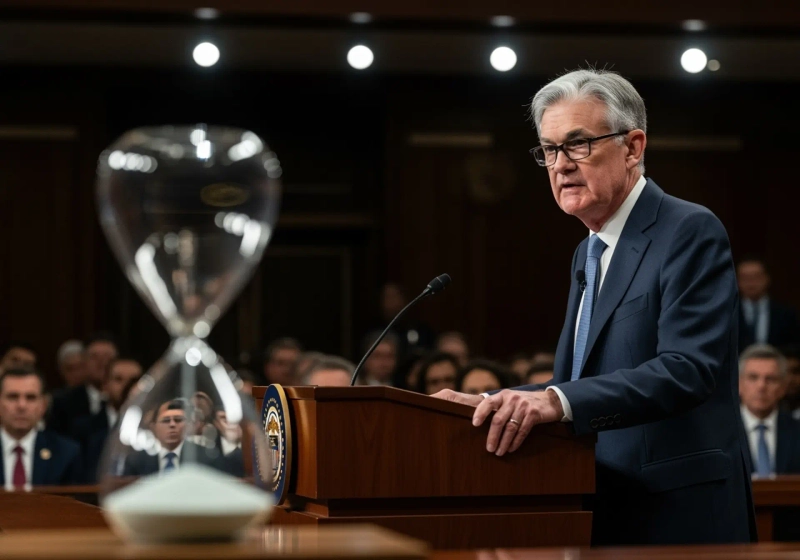
It has been found that the central bank governor’s remarks have a greater impact on the financial market than policy rate decisions. The markets swing depending on what Jerome Powell, Chair of the US Federal Reserve (Fed), and Changyong Rhee, Governor of the Bank of Korea, say before and after the rate decisions.
Eric Swanson, Professor of Economics at University of California, Irvine, presented this research finding in his paper titled 'Speeches by the Fed Chair Are More Important Than FOMC Announcements' at the World Congress of Economics held at Seoul COEX on the 21st.
Professor Swanson compared various communication methods—such as press conferences and speeches—by the Fed Chair from 1988 to 2023 and the financial market impact of official FOMC announcements. The analysis showed that speeches by the Fed Chair moved stock prices (S&P 500) by 1.72% points on average, a greater impact than FOMC statement releases (1.343% points).
Yields on government bonds were also highly responsive to the Chair’s speeches. The 3-year yield changed a total of 12.31% in response to speeches by the Fed Chair, compared to 10.88% following FOMC statement releases. The FOMC announcement had the strongest impact only on ultra-short-term rates directly linked to the Fed’s policy rate decisions.
Even when calculating the average rate of change per announcement or speech, considering that there were more speeches (411) than FOMC decisions (360), the results remained similar. However, before COVID-19 (1988–2019), speeches by the Chair were more influential, while from 2020 to 2023, official press conferences had a greater impact. The release of meeting minutes and speeches by Vice Chairs did not significantly affect the market.
Aiyue Deng, Professor at Beijing University of Posts and Telecommunications, also presented findings in her paper 'How Do Fed Chairs Affect the Financial Market?' She analyzed that if the Fed Chair made one additional dovish remark, ETFs tracking the S&P index would rise 5% after a 10-day lag. The policy rate would fall by 0.015% points. She also analyzed not only word choices but the tone of voice, but was unable to produce statistically meaningful results due to data limitations.
The remarks of the Fed Chair also had spillover effects on Canada’s financial markets. Using data from 1997 to 2023, Rodrigo Sekkel, Economist at the Bank of Canada, analyzed the impact of the Fed Chair’s speeches, press conferences, and minutes releases on Canadian markets and found that communication events had a stronger effect than policy rate announcements. In particular, long-term rates responded significantly.
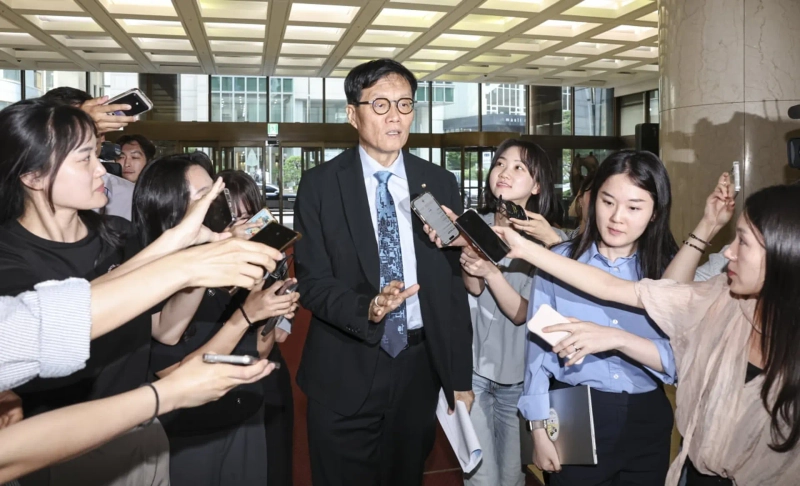
There was also a presentation on the importance of monetary policy communication using the Korean case. Ki-Young Park, Professor of Economics at Yonsei University (former member of the Bank of Korea Monetary Policy Committee), together with Young-Jun Lee, Professor of Artificial Intelligence at Jeju Halla University, analyzed this in their joint work 'Measuring Monetary Policy Surprises Using Text Mining.'
Former committee member Park analyzed that the tone of communications by the Bank of Korea ahead of monetary policy meetings and the Governor’s press conference after the meetings, as reflected in media reports, could significantly move government bond yields. When the proportion of hawkish news coverage increased by 1% point after a monetary policy decision, the yield on 3-year government bonds rose by 0.0755% points. The credit spread, calculated as the gap between 10-year and 3-year yields, also increased by 0.0342% points.
This is a larger effect than an actual policy rate hike. Rate hikes were found to have little significant impact on yields for 3-year or longer maturities. However, they did affect short-term rates such as the overnight call rate and CORIBOR, which are directly linked to the base rate.
Jin-Kyu Kang, Reporter josep@hankyung.com

Korea Economic Daily
hankyung@bloomingbit.ioThe Korea Economic Daily Global is a digital media where latest news on Korean companies, industries, and financial markets.