

Accelerating Discussions on Security Guarantees for Ukraine... Russia: "Meaningless Without Our Participation"
Summary
- NATO and major European nations discussed security guarantee measures for Ukraine, and options such as forming a multinational force and establishing a 'Korean-style buffer zone' are reportedly under review.
- The United States has shown a passive stance regarding troop deployment to Ukraine and mentioned only the possibility of air power support.
- Russia has stated it would not agree to any collective security guarantees that exclude itself, highlighting that significant geopolitical risks still remain.
The North Atlantic Treaty Organization (NATO) military leadership held a virtual meeting on the 20th (local time) to discuss security guarantee measures for Ukraine. However, Russia opposed the current Western security guarantee proposals.
Giuseppe Cavo Dragone, Chairman of NATO’s Military Committee, stated on X (formerly Twitter) after the virtual meeting of NATO defense chiefs that afternoon, "We had an excellent and frank discussion" and "Reaffirmed our support regarding Ukraine."
The meeting was attended virtually by the defense chiefs of all 32 NATO member states, including U.S. General Alexus Grynkewich, NATO’s Supreme Allied Commander Europe. Chairman Cavo Dragone did not disclose the details of the meeting.
It was reported that concrete measures for the European-led security guarantees for Ukraine, agreed at the summit level by the United States, Europe, and Ukraine, were intensely discussed.
Allies of Ukraine in Europe are considering establishing a multinational force to support a peace treaty. The international coalition called the "Coalition of the Willing," led by the United Kingdom and France, is expected to form the core of this multinational force. However, according to the AP, the military leadership is still deliberating the exact role of the deployed troops.
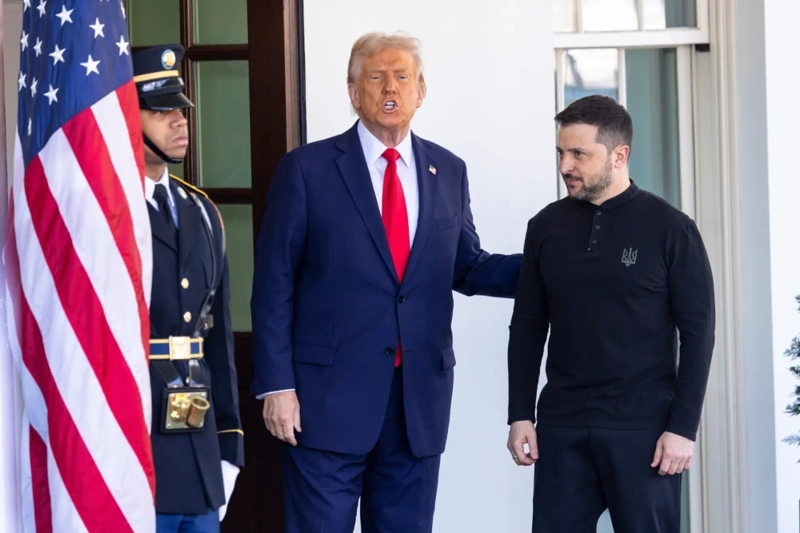
There have also been reports in European media that the creation of a so-called "Korean-style buffer zone," with a multinational force protecting Ukraine’s borders, is being considered. The Italian daily La Stampa, citing multiple EU sources, reported that this was discussed at the summit held on the 18th at the White House between President Donald Trump, President Volodymyr Zelenskyy of Ukraine, and European leaders.
The outlet stated, if the plan is realized, "rather than a permanent U.S. military base (as on the Korean Peninsula), European forces will be stationed on the ground with U.S. technology support in a hybrid deployment." The specific role the U.S. would play, despite expressing willingness to participate, remains unclear.
President Trump stated that there would be no U.S. troop deployment and that Ukraine joining NATO was not possible. However, he mentioned that the U.S. could provide air power support if Europe deploys forces to Ukraine.
Russia issued a negative stance as soon as the U.S.- and Europe-led security guarantee talks for Ukraine began in earnest. Russian Foreign Minister Sergey Lavrov stated, according to AFP and Reuters, "Seriously discussing security guarantees for Ukraine without Russia is a utopian and meaningless path."
Minister Lavrov said, "We will not agree to any collective security guarantees negotiated without Russia" and "We would only accept security guarantees for Ukraine established on an equal basis with the participation of countries such as China, the United States, the United Kingdom, and France."
This essentially means that both Russia and China must participate in the discussions. From the perspective of Europe and Ukraine, this demand is unacceptable. Even if a European-led security guarantee proposal is established, Russia implies it would exercise a ‘veto’.
There is a difference with the U.S. statement that after the summit between President Trump and Russian President Vladimir Putin, Russia had agreed to partially accept Western security guarantees. Politico Europe interpreted Minister Lavrov’s comments as indicating that Russia’s hard-line stance on Ukraine has not softened at all.
Reporter Joo-Wan Kim kjwan@hankyung.com

Korea Economic Daily
hankyung@bloomingbit.ioThe Korea Economic Daily Global is a digital media where latest news on Korean companies, industries, and financial markets.