

Powell 'Clears the Punch Bowl' in the Bull Market: "Stocks Are Significantly Overvalued"
Summary
- Jerome Powell, chair of the U.S. central bank, warned that U.S. stocks are significantly overvalued and reiterated concerns about market overheating.
- He pointed out that tech stocks have a high average price-to-earnings ratio (PER), suggesting the possibility of growing bubble debate.
- Powell left open the possibility of additional rate cuts this year but said he would remain cautious about excessive expectations.
Repeated warnings for the U.S. stock market
Checks as indices hit record highs
Since the start of the year, "valuation pressures have increased"
Last month, "the market was overly optimistic"
Keeps the door open for further rate cuts
"Rate conditions are slightly restrictive, but..."
Expresses the dilemma between inflation and employment
Jerome Powell, chair of the U.S. central bank (Fed), warned that U.S. stocks are "significantly overvalued." As the U.S. market heats up centered on artificial intelligence (AI)-related stocks, Powell's move to play the central bank's role of removing the punch bowl as the party heats up is likely to intensify debate over a market peak.
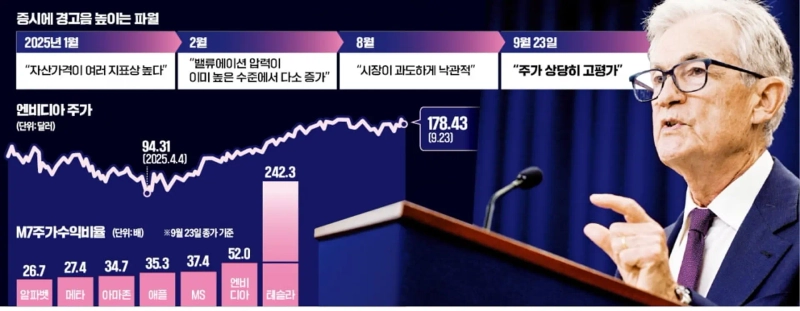
◇ Powell warns of 'market overheating'
Powell said this on the 23rd (local time) in a speech to the Rhode Island Chamber of Commerce while answering a question about "how much weight we place on market prices when deciding the policy rate and whether we will continue to tolerate high asset values."
Specifically, he said, "We review overall financial conditions and check ourselves on whether our policy is affecting financial conditions in the way we intend," and added, "By several measures, for example, stock prices are considerably overvalued." As a result, major tech stocks, including market-cap leader NVIDIA, plunged in New York, and the three major U.S. indices—the Dow, the S&P 500, and the Nasdaq—closed lower together that day.
This is not the first time Powell has warned about the stock market. At a press conference after the January monetary policy meeting, he said, "Asset prices, including stocks, are high by several measures." In February, a Fed report assessed that "valuation pressures have increased somewhat from already high levels." At last month's Jackson Hole symposium, he also said the "market was overly optimistic." This time he raised the warning level by saying, "Stock prices are considerably overvalued."
The European Central Bank (ECB) also diagnosed in a June report that "U.S. stock prices are at levels that raise concerns about overvaluation," saying "the market is overheated and asset values are priced above fundamental values."
◇ Growing bubble theory around tech stocks
Powell's warning is likely to intensify debate over a bubble in the U.S. market. U.S. tech stocks have been repeatedly criticized as being at a 'peak.' The Magnificent Seven (M7) is a representative example. The average price-to-earnings ratio (PER) of the seven stocks—NVIDIA, Microsoft (MS), Apple, Amazon, Meta, Google, and Tesla—reaches about 30 times, far above the S&P 500's 10-year average (18 times).
The rise in the U.S. market was also driven by expectations of Fed rate cuts. As expectations grew after the Fed's monetary policy meeting on the 17th–18th that it would cut the policy rate, asset prices such as stocks rose significantly. Following the Fed's 0.25% point cut in the policy rate on the 18th and its hint at two additional cuts this year, major indices hit record highs. The S&P 500 surged to levels exceeding Bloomberg's year-end average forecast (6486). However, many argue that much of the rise in U.S. tech stocks is based on earnings, so it is not necessarily a bubble like during the dot-com era.
◇ Interest in whether rates will be cut further this year
In his speech, Powell also left open the possibility of further rate cuts this year. Regarding the current policy rate, he said, "We judge it to be slightly restrictive." According to the Chicago Mercantile Exchange (CME) FedWatch tool, the rate futures market sees a 77% chance that the Fed will lower the policy rate by 0.5% points over the two remaining policy meetings this year.
Powell, however, showed distance from excessive expectations for rate cuts, saying that cutting rates aggressively would make it impossible to control inflation, and keeping policy too tight for too long could risk weakening the labor market. He also said, "Our policy is not on a preset path," and "we will continue to determine an appropriate policy stance based on incoming data, changing outlooks, and the balance of risks."
David Russell, global market strategist at TradeStation, interpreted, "Powell is neither trying to provoke the White House nor yielding to calls for rate cuts," adding, "He is trying to avoid excessive demands for rate cuts."
New York = Shin-young Park / Gyeong-je Han nyusos@hankyung.com

Korea Economic Daily
hankyung@bloomingbit.ioThe Korea Economic Daily Global is a digital media where latest news on Korean companies, industries, and financial markets.