

PiCK
Korea's No.1 big tech and virtual asset exchange unite…targeting stablecoins
Summary
- Naver Financial plans to incorporate Dunamu as a subsidiary by issuing a large number of new shares and will actively pursue the stablecoin business.
- The combination of Naver and Dunamu is expected to be an important turning point that will change the landscape of the domestic digital finance market and the virtual asset industry.
- Industry insiders say that if a won stablecoin is successfully introduced, Naver and Upbit could generate annual revenue of about 300 billion won.
Pursuing incorporation as a subsidiary…expanding territory into virtual asset business
Naver Financial to issue new shares in exchange for Dunamu's entire stake
Platform and virtual asset exchange combined…a seismic shift in digital finance expected
Naver is set to bring in Dunamu, which operates Upbit, the country's No.1 virtual asset exchange. Its financial unit, Naver Financial, plans to incorporate Dunamu as a subsidiary through a comprehensive share exchange. Once the deal is completed, observers say Korea's largest big tech, Naver, is likely to rapidly expand its virtual asset business.
According to industry sources on the 25th, Naver Financial will issue a large number of new shares and swap them for the entire stakes held by existing Dunamu shareholders. The two sides will hold a board meeting to finalize the agenda once they complete negotiations on the exchange ratio.
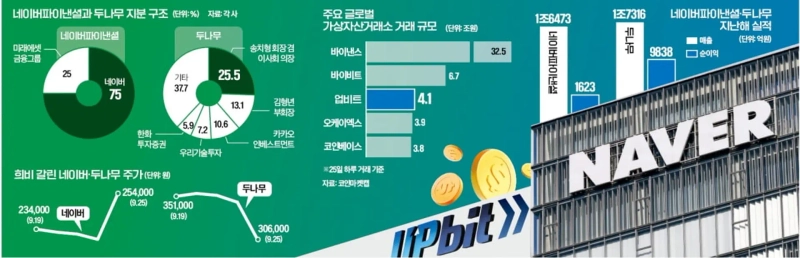
Dunamu's shareholders include Chairman and Board Chair Song Chi-hyung (shareholding 25.5%), Vice Chairman Kim Hyung-nyeon (13.1%), Kakao Investment (10.6%), Woori Technology Investment (7.2%), and Hanwha Investment & Securities (5.9%). Naver Financial's largest shareholder is Naver, which holds about 75% of the shares (including convertible preferred shares).
The appearance of stablecoins is analyzed to have played a decisive role in Naver's decision to partner with Dunamu. Stablecoins are expected to become a key link in building digital financial infrastructure when combined with Naver's vast platform ecosystem. Industry sources say discussions accelerated as the possibility of allowing won-denominated stablecoin issuance in Korea grew. In particular, the plan reportedly became more concrete after Lee Hae-jin, Naver's founder and chairman of the board, returned to management in March.
If the deal goes through, it is expected to be a turning point that changes the landscape of Korea's virtual asset market and digital finance industry. With the combination of the country's top big tech and a virtual asset exchange, there is growing expectation that Korea could take the lead in the global digital asset ecosystem.
Naver disclosed that "Naver Financial is discussing various collaborations with Dunamu, including stablecoins, trading of unlisted shares, and a share exchange," and "no additional cooperation items or methods have been finalized."
Korea's No.1 big tech and virtual asset exchange unite…targeting stablecoins
Covering finance, virtual assets, and shopping…will a national 'super platform' be born?
Naver entered the financial business in 2015 but reportedly had no real interest in banking. It is said that Chairman Lee Hae-jin judged that banking would not create synergy with Naver's existing platform business. Over the past decade, the company focused on simple payments and comparing financial products. However, many say the financial platform innovation Naver pursues has remained unfinished.
The situation changed as stablecoins emerged as a core payment method in the digital ecosystem. Naver expects stablecoins to be the crucial puzzle piece connecting its existing platform and finance. Analysts view Naver's partnership with Dunamu, operator of Upbit, as part of this plan.
Securing large-scale payment infrastructure
According to industry sources on the 25th, Naver Financial's annual transaction volume reaches 80 trillion won. This indicates it already possesses a powerful payment network. If Naver issues a won stablecoin together with Dunamu, it is expected that it could be applied immediately to large-scale transactions.
If stablecoins become a payment method in simple payments, Naver could also expect to replace or reduce card network fees. If stablecoin transactions expand into previously impossible areas such as collateralized lending, foreign remittances, and cross-border payments, revenue sources would diversify. In addition, issuing a won stablecoin could yield earnings from managing deposited funds.
Naver has grown its platform business in Japan and Southeast Asia but lacked a clear financial weapon globally. With Dunamu, Naver could enter overseas payment and remittance markets based on blockchain and virtual asset infrastructure. There is anticipation that a Korean-style fintech model could be built to compete with PayPal and Stripe. Moreover, Dunamu's stable cash flow, earning 1 trillion won in profit annually, is expected to support Naver's investments in new businesses.
Market participants estimate that if Naver and Upbit's won stablecoin issuance becomes a reality, it could generate annual revenue of about 300 billion won by around 2030. An industry source said, "If a won stablecoin is successfully established, it could secure competitiveness not only in payments and remittances but also in the global market."
Dunamu can focus on new businesses
By partnering with Naver, Dunamu is also expected to increase governance transparency and focus on future new businesses. Although Dunamu has strong blockchain technology, it faced limits in diversifying its business due to negative perceptions that it "makes money from coins." Transaction fees account for 98% of Dunamu's total revenue. Even if it wanted to pursue mergers and acquisitions (M&A) or overseas expansion, there were many constraints. As a result, prospects for an initial public offering (IPO) were unclear. While moves to allow won stablecoin issuance in Korea have increased, virtual asset exchanges themselves have been somewhat excluded from discussions.
If Dunamu joins Naver, many of these issues are expected to be resolved. It would be incorporated into a big tech affiliate, moving away from individual founder-controlled governance. If Upbit combines with Naver's platform, it would secure real use cases such as stablecoin payments and remittances, allowing it to move away from a revenue structure centered on exchange fees. Coupled with Naver's networks in Japan and Southeast Asia, overseas expansion could be pursued.
If the transaction is completed, it is expected to go through the Financial Intelligence Unit (FIU)'s approval process for a change in major shareholder. However, how financial authorities evaluate big tech's entry into the virtual asset industry remains a variable. There is also a view that if the legalization of won stablecoins is discussed in a bank-centered manner, it could undermine the Naver–Dunamu alliance strategy.
Cho Mi-hyun / Cha Jun-ho / Ko Eun-yi reporters mwise@hankyung.com

Korea Economic Daily
hankyung@bloomingbit.ioThe Korea Economic Daily Global is a digital media where latest news on Korean companies, industries, and financial markets.