

With fears of $350 billion outflow and a stronger dollar... Exchange rate surges above 1410 won
Summary
- It reported that the won-dollar exchange rate surpassed the 1410 won level for the first time in about four months due to improving U.S. economic indicators and the stronger dollar.
- It stated that a breakdown in tariff negotiations with the U.S. and pressure to invest $350 billion in the U.S. are adding to foreign exchange market anxiety and contributing to the exchange rate rise.
- It noted that exchange rate anxiety has led to reduced expectations for a Bank of Korea rate cut, and that government bond yields are rising.
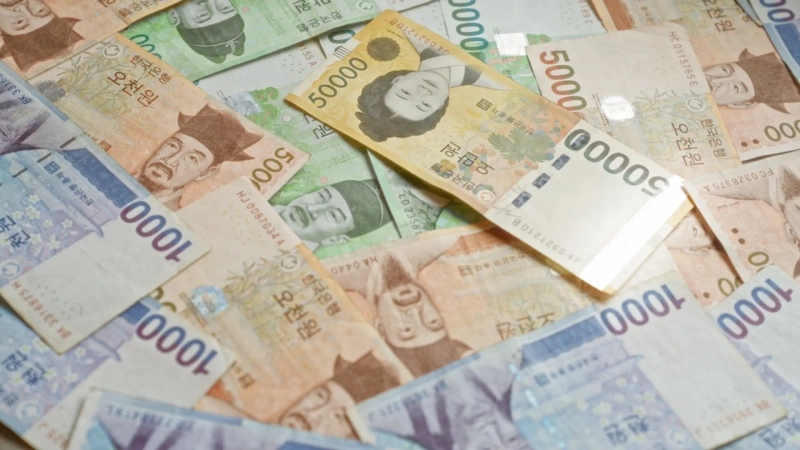
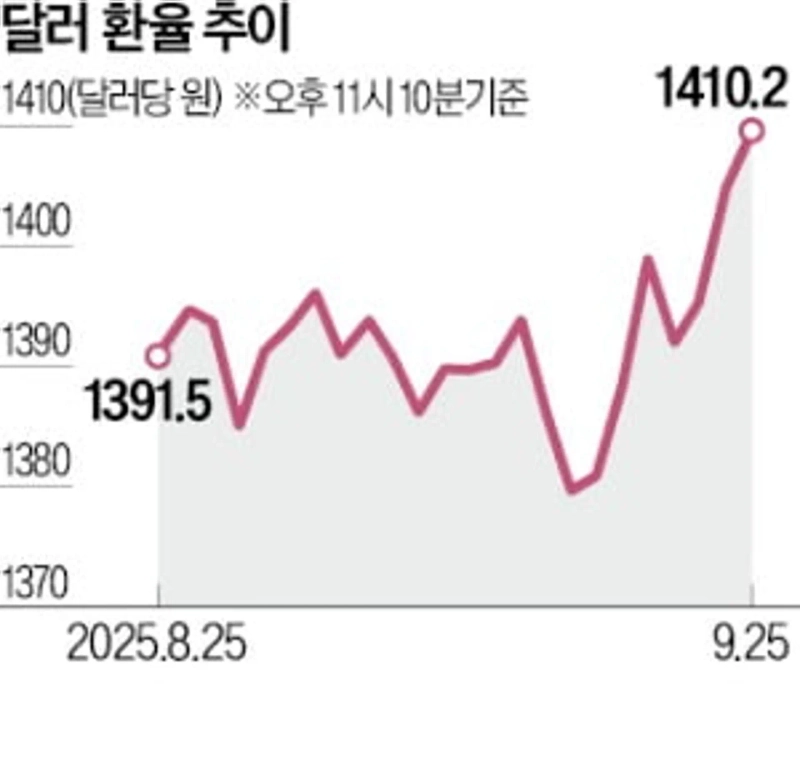
The won-dollar exchange rate jumped above 1410 won for the first time in four months. The dollar strengthened as U.S. economic indicators showed improvement, and worries about pressure to invest $350 billion in cash in the U.S. amid a breakdown in tariff negotiations with the United States have significantly spread anxiety, analysts say.
On the 26th in the Seoul foreign exchange market, the won-dollar rate stood at 1410 won 60 jeon (as of 10:00 AM). It was trading more than 10 won higher than the previous day's weekly trading closing price (1400 won 60 jeon). Around 9:27 AM, it rose as high as 1412 won 10 jeon. This is the first time the exchange rate exceeded 1410 won in weekly trading since May 15 (1412 won 10 jeon), about four months ago.
Dollar strengthens as U.S. economic indicators improve
The sharp rise in the exchange rate on the day is closely related to the stronger dollar. U.S. economic indicators were confirmed to be strong, which reduced the need for the U.S. central bank (Fed) to cut rates significantly. The U.S. Commerce Department said on the 25th (local time) that the final estimate for U.S. real GDP growth in Q2 was 3.8% (annualized quarter-on-quarter). This was revised up by 0.5% percentage points from the preliminary estimate (3.3%) released last month, and was the highest in seven quarters since Q3 2023 (4.7%).
Employment also was not assessed to have weakened. According to the U.S. Department of Labor, initial jobless claims last week, seasonally adjusted, were 218,000, below market expectations (235,000). Bill Adams, chief economist at Comerica Bank, said, "Employment is in low gear this year, but economic growth is solid and the labor market does not appear to have weakened in September."
When the economy shows strength, the Fed does not need to rush to cut rates. It is more likely to lower rates gradually while monitoring inflation conditions. The likelihood of dollar weakness from rate cuts has therefore diminished. Reflecting these indicators, the dollar index, which measures the dollar's value against six major currencies, surpassed the 98 level and rose 0.70% from the previous day to 98.485.
Concerns over $350 billion outflow
Besides global dollar strength, Korea-specific concerns due to a breakdown in tariff negotiations with the United States are also cited as main factors driving the won-dollar rate higher. Overnight, President Donald Trump reiterated that the amount Korea would invest in the U.S. under a Korea-U.S. trade agreement is $350 billion (about 490 trillion won), saying "that is up front." The Wall Street Journal (WSJ) also reported that U.S. Commerce Secretary Howard Lutnick is pressuring to increase the investment amount beyond $350 billion.
If, due to such U.S. pressure, more than $350 billion had to be invested in the U.S. in cash, the foreign exchange market would inevitably face a major shock because the won is not a reserve currency. Analysts say the current foreign exchange reserves of $4,162 billion are insufficient to raise that amount. Wi Jae-hyun, an economist at NH Futures, said, "Along with uncertainty related to investment to the U.S., the dollar's strength has expanded upward pressure on the exchange rate."
The behavior of foreign investors in the domestic stock market is also a variable for the exchange rate. Foreign investors, who had recently entered the domestic market in large numbers, showed net selling flows that morning. There are concerns that if they exit the stock market rapidly, the exchange rate could rise further.
However, if the exchange rate rises sharply, the foreign exchange authorities may intervene in the market to curb the rise. Min Kyung-won, an economist at Woori Bank, forecasted, "There is a high probability that authorities will carry out active smoothing operations."
October rate cut drifts further away
As exchange rate anxiety grows, the likelihood of the Bank of Korea cutting the base rate next month is assessed to have further diminished. Previously, Monetary Policy Board member Hwang Geon-il and Jang Jeong-su, director of the Financial Stability Bureau, said in press briefings that "they are paying attention to volatility rather than the level of the exchange rate," but the current trend shows both the level and volatility rising. With continued housing market instability and increased financial anxiety as the exchange rate fluctuates, cutting rates could amplify risks, which the Bank of Korea is expected to consider carefully.
As expectations for rate cuts shrink, government bond yields are also rising. On the day, in the Seoul bond market, the 3-year government bond yield traded at an annual 2.564% (as of 10:20 AM). This was a 0.038% percentage point increase from the previous trading day's closing yield of 2.528% (bond prices fell). The 2-year yield also rose above 2.5%.
Kang Jin-gyu reporter josep@hankyung.com

Korea Economic Daily
hankyung@bloomingbit.ioThe Korea Economic Daily Global is a digital media where latest news on Korean companies, industries, and financial markets.