

PiCK
U.S. federal government shuts down after seven years…Could cause chaos at airports [Sang-eun Lee's Washington Now]
Summary
- Due to the U.S. federal government shutdown, it said that aviation and other industries are expected to face disruption and losses of 1 billion dollars per week.
- It reported a dollar value decline and gold price increase, and that bond markets and stocks were relatively less affected.
- It said markets are focusing on increased uncertainty from the non-publication of employment data and labor market impacts rather than the shutdown itself.
Treasury currency report may also be delayed
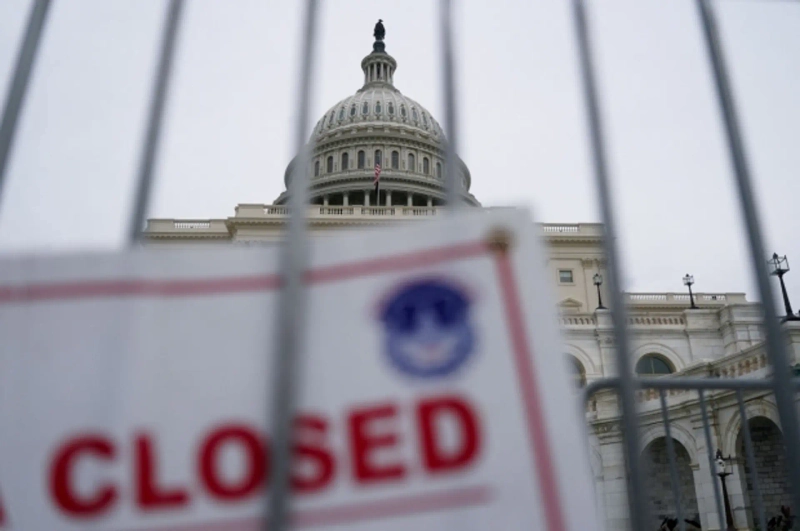
The U.S. federal government has entered a shutdown (temporary suspension of operations). It is the first time in seven years since December 2018 during President Donald Trump's first administration.
The U.S. Congress failed to pass the fiscal year 2026 budget bill or a continuing resolution (CR) to replace it by midnight on September 30. In the Senate, a Republican temporary budget bill that would have temporarily allowed federal government spending for seven weeks until November 21 to avoid a shutdown was put to a vote but failed 55 to 45. Whether temporary or regular, 60 votes are needed to pass a U.S. government budget, but it did not reach that threshold.
○Only essential personnel work unpaid
With the start of the shutdown, a large number of federal government employees will be classified as nonessential and go on unpaid furlough. Those designated as essential by type of work must report to work, but because they are not paid, there is a tendency for employees on the ground to avoid work through sick leave, etc. As a result, citizens end up having to tolerate inconveniences.
Fields where federal employees play a large role, such as airport facilities, are likely to find it difficult to avoid confusion. The U.S. Department of Transportation said that in a shutdown more than 11,000 employees, equivalent to one quarter of Federal Aviation Administration (FAA) staff, would go on unpaid leave. It also said air traffic controllers and security personnel would have to work unpaid.
During the 35-day shutdown from late 2018 to early 2019, security checkpoint processing times increased sharply and shortages of controllers and customs officers disrupted operations at major airports, causing significant damage to the related industry. The U.S. Travel Association (USTA), an alliance of airlines, hotels, and rental car companies, estimated that if this shutdown is prolonged it would cause losses of 1 billion dollars per week.
Law enforcement agencies such as the Federal Bureau of Investigation (FBI), the Drug Enforcement Administration (DEA), and the Coast Guard will continue operations. Federal courts can maintain normal functions for several weeks through budgets from various fees. The United States Postal Service (USPS) is run on its own revenues rather than general federal taxes, so it is expected to continue functioning.
The U.S. Department of Labor said that the Bureau of Labor Statistics (BLS) may delay the publication of monthly employment trend reports or there may be a degradation in the quality of the cited data. The Department of Commerce's Bureau of Economic Analysis (BEA) is also likely to suspend report releases. It is also difficult to guarantee whether the Treasury Department's report related to currency manipulator designation will be released as originally scheduled in October.
○Dollar value falls, gold price rally
The dollar index (DXY) fell from around 98 on September 30 to about 97.5 on the day after the shutdown. It fell about 1% in a week. The 10-year U.S. Treasury yield, which had briefly fallen to around 4.11% the day before, rose to 4.168% that day (bond prices fell). However, since shutdown concerns had been increasing since last week, the shock was not large.
Gold, which has been hitting record highs day after day this year, continued its rise for reasons including weakened U.S. government leadership due to the shutdown and inflation concerns. The spot price of gold rose to 3875.53 dollars per troy ounce just before the shutdown occurred, then fell slightly. December delivery gold futures briefly traded above 3900 dollars that day.
By contrast, the effect on the stock market was relatively limited. The S&P 500 index closed up 0.41% and the Nasdaq index closed up 0.30%. However, futures such as S&P 500 futures and Nasdaq 100 futures were down around 0.45% from the previous day, which was interpreted as reflecting shutdown concerns. Kyle Rodda, chief analyst at Capital.com, told Reuters, "Generally, government shutdowns do not have a big impact on markets (the stock market)," citing that the New York stock market rose even during the 35-day shutdown in Trump's first administration.
The market is focusing more on the increased uncertainty from non-publication of employment data than on the shutdown itself, and on labor market impacts from additional federal employee layoffs.
As in his first administration, the possibility that the shutdown could be prolonged is being cautiously considered. According to the New York Times (NYT), Senate Democratic Leader Chuck Schumer pressured that payments for Obamacare (ACA) should be extended before the shutdown. He argued, "If the president is wise, he should use all means immediately to resolve the healthcare crisis," and "If people start paying $400, $500, $600 more per month in health insurance premiums, I will hold the president responsible." If the two sides remain deadlocked, it will become increasingly difficult to end the shutdown early.
Washington= Sang-eun Lee, correspondent selee@hankyung.com

Korea Economic Daily
hankyung@bloomingbit.ioThe Korea Economic Daily Global is a digital media where latest news on Korean companies, industries, and financial markets.