

400,000-won Hynix · 90,000-won Samsung Electronics… pushed the KOSPI
Summary
- It reports that collaboration with OpenAI is leading to a surge in sales and continued stock price increases for major semiconductor stocks such as Samsung Electronics and SK hynix.
- Securities firms say that increased HBM demand and expanded AI investment by global tech companies are driving continuous upward revisions of semiconductor companies' earnings estimates and target prices.
- It's forecast that the KOSPI index is likely to rise further due to the semiconductor stock rally, and could comfortably settle at the 3,800 level, which corresponds to a PBR of about 1.2x.
Semiconductor stocks surge on OpenAI collaboration
OpenAI requests monthly supply of 900,000 HBM units
SK hynix intraday 405,000 won
Samsung Electronics surpasses 90,000 won for first time in 4 years 9 months
"3,800 level also achievable" securities industry outlook
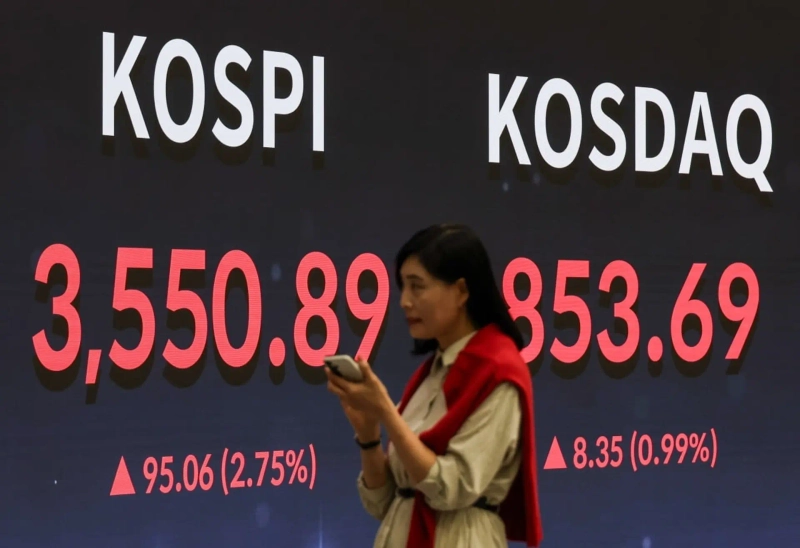
The KOSPI index was able to reach the previously uncharted 3,500 level thanks to a 'semiconductor stock rally.' Expectations that sales of high-bandwidth memory (HBM) from Samsung Electronics and SK hynix will surge due to collaboration with OpenAI drove this. It is widely expected that the KOSPI, backed by leading domestic semiconductor stocks, will continue a steady upward trend for the time being.
3500 created by 400,000 Hynix · 90,000 Samsung Electronics
On the 2nd, the KOSPI index closed at 3549.21, up 2.70%. Semiconductor stocks led the gains. Samsung Electronics and SK hynix agreed to participate as key collaborators in OpenAI's AI project 'Stargate.' OpenAI requested domestic semiconductor companies to supply 900,000 HBM units per month.
On that day in the securities market, SK hynix surged 9.86%. It rose intraday to 405,000 won. Samsung Electronics closed at 89,000 won, up 3.49%. It jumped intraday to 90,300 won, touching the '90,000-won Samsung Electronics' level for the first time in 4 years and 9 months since January 2021.
Major semiconductor materials, parts and equipment stocks such as Hanmi Semiconductor (6.01%), Tes (5.05%), Techwing (2.52%) also rose in succession. A securities industry official said, "The volume OpenAI requested is, by simple calculation, worth about 10 trillion won per month," adding, "Considering SK hynix's second-quarter sales were about 22 trillion won, it is easy to expect that domestic semiconductor companies' results will increase substantially."
Expectations that a memory semiconductor super cycle is arriving are also lifting semiconductor stocks. The AI boom has sharply increased HBM demand, and as semiconductor companies converted existing DRAM production lines to HBM production, DRAM output declined sharply. Even NAND, which had been in a long downturn, saw AI data center demand explode, resolving the oversupply situation. The fact that Micron Technology's stock jumped 8.9% on the New York market the previous day also had a positive effect on domestic semiconductor stocks.
As OpenAI and the government signed a partnership agreement to build next-generation AI data centers domestically, related stocks such as Samsung C&T (4.93%) also surged. Expectations that power grid investment will accompany AI data center construction boosted shares such as HD Hyundai Electric (4.87%) and Hyosung Heavy Industries (2.69%).
"Semiconductor sector will sustain KOSPI's upward trend"
Securities firms expect the semiconductor sector's high-flying trend to continue for the time being. Overseas investment banks have repeatedly raised target prices for Samsung Electronics and SK hynix. At the end of last month, Japan's Nomura Securities raised its target price for SK hynix to 540,000 won and for Samsung Electronics to 123,000 won. Even Morgan Stanley, once dubbed the 'semiconductor grim reaper' for its bearish view, raised its target price for Samsung Electronics from 86,000 won to 96,000 won at the end of last month.
Analysts note that rising DRAM prices and continued AI investment by global tech companies have steadily pushed up earnings estimates for semiconductor companies, making a concurrent rise in stock prices highly likely. Lee Eun-taek, head of the asset allocation strategy team at KB Securities, said, "When listed companies' earnings per share (EPS) on the securities market enter a major uptrend, they typically rise an average of 60–80% from the bottom, but now they have only risen 11% from the low," adding, "Only about 20% of the semiconductor sector's upward earnings revisions have been reflected."
Fueled by the semiconductor stock rally, the prevailing view is that the KOSPI index will also draw an upward curve. Jeong Seong-han, Chief Investment Officer (CIO) at Shinhan Asset Management, said, "Even if only semiconductor stocks maintain the upward trend, the market should comfortably settle at the 3,800 level, which corresponds to a PBR of around 1.2x."
There are also remarks that expectations for the government's capital market modernization policies remain alive. Kim Hak-gyun, head of the research center at Shinyoung Securities, said, "Corporate governance improvement efforts are a unique positive for the Korean market," adding, "Given the stock market's tendency to rise excessively once it gets on an upward trend, it is highly possible it will climb higher than now."
Shim Seong-mi / Maeng Jin-gyu / Jo A-ra / Seon Han-gyeol reporters smshim@hankyung.com

Korea Economic Daily
hankyung@bloomingbit.ioThe Korea Economic Daily Global is a digital media where latest news on Korean companies, industries, and financial markets.