

From quants to analysts… Wall Street puts AI 'front and center' [AI at Work, Part 2]
Summary
- Global IBs such as JP Morgan and Goldman Sachs are applying generative artificial intelligence (AI) across operations, significantly improving work efficiency.
- AI is actively replacing quant investing, asset management, and analyst work, but it noted limits in unstructured and emotional areas such as venture investing.
- AI adoption is producing direct effects such as reduced labor hours, but there are challenges including high development costs, accuracy issues, and limits in areas requiring emotional judgment.
Global IBs apply AI across operations
Also performs asset management and analyst roles
"Limits in unstructured areas like venture investing"
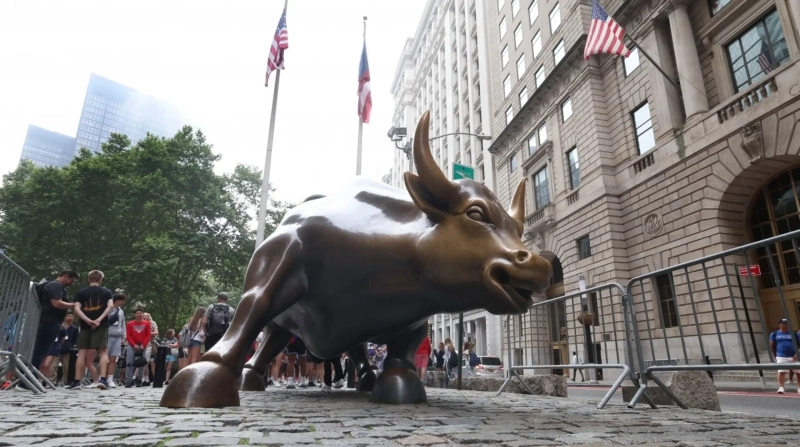
We are entering an era of great transformation driven by artificial intelligence (AI). The financial sector is rapidly changing as it embraces AI as a core engine of operational innovation. Hankyung.com, through a three-part special series, diagnoses the current state of AI usage in the financial sector centered on Yeouido's securities firms and examines the future changes in employment and the labor market that AI will bring. Furthermore, it seeks solutions for how finance professionals and office workers should prepare to live in the AI era. [Editor’s note]
Global investment banks such as JP Morgan and Goldman Sachs have introduced generative artificial intelligence (AI) to improve work efficiency. On Wall Street, attempts have been underway for several years to replace not only simple customer service but also quant investing (computerized quantitative analysis-based investing), asset management, and even the "flower of the securities industry," analyst work, with AI. However, there are forecasts that it will take considerable time for AI to replace unstructured tasks such as activism and venture investing.
According to the Korea Capital Market Institute and foreign media including the Wall Street Journal (WSJ) on the 7th, global investment banks are applying generative AI across their operations. When AI was first introduced, it was mainly used in front office areas such as chatbot services for customer response, but recently it has been applied to back and middle office tasks such as internal operations and compliance.
JP Morgan has been developing and using its own AI solutions since 2023. Last year, it developed an "LLM Suite" for internal tasks such as document summarization and drafting. Based on OpenAI's ChatGPT technology, it operates in a limited way within JP Morgan to ensure security. It also adopted CoiN (Contract Intelligence) for loan contract review and compliance checks. Through this, it is estimated to have reduced analysts' working hours by 360,000 hours annually. In addition, JP Morgan spent hundreds of millions of dollars developing the "LOXM" program, which supports speed improvements and trade optimization when executing large trading orders.
Goldman Sachs also uses an AI chatbot to support internal tasks such as document summarization and organization. Morgan Stanley has also introduced an internal AI chatbot called "AskResearchGPT." In particular, the "MNLPFEDS" program, which predicts the Federal Reserve's monetary policy direction, is also a representative AI platform of the company.
They are applying AI not only to quant investing and asset management but also to analyst work. According to the WSJ, institutions such as BNY Mellon and JP Morgan have begun collaborating with humans through AI-based "digital employees." The UK's Man Group plans to deploy its internally developed AI system "AlphaGPT" in actual trading.
Attempts by Wall Street to replace analyst work with AI are not new. A representative example is Goldman Sachs' AI-based robo-analyst "Kensho," introduced in 2017. Kensho was developed by the AI financial data analytics firm Kensho Technologies. Kensho is said to perform in five minutes work that would take 15 analysts four weeks to process. Daniel Nadler, founder of Kensho Technologies, once told The New York Times, "Kensho can do in a few minutes what a specialist analyst making $500,000 a year (about 700 million won) would take 40 hours to do."
However, there are expectations that AI will have limits in replacing tasks that require direct communication with clients and emotional judgment, such as venture investing and activism. The Financial Times reported, "Face-to-face tasks in finance that require direct human interaction or emotional intelligence are expected to remain areas where humans hold the advantage over AI."
Jeong Yu-shin, professor in the Department of Business Administration at Sogang University (director of the Digital Economy and Finance Research Institute), said, "Global financial firms are applying AI not only to the front office but also to the back and middle offices," adding, "AI has no problem performing logical, repetitive, and rational tasks by finding past patterns." However, he added, "In areas that are irrational, emotional, information-asymmetric, or predictive of the future, AI will ultimately not be able to catch up with humans," and "Attempts to predict the future through past patterns continue, but development costs are high and there will be limitations in accuracy."
Reporter Ko Jeong-sam, Hankyung.com jsk@hankyung.com Reporter Jin Young-gi, Hankyung.com young71@hankyung.com

Korea Economic Daily
hankyung@bloomingbit.ioThe Korea Economic Daily Global is a digital media where latest news on Korean companies, industries, and financial markets.