

AI·Stablecoin… New businesses to regain the 'lost three years' gain momentum
Summary
- Kakao's resolution of judicial risk is expected to give momentum to an AI-centered management strategy and the promotion of new businesses.
- Kakao plans to ramp up its stablecoin business through blockchain affiliate Kaia and pursue strategies to expand its financial ecosystem.
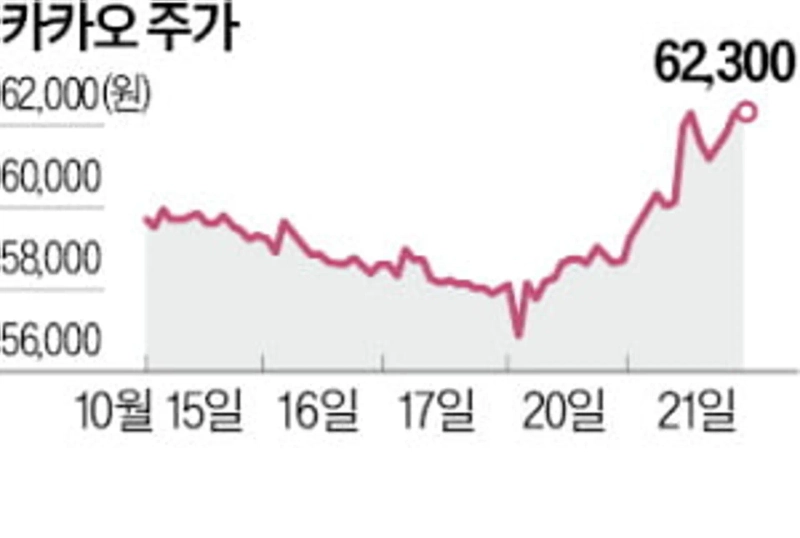
- Immediately after the not-guilty verdict, Kakao's share price rose 5.9%, indicating a positive market reaction to the resolution of uncertainty.
Shaking off risks and starting 'management reform'
Streamlining non-core affiliates for AI transition
Shares rebound nearly 6% immediately after the ruling
With the management's judicial risk resolved, Kakao is now better positioned to accelerate its transition into an "artificial intelligence (AI) platform company." Attention is on whether Kakao, which led innovation in the mobile era with KakaoTalk, will find a new growth trajectory in the AI era.
The IT industry on the 21st viewed the not-guilty verdict for founder Kim Beom-su as an opportunity for Kakao to make up for the "lost three years." While competitors such as Naver rushed into the large language model (LLM) race, Kakao was unable to speed up AI investment and global expansion due to the founder's trial and market uncertainty. Critics say this widened the technology gap as major domestic and foreign big techs stepped up AI investments. Major projects — including expansion of the Piccoma business in Japan, entry into the European content market, and consideration of acquiring promising startups — were mostly put on hold. A Kakao official said, "It is true that two years of ongoing trials and investigations made it difficult to respond nimbly to rapid market changes," adding, "Risk resolution will make us more flexible."
Kakao's push for organizational reform and an AI-centered management strategy is also expected to gain momentum. Since taking office, CEO Jeong Sin-a has clearly stated a policy of "selection and concentration" in two shareholder letters. Immediately after assuming office, the number of affiliates was reduced from 132 to 99, and the company plans to cut it to around 80 by year-end.
The resolution of judicial risk is expected to act as a real driver for these reform efforts. It is evaluated that conditions have been created for global AI collaboration and research and development (R&D) investment to receive greater momentum. Kakao recently announced plans to combine its generative AI model "Kanana" with OpenAI ChatGPT-based technology and apply it to KakaoTalk. The plan is to make the in-chat "AI agent" the central pillar of the Kakao ecosystem, linking search, advertising, and commerce.
Positive changes are also expected for Kakao's new financial businesses. Kakao is pursuing a won-pegged stablecoin business centered on its blockchain affiliate Kaia. Integration with payment networks of financial affiliates such as KakaoBank and Kakao Pay is also under consideration. The strategy is to integrate purchase, payment, and remittance flows within KakaoTalk on a token-based system to expand the financial ecosystem. The industry expects that this ruling will speed up financial negotiations and internal approval processes. Kakao's share price, which had fallen to 32,550 won last year, rose about 5.9% from the previous day after the not-guilty verdict and closed the regular session at 62,300 won.
Ahn Jeong-hun/Go Eun-yi, reporters ajh6321@hankyung.com

Korea Economic Daily
hankyung@bloomingbit.ioThe Korea Economic Daily Global is a digital media where latest news on Korean companies, industries, and financial markets.