

PiCK
"Fair negotiations with Korea" Leaving for the U.S. in two days… Final tariff talks with Lutnick
Summary
- It is reported that South Korea and the United States are narrowing differences over USD 350 billion in U.S. investment.
- The two negotiating teams said they are negotiating with the final goal of tariff reductions and signing an MOU.
- They said that if negotiations over the timing of automobile tariff reductions are delayed, actual implementation could be postponed.
Trump's stance changed in three days
Is a Korea–U.S. 'joint statement' imminent?
Deputy minister of the Ministry of Economy and Finance in charge of exchange rates accompanies
Views on USD 350 billion in U.S. investment appear to have converged
The ultimate goal is both countries signing an MOU
On alert for timing of automobile tariff reductions
Kim Yong-beom, Director of Policy at the Presidential Office, and Kim Jeong-gwan, Minister of Trade, Industry and Energy, are taking a flight to the U.S. again on the 22nd reportedly because of last-minute negotiations with U.S. Commerce Secretary Howard Lutnick. In particular, after U.S. President Donald Trump said "we had fair negotiations with Korea" and a negotiation schedule was set immediately the following day, there is growing observation that the two countries' positions are narrowing. There are also expectations that a 'joint statement' between the two leaders could be produced at the Korea–U.S. summit scheduled for the 29th.
◇ Kim Yong-beom, Director of Policy, also returns to the U.S.
On the 21st, the Ministry of Trade, Industry and Energy said that Minister Kim will depart for Washington, D.C. on the morning of the 22nd to continue follow-up negotiations with the U.S. Kim Yong-beom and Choi Ji-young, Deputy Minister for International Finance at the Ministry of Economy and Finance, will accompany him. Kim Yong-beom is leaving for the U.S. three days after returning from his previous trip, and Minister Kim is heading back to the U.S. only two days after returning home.
Inside and outside the government, there was an interpretation that Lutnick reported the status of negotiations with Korea to President Trump on the 20th (local time) when Trump said "we had fair negotiations with Korea," and that President Trump may have received this positively. On the 17th, President Trump said "it is fair that hundreds of billions of dollars flow into the U.S.," appearing to pressure Korea, but observers say the tone has shifted. A government official said, "There is sufficient consensus that the two negotiating teams need to produce something on the occasion of the APEC leaders' meeting." The reason is that the U.S. can showcase the effect of 'Trump tariffs' on the multilateral diplomatic stage, and Korea can use the opportunity to secure tangible benefits.
Minister Kim and Secretary Lutnick reportedly met for about two hours at the U.S. Commerce Department building on the 17th, then had dinner together, narrowing many of their differences. On his way home, Minister Kim told reporters, "(Rather than) the timing of a (deal), the priority is whether the (negotiation) result is most in line with the national interest," adding that "he could revisit the U.S. if necessary after consulting related ministries."
There was also an interpretation that Minister Kim's decision to return to the U.S. one day after his return home was to prepare a follow-up proposal that could narrow the two countries' differences on the method of USD 350 billion in U.S. investment. The fact that Deputy Minister Choi from the Ministry of Economy and Finance, the agency responsible for the foreign exchange market, is accompanying them is explained as relating to safeguards for the Korean foreign exchange market in the U.S. investment process. After finishing U.S. negotiations and returning home earlier, Director Kim also said, "We must thoroughly review with related ministries to convey our position and engage in additional negotiations."
◇The timing of MOU signing may be delayed
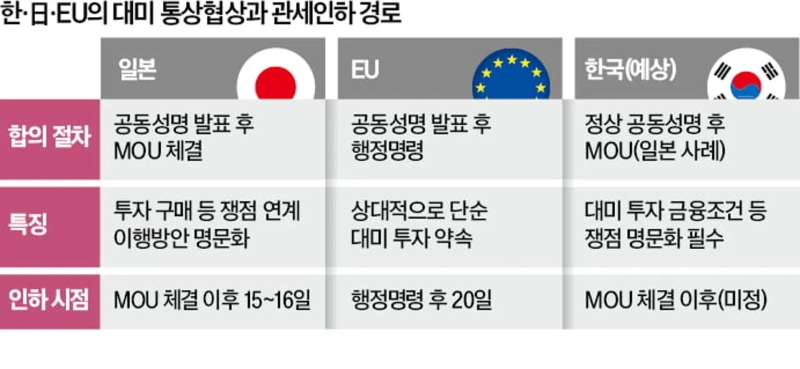
The negotiating team's final goal is the signing of a memorandum of understanding (MOU). After that, they must obtain an executive order from President Trump that includes tariff reductions on Korea. However, time is tight, and there is analysis that the joint statement could remain declarative in nature. In that case, Korea and the United States would have to continue negotiations after APEC, and the timing of automobile tariff reductions could also be delayed. Japan concluded tariff negotiations with the U.S. on July 22, but the two countries signed an MOU on September 4 when the second joint statement was issued. After that, the Federal Register posting (9th), the Commerce Department's proposed revision to the Harmonized Tariff Schedule (15th), and the Commerce Department's implementation notice posted in the Federal Register (16th) followed, and the tariff reductions were formally enacted. A trade official said, "The summit meeting is the point at which the maximum results must be produced."
The two countries are reportedly pursuing a plan to include security issues such as revisions to the Korea–U.S. nuclear cooperation agreement and increases in defense spending in this joint statement. It may include content to expand Korea's authority for reprocessing spent nuclear fuel and enriching uranium. There is also speculation that it could include a pledge to raise defense spending to about 3.5% of GDP over 10 years, similar to member countries of the North Atlantic Treaty Organization (NATO).
Ha Ji-eun / Kim Dae-hoon / Lee Hyun-il reporters hazzys@hankyung.com

Korea Economic Daily
hankyung@bloomingbit.ioThe Korea Economic Daily Global is a digital media where latest news on Korean companies, industries, and financial markets.