

"South Korea has optimal conditions for digital assets… stablecoins have sufficient commercial viability"
Summary
- South Korea's existing infrastructure and high MZ-generation investment participation rate were cited as favorable conditions for the rapid adoption of a Korean won stablecoin.
- It was stated that if stablecoins were to replace domestic credit card payments, they could offer advantages in areas such as cost reduction and settlement time.
- Speakers emphasized that institutional arrangements and establishment of a regulatory framework are urgent, and that a transparent market environment is needed.
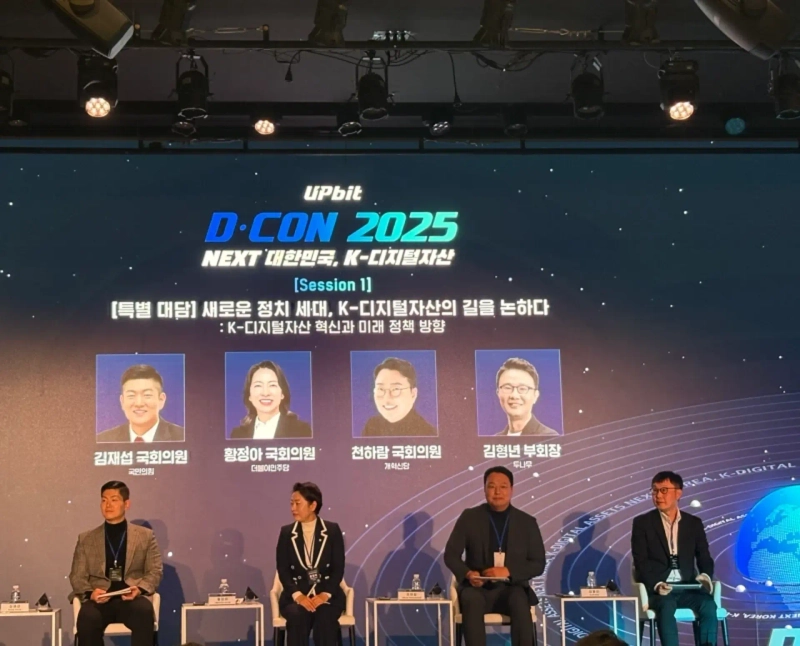
South Korea's existing infrastructure was claimed to be the optimal condition for nurturing the digital asset industry. In particular, the Korean won stablecoin (a virtual asset whose value is linked to fiat currency), which has been steadily discussed throughout this year, is expected to take hold at a rapid pace. Accordingly, voices are growing that related regulatory arrangements and a clear rule framework need to be put in place urgently.
Hwang Jeong-a of the Democratic Party said at a panel discussion of the Upbit Digital Asset Policy Conference 'DCON 2025' held on the 19th at the Fairmont Ambassador Hotel in Yeouido, Seoul, "South Korea has 40 million KakaoPay users, 31 million Naver Pay users, 30 million Toss users, 9.7 million virtual asset (cryptocurrency) real-name accounts, and a high investment participation rate among the MZ generation," adding, "these are conditions that allow a stablecoin to take root quickly."
She added, "If stablecoins were to replace credit card payments, which account for most payments in Korea, they could provide advantages in various aspects such as costs and settlement time."
However, regulatory gaps were pointed out as a weakness. Rep. Kim Jae-seop of the People Power Party said, "Countries such as the United States and Europe are establishing laws to secure market trust," and "if only Korea's regulatory vacuum is prolonged, it will be difficult to secure industrial competitiveness." He went on to explain, "The previously proposed Digital Asset Market Integration Act includes a system to classify digital assets by function to speed up regulation and requirements necessary for the introduction of stablecoins."
The speakers commonly agreed that legal and institutional arrangements should be made proactively to properly leverage Korea's strengths. Rep. Hwang said, "We must first establish a stablecoin system that domestic consumers and companies can use safely," adding, "if bold attempts follow, the domestic digital asset ecosystem can be grown." Rep. Kim Jae-seop also said, "It is true that there are concerns about whether there would actually be demand if a won-based stablecoin were issued," but added, "however, preparations must be made through rapid institutionalization."

Uk Jin
wook9629@bloomingbit.ioH3LLO, World! I am Uk Jin.